
- Home
- Art
- British Birds Art
- Swallow Art & Folklore

Swallow Folklore
The Meaning & Magic of Summer’s Returning
Bird
By Lotti Brown
Discover the folklore and meaning of swallows - birds long associated with summer, hope, protection and return - alongside seasonal traditions, migration myths and personal reflections from Yorkshire field walks and my swallow art.
I love to watch the swallow swooping low over the barley fields where I walk – fast and silent, they dart like tiny arrows, alive and twisting as they chase insects…
Sometimes they come so close I think they’ll collide with me – but always they curve away elegantly, just in time, never slowing, never faltering…
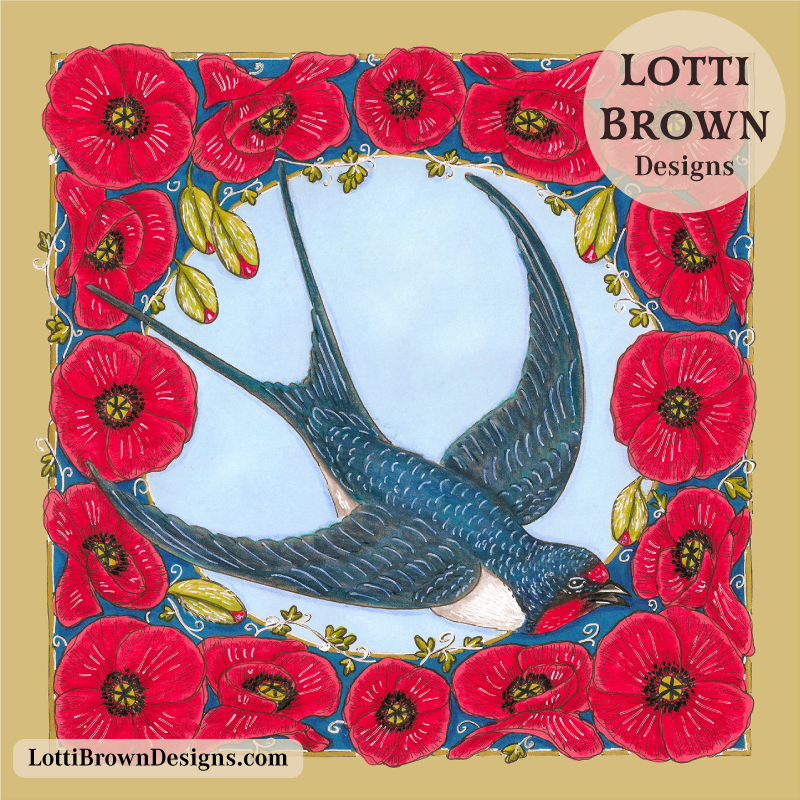 Swallow art by Lotti Brown
Swallow folklore is deeply woven into our experience of summer…
Swallows feel like long, slow summer evenings - walking in the fields with the sun low and golden, the air soft and full of life.
In this long moment, it feels like time has briefly stood still – generous and full – a celebration of summer, freedom and life itself… standing carefree aside from the real world for as long as the swallows swoop around me.
Soon enough, though, the shadows lengthen, and the swallows gather along the wires - chattering and restless, full of the energy of the changing season - until one day, they’re simple… gone.
Our summer swallow has begun its long journey to follow the warmth - and we must wait and hold our swallow memories close until they come again next year.
Swallows have long been a signifier of summer - certainly all over Europe - as they make their long journeys across continents, cherished and welcomed for thousands of years.
Swallow – What’s in a Name?
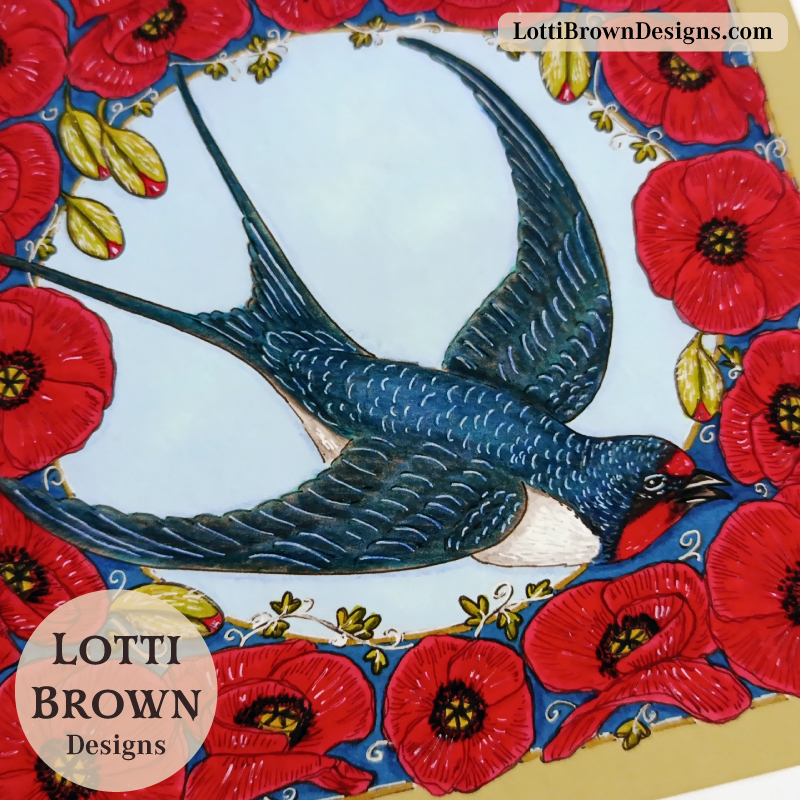 Swallow art print (detail)
The English name ‘swallow’ has been known in written English since the 7th century, deriving from the Anglo-Saxon ‘swalowe’ and Germanic ‘swalwo’ meaning ‘cleft stick’ or ‘forked tail’.
In Gaelic, the swallow is known as ‘gobhlan-gaoithe’ – meaning ‘fork of the wind’...
Even in their names, swallows seem to carry movement and air with them.
And in Latin, we know the bird as ‘Hirundo rustica’ – Hirundo meaning ‘swallow’ and rustica meaning 'rural'.
Other common names for the swallow recognise their habit of making their nest in buildings:
- Barn swallow
- Chimney swallow
- House swallow
- Red-fronted swallow
Their closeness to our homes and barns has helped make them one of our most familiar and beloved summer birds.
They usually return to the same spot year after year – and while a swallow nest can last 10 to 15 years, they may also use the same spot for generations, so no wonder we hold them in such affection – if you have a swallow family nesting in your house or barn, they start to feel like family.
Bird of Summer
Swallows are the universal herald of spring and summer.
Across Europe, the return of the swallows was celebrated as one of the great signs that summer had arrived…
In Greece, March 1st traditionally saw a Procession of the Swallows with songs and celebrations and a model swallow paraded through the streets. In Rhodes, the traditional swallow song was sung:
“He comes! He comes! Who loves to hear,
Soft sunny hours, and seasons fair,
The swallow hither come to rest,
His sable wing and snowy breast.”
In Germany, swallows traditionally return on the Feast of the Annunciation, 25th March. In villages, farmers opened their barn doors wide to welcome the travellers home, while in villages fanfares of trumpets sounded to mark the swallows return.
In Russia, swallows also returned on 25th March and it was said they brought the warmth with them from Paradise.
In England, swallows traditionally start to return from around 11th April, but 15th April was marked as ‘Swallow Day’. (I recorded my first swallow this year on 18th April, in East Yorkshire.)
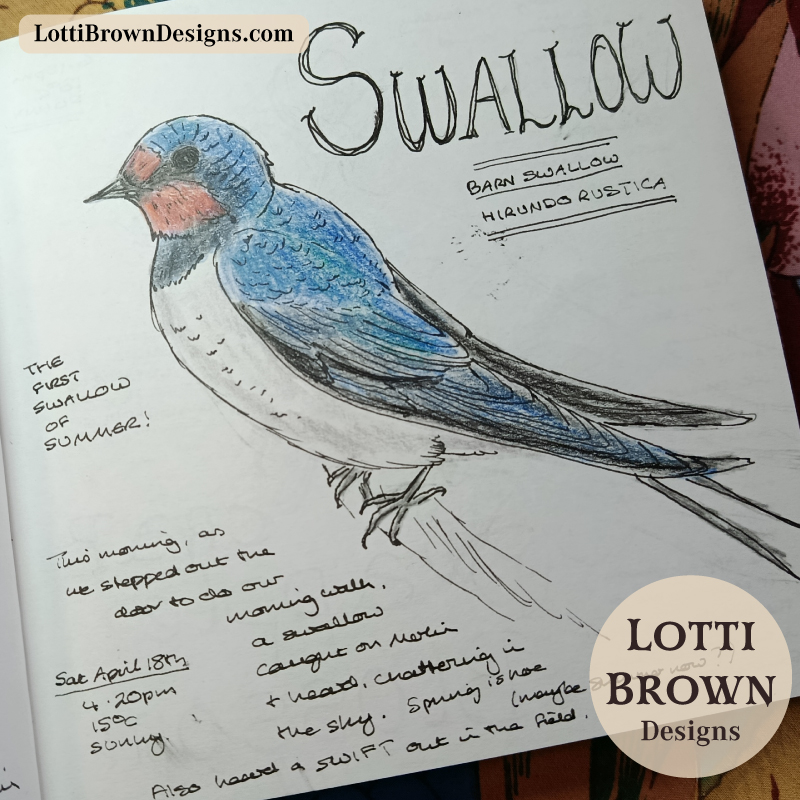 Recording the first swallow of summer in my nature journal (18th April)
Swallows can continue to arrive through April and May, the males arriving a little in advance to prepare the nesting sight and the females and youngsters following.
In Somerset, there was a folk belief that the swallow and the house martin are husband and wife, likely due to their arrival around the same time, and as they so often fly together in the sky.
And this Essex saying confirms that these birds were linked together in the imagination, as they remain in ours today:
“The martin and the swallow,
Are God Almighty’s shirt and collar.”
In Cornwall, people would jump in the air when they saw their first swallow…
Whilst in Ireland, at the sight of the first swallow, one should make a wish.
Swallows were welcomed warmly at their return – and it was believed lucky if a swallow chose your home or barn in which to make its nest.
It’s said that the first swallow of the season brings love…
And in Wales, swallows were seen as messengers of peace – a symbol that still brings hope when we see them today.
It’s lovely to think how deeply people welcomed the swallows home each spring - not just as birds, but as part of the turning of the year itself.
The Lucky Swallow in Folklore
A swallow nesting in a home was thought to protect the home and household from lightning, fire, storms and evil.
In Scotland, a swallow nesting in a window was said to bring prosperity.
In Somerset, a swallow nesting in your home meant health, wealth and happiness.
And if you were lucky enough to have a swallow actually fly into your home through a window, it would bring joy.
Swallows were so valued it was considered a sin to kill one or destroy their nest and could bring much misfortune – lame animals, spoiled milk, rain-ruined crops, or hens that stop laying.
From ancient Rome to Ancient China, the swallow was considered a 'lucky neighbour'...
A Croatian proverb echoes this sentiment: ‘Swallows turn a house into a home.’
The Sacred Swallow
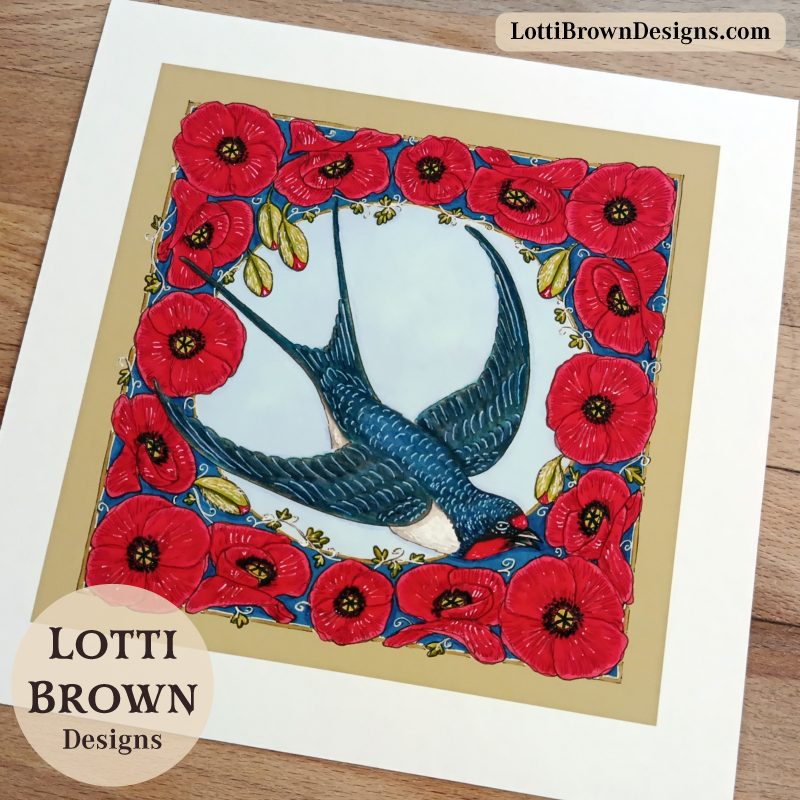 Swallow art print
The swallow was considered not just lucky, but a sacred bird, blessed by God…
In Brittany, it was said that the swallows would always time their arrival to be present for the holy day of Good Friday.
And in Lincolnshire, the swallow was traditionally known as a ‘bird of blessing.’
In Piedmont, swallows were called ‘chickens of the Lord’, while in Germany, they were seen as birds of the Madonna – and in the Oberinntal region of Austria, it was once believed that swallows assisted God at the Creation, in building the sky.
European stories tell that swallows removed a thorn from Christ’s crown and wiped blood from His wounds – in part explaining why the swallow’s breast is red – and leading to them being viewed as cherished and sacred birds and meaning that their nests are protected by God.
Across Europe, swallows were treated not simply as birds, but as blessed little travellers whose return brought comfort and hope after winter.
The Swallow’s Markings
Other stories of how the swallow got its markings tell how the swallow brought fire and warmth from the heavens for mankind – another reference to the swallow bringing the warmth of summer as well as explaining his red bib.
In another tale, the swallow carried fire from the heavens on his long tail, burning the central part of his tail, and giving us the long forked tail we recognise him by and that helps him fly and manoeuvre so effortlessly.
And a Welsh folk tale tells that the swallow was once a seamstress. She stole a ball of white yarn and was turned into a swallow with a white breast as a reminder.
The Healing Swallow & The Swallow Stone
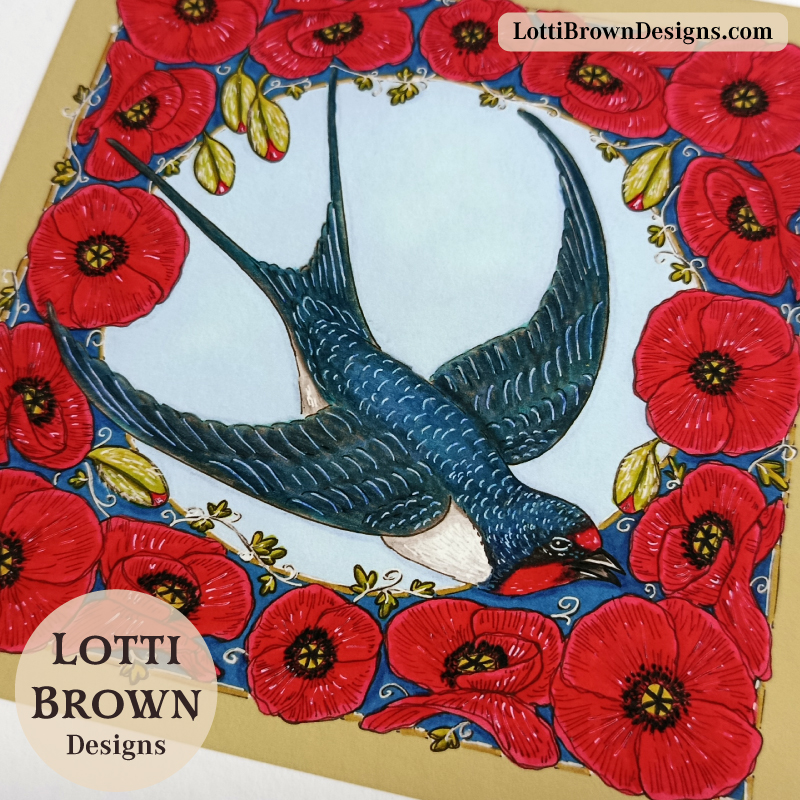 Swallow art illustration
It was said that a swallow is able to find a special healing stone on a seashore that restores sight to the blind. This was believed to be the stone that swallows use to ‘give sight’ to their young. So anyone finding this stone in the swallow’s nest would use it to attempt to cure a variety of eye conditions.
There was also once a widespread belief that a swallow’s body contained three magical stones that were able to confer special powers on anyone who held one:
- The white stone, when put in your mouth, would make you ‘fair’.
- The red stone, put in your mouth, would bring favour from the one you love.
- The green stone, put in your mouth, would mean you were never in peril.
Another theory has the swallow stone bringing ‘such eloquence that no man shall have the power to deny the request.’
It was also thought that swallows were able to cure:
- Toothache
- Alcoholism
- Fractures and strains
- Epilepsy
- And other complaints and conditions
The Spendthrift and the Swallow
The Spendthrift and the Swallow is one of the tales of Aesop’s Fables and the origin of the well-known proverb: ‘One swallow does not make a summer’.
The tale tells of a spendthrift who has been careless with his money and finds himself short of funds. He sees a swallow and believes that the summer warmth has come and so sells his cloak to earn some money.
Sadly, one swallow does not make a summer, and cold weather makes a return – and the spendthrift and the swallow both suffer.
It’s interesting how this tale tells us both how the swallow is associated with the return of summer warmth and that also we should not rely on this.
In fact, folklore traditions do share that the swallow isn’t always associated with the arrival of summer weather…
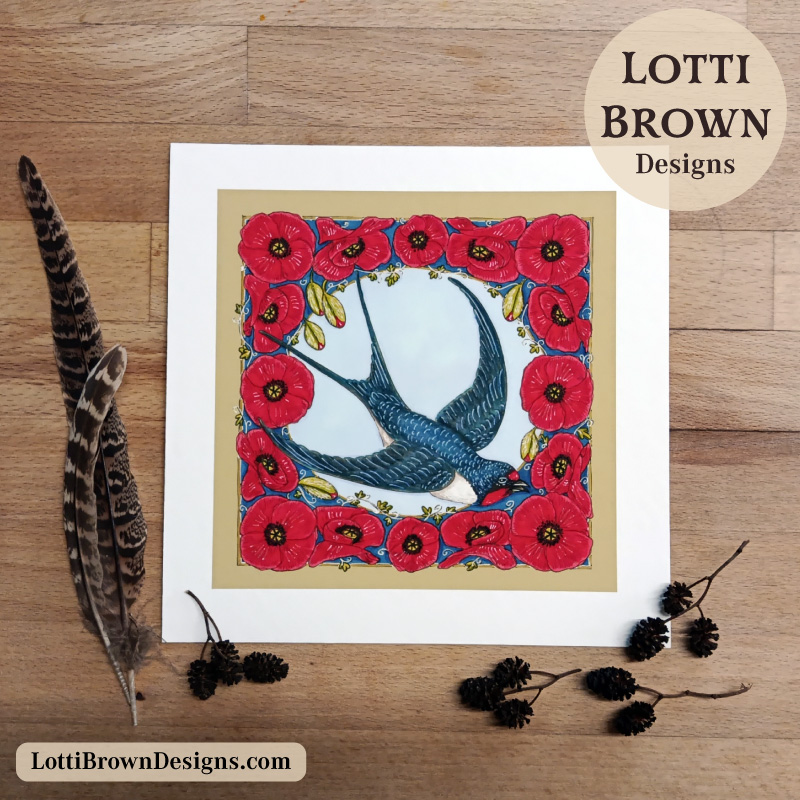 Swallow art print
Swallow & Weather Folklore
In Yorkshire, ‘swallow storms’ were periods of stormy weather that often coincided with the arrival (or departure) of the swallows.
Much weather lore looked to the swallows’ flight to predict the coming weather...
A Somerset saying shares:
“Swallows fly high, no rain in the sky,
Swallows fly low, it’s likely to blow.”
When swallows are seen high in the sky, it often really is a sign of good weather as the insects rise up high in the thermals. When the weather is humid and rain or storms are likely, the insects fly lower and the swallows chase them and fly low too.
We often see the swallows flying low over the barley fields around the village – it’s one of my favourite sights – I will have to try predicting the weather from their flight and see how it turns out.
Swallow Migration Folklore
Swallows are rightly famous for their dramatic spring arrivals, bringing the hope of warm summer days.
Their autumn departures are also an important marker in our seasons.
The swallows start to leave us from late August and as August progresses, you can often see the birds gather together in groups on the wires as they prepare for their incredible journey.
- The swallows return from Britain and Europe to sub-Saharan Africa – a total journey of over 5,000 miles.
- The swallows start their journey in small stops at first as they gradually move south, stopping overnight in reed beds where they roost in large groups sometimes numbering hundreds or thousands.
- By September or October, they’re ready to leave and cross the English Channel. They can travel up to 200 miles a day and often cross the Saharan desert in one go, arriving at their destination in December.
- Their return journey is much faster, only taking 4 to 5 weeks, with the instinct to return and nest driving the migration.
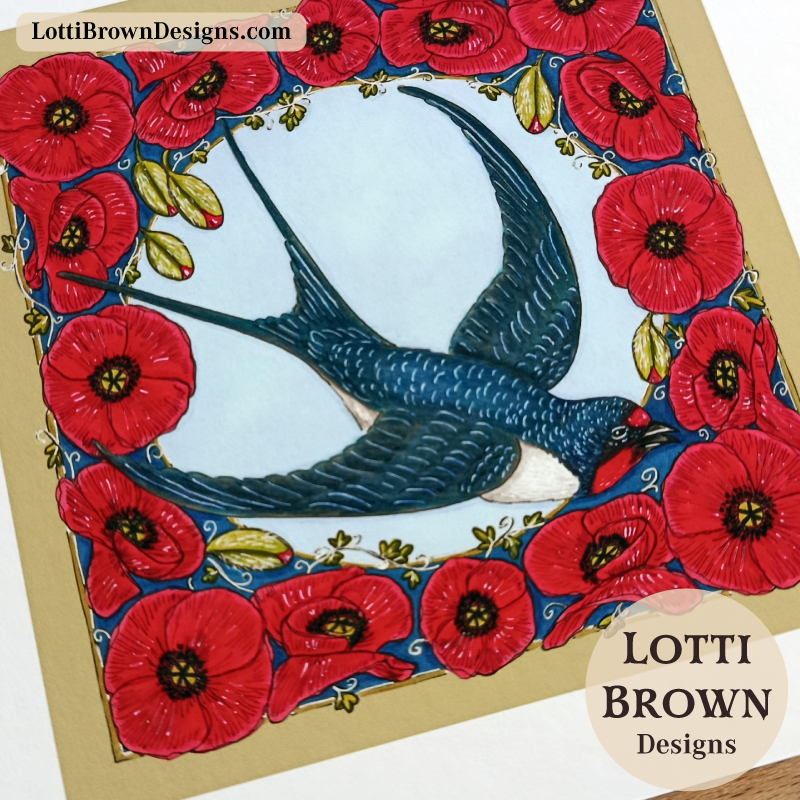 Swallow illustration
Much swallow folklore centres around their mysterious migrations…
It was traditionally believed that swallows flew over the sea carrying a small stick, which they could use to rest on, like a tiny raft.
An Estonian legend depicts the swallows as being guided on their journeys by the daughter of Ukko, god of the sky, whose bridal veil is the Milky Way.
Modern day theories believe the swallows journey by day and navigate using the position of the sun, known landmarks and the magnetic field.
It was once believed that swallows hibernated instead of migrating. It was commonly believed they spent the winter underwater in rivers and ponds or underground – migrating swallows roosting in reedbeds likely sparked these beliefs.
There were also theories that the swallows hibernated in caves, or in the crags of rocks, cliffs or mountains, while in Cornwall, they were said to hibernate in tin mines.
Perhaps it’s no wonder people created such stories - it almost seems impossible that such small birds can make such enormous journeys.
October 4th is traditionally seen as the day when the swallows leave for winter, the feast day of St. Francis of Assissi, patron saint to animals – it’s beautiful to think that the swallows are under such saintly protection as they start their epic journey and shows how much people cherished these little birds that seem to symbolise the very seasons of the year.
Swallow Meaning & Symbolism
In folklore, swallow symbolism is closely tied to hope, freedom, summer and safe return…
The swallow is an important marker of the seasons as spring turns to summer. Swallows have represented the return of summer warmth for thousands of years – and with the return of summer, they also represent the return of hope, joy and peace.
Swallows embody freedom - life lived on the wing, soaring effortlessly through summer skies.
There’s also a certain freedom in leaving and returning – as if the swallows know their true home, and leave with a promise of return.
They represent journey, resilience and overcoming challenges – change, destiny and hope...
And the cyclical nature of the seasons and life.
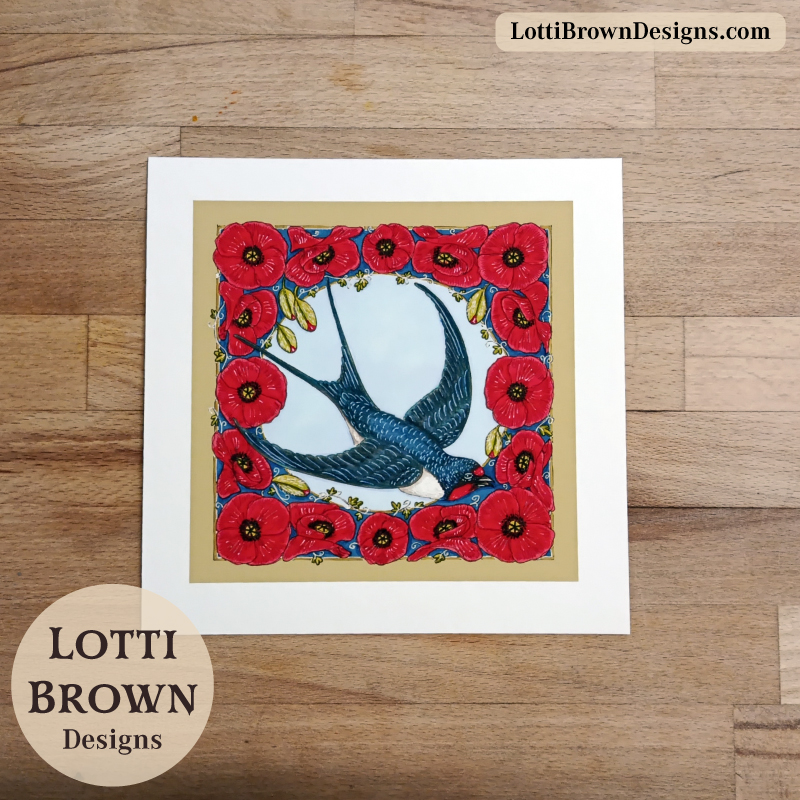 Barn swallow art
Drawing my Swallow Art
My swallow art was inspired by the swallows I see each summer flying over the barley fields behind my house in Yorkshire – I love to watch them swoop by so fast and so close…
This year, I also watched swallows flying in Craster harbour. The sun was shining and we looked down on them as they darted across the harbour, their blue feathers glinting with turquoise and purple, shimmering beautifully in a way I’ve never noticed before – almost iridescent like a kingfisher…
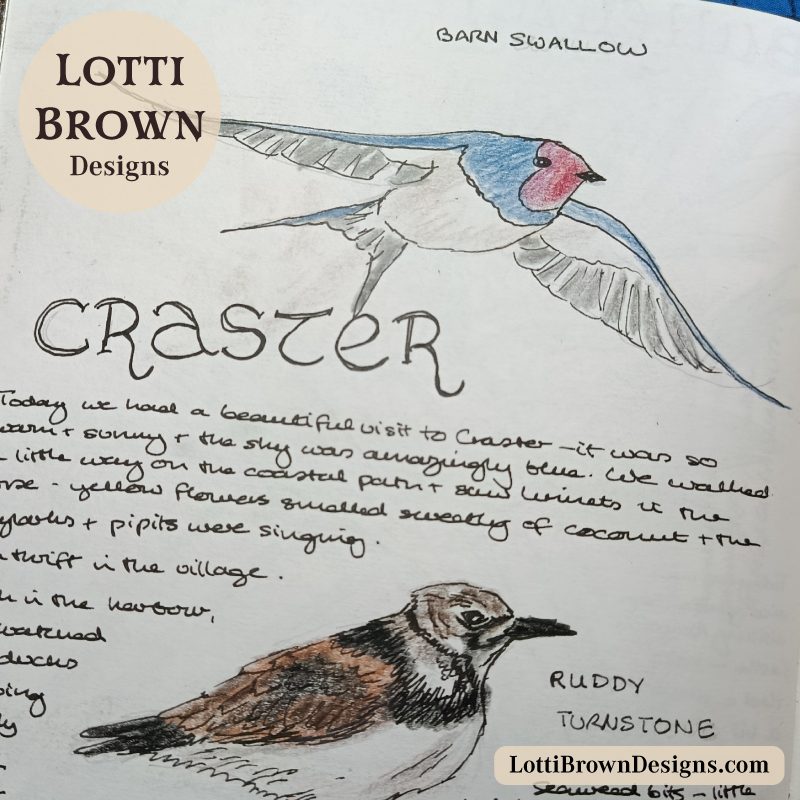 Watching swallows in Craster Harbour (recorded in my nature journal)
I tried to bring some of these colours and iridescence into my swallow drawing – bringing memories of that quiet day watching the little birds perform their amazing sky acrobatics.
I paired my swallow with red poppies, symbol of the cornfields of summer, where I so often see them fly.
Swallows always feel fleeting somehow - here for such a short time before summer begins to slip away again.
I wanted my swallow artwork to hold onto a little of that feeling: the warmth, movement, freedom, and light of summer evenings in the fields.
Swallow by Lotti BrownIf you too love watching the swallows return each year, you can find my swallow art collection in my Teemill store here…
It’s easy to understand why swallows became such an important part of folklore and seasonal tradition…
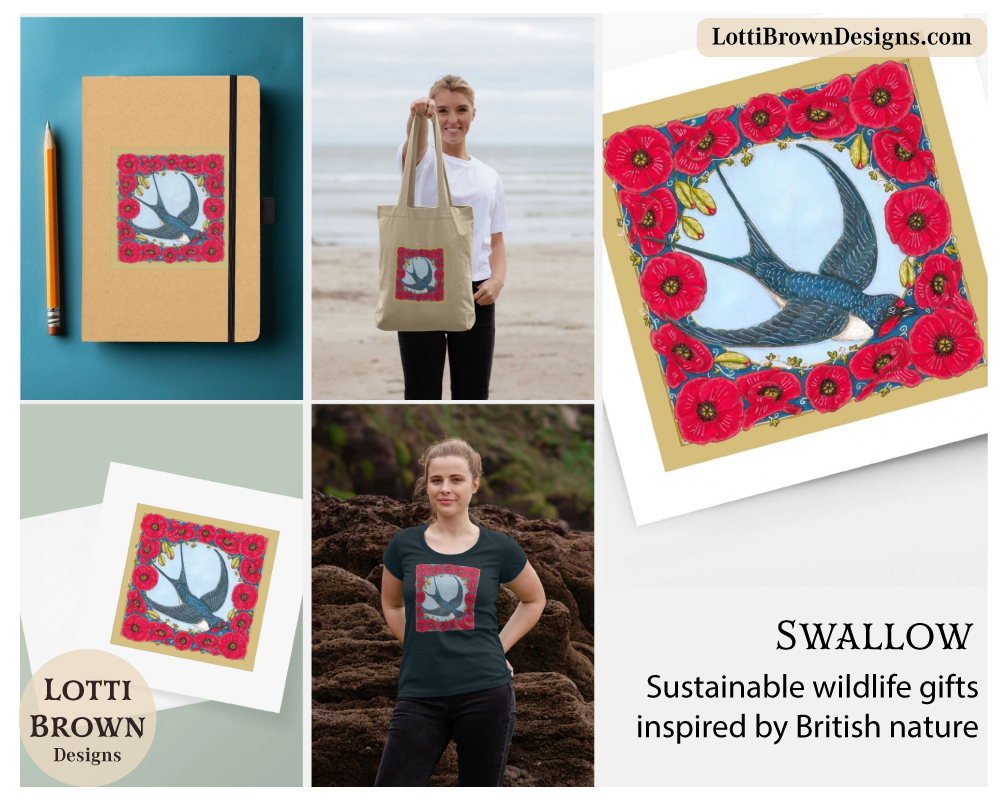
My swallow artwork is available as sustainable art prints, notebooks, greetings cards, tote bags and clothing in my Teemill shop.
Read more about the folklore of our other summer birds below...
More British birds art & folklore here...
Read about my year of birdsong here...
Explore nature and folklore as the seasons change, here...
Discover more folklore of nature in my Folklore Hub here...
More bird folklore and art:
- Kingfisher
- Song thrush
- Goldfinch (& goldfinch nest diary)
- Wren
- Blackbird
- Chaffinch
- Blue tit
- Lapwing
- Corvids
Explore nature journaling in my Nature Journaling Hub here...
 Birds of summer skies
Have you ever thought about nature journaling..?
If you like nature, you might like to start your own nature journal!
Find out all about nature journaling here...
You can get started with my free guide here.
Or explore my gentle self-paced nature journaling course with nature journaling exercises to get you confident with nature journaling - take a look here...
Further Reading/Resources
- Discovering the Folklore of Birds and Beasts - book by Venetia Newell
- The Folk Lore and Provincial Names of British Birds - book by Charles Swainson
- A Dictionary of English and Folk-Names of British Birds - book by H. Kirke Swann
- British Birds: Names - Facts - Myths - book by Geoff Green
- RSPB Bird Tales - Traditional Stories, Folklore & Activities - book by Dawn Casey
- Favourite Countryside Birds – 'Dairy Diary' book

Shall we stay in touch..?
Each month, I share stories from my own nature journal, new art from my studio, and simple seasonal inspiration to help you feel more connected with the turning year - if you'd like to stay updated, please sign up with your email address below...
Recent Articles


-
Barn Owl Folklore & Meaning - Symbolism of the Barn Owl
Sep 15, 26 03:34 AM
 Explore barn owl folklore, symbolism and meaning, from ancient myths to British traditions. Discover the quiet wisdom and mystery of this ghostly bird.
 -
Bramble Meaning, Myth & Symbolism - Celtic Tree Calendar Art
Sep 02, 26 11:32 AM
 A look at bramble meaning, myth and symbolism as I share my bramble Celtic Tree Calendar art for the month of 'Vine'...
 -
Nature Journal Prompts
Aug 26, 26 04:05 AM
 Easy nature journal prompts to inspire and encourage you - one per week...
Shop My Current Artwork Collections

My art is available as sustainable art prints, notebooks, greetings cards, tote bags and clothing in my Teemill shop.
Find my stockists for all my earlier artworks here...

Lotti Brown is a self-taught nature artist and nature journaling educator whose hand-drawn work is inspired by wildlife, folklore, and close observation. With 18 years in creative fields and 10 years creating nature art, she brings deep practical experience to her work. Trained by the Wild Wonder Foundation, she shares nature journaling courses and guides online. Her artwork has been licensed internationally and exhibited at Goole Museum and Bridlington Spa in the East Riding of Yorkshire, UK.
Follow me:
Share this page: