
- Home
- Art
- British Birds Art
- Lapwing Folklore

Lapwing Folklore, Meaning &
Hand-Drawn British Nature
Art
By Lotti Brown
Explore lapwing folklore, myths and meaning with me as I share my hand-drawn lapwing art to celebrate one of my favourite birds…
If there’s one bird that I feel like represents the wide-open fields and huge open skies around the village in East Yorkshire, where I live, it’s the lapwing – a bird who stays with us through the in-between months…
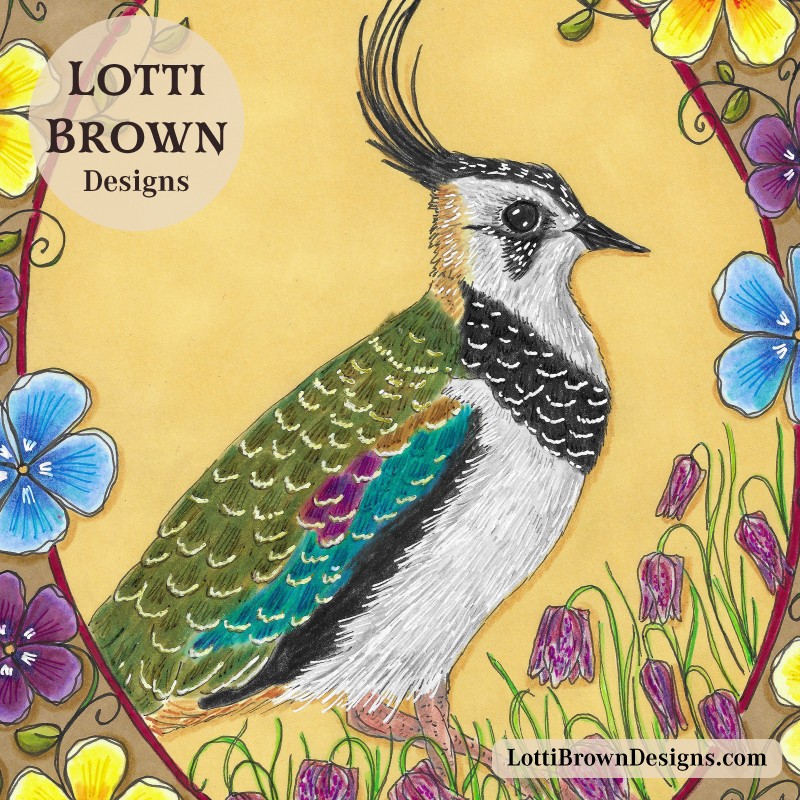 My hand-drawn lapwing illustration (detail)
Meet the Lapwing
This is a bird whose haunting calls have accompanied so many of our daily walks in the fields, as they twist and turn, overhead – twisting and tumbling overhead, black and white wings flipping and flopping in that unmistakable, almost otherworldly flight. They are birds of the open land and the in-between months, companions through cold winds, floodwater, and winter mud.
Lapwings are the birds who stay with us when the landscape feels stripped back to its bones - gathering together, finding sustenance where little seems to remain.
And as the earliest green shoots of Spring appear in the fields, the lapwings rear their young – calling and displaying to entice us away from the nests, babies huddled in a dip in the ground. And a few weeks later, my favourite part – the young lapwings take to the sky for flying lessons. It’s amazing to watch them with their parents as they learn to twist and tumble in mid air, calling out for reassurance and praise as they do so…
And then all too soon, as summer arrives and the air begins to sing with swallows, the lapwings are gone – and we will need to wait until the cold days of winter until they return to these fields.
These are the birds of wide skies, cold winds and the in-between places – our companions through the darkest months.
Perhaps that’s why they have gathered so many stories around them - birds that arrive when the land is bare, and leave again just as summer begins to sing.
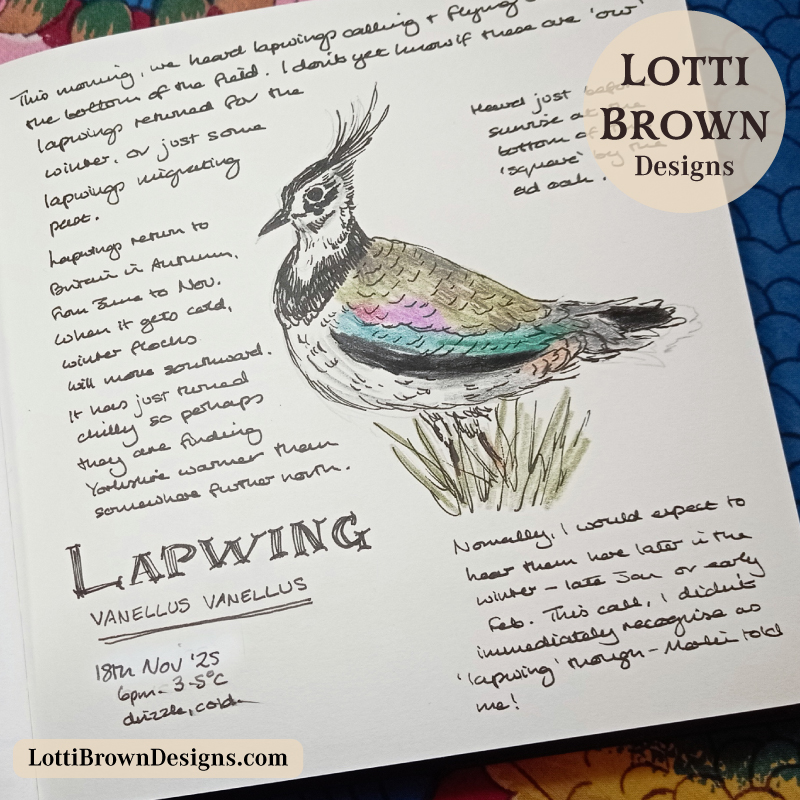 Nature journal illustration of a lapwing, showing its head plume and iridescent plumage
The Lapwing of Many Names
The name ‘lapwing’ comes from the Anglo-Saxon ‘Hleap-wince-lit’ meaning ‘one who turns about in running’ or to ‘leap and totter’ – from the habits of the lapwing in the sky and as she runs about to protect her nest (more on this just below)…
The Latin name of the lapwing is ‘Vanellus vanellus’ meaning ‘little fan’ from the flapping of her wings.
The lapwing was once very common in the countryside in Britain, seen in its thousands, and there are many common names from different areas:
- Green Plover
- Flopwing, Lipwingle, Flopwing, Flap-jack – from the flapping flight and the lapwing’s habit of faking a broken wing to distract from her nest
- Peewit (this is the name I knew the lapwing by as a child), Piewipe, Peweep, Puit, Peaseweep – from the call that sounds like ‘pee-wee’ – also Weep, Wype
- Tewhit, Tee-wheep, Teufit, Teuchit, Tuet, Teeuck – from the sound of the call
- Hornpie, Horneywink – from the crest on top of the head – in Gaelic the name is ‘Adharcan-luachrach’ meaning ‘little horn of the rushes’
- Cornwillen
- Old maid – possibly connected with the European folklore of the lapwing being an old maid calling out to the bachelor green sandpipers
- Toppyup – likely referring to the flight
- Wallop
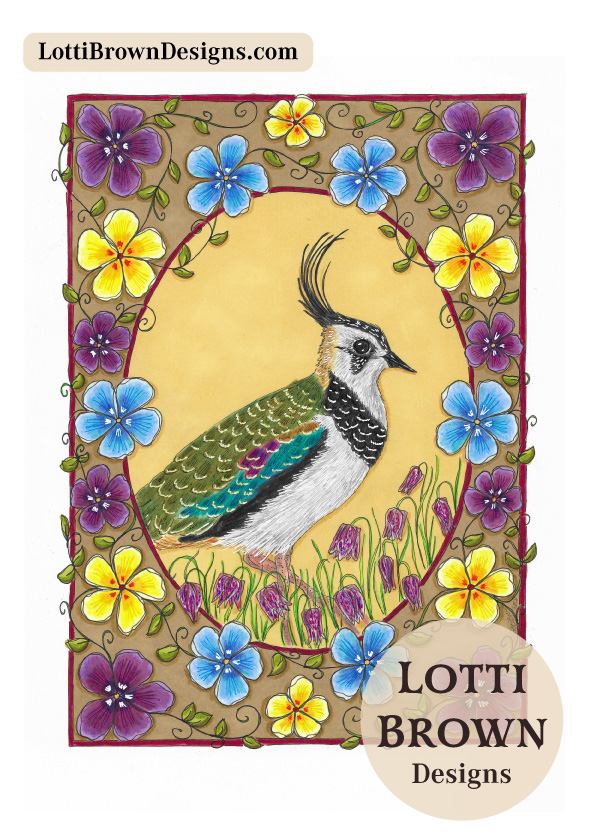 My hand-drawn lapwing art
Lapwing Folklore and Superstition in Britain – Voices of
Omen and Warning
Lapwing folklore in Britain is rich with stories of winter, warning, protection and renewal - themes that feel woven into the fields and skies they inhabit.
It was often believed that lapwings were roaming spirits, due to their ghostly calls.
Sometimes, it was said that the lapwings called out ‘Bewitched!’ – the calls of the lapwing were said to be able to foretell disasters. The folklore of the 7 whistlers – the sound of 7 lapwings flying together, calling by night – is said to have warned of mining disasters in Leicestershire and Northumberland.
The lapwing’s mournful cry was said to be at regret at having once mocked Christ.
In some areas lapwings were unpopular as their habit of taking to the skies with their piercing calls was prone to give away hiding places…
Although this very habit proved to be a godsend for the wounded founder of the ‘Tyrwhitt’ family in Lincolnshire, who was rescued due to the distinctive calls of the lapwing. In gratitude, he took the emblem of three lapwings as the family crest.
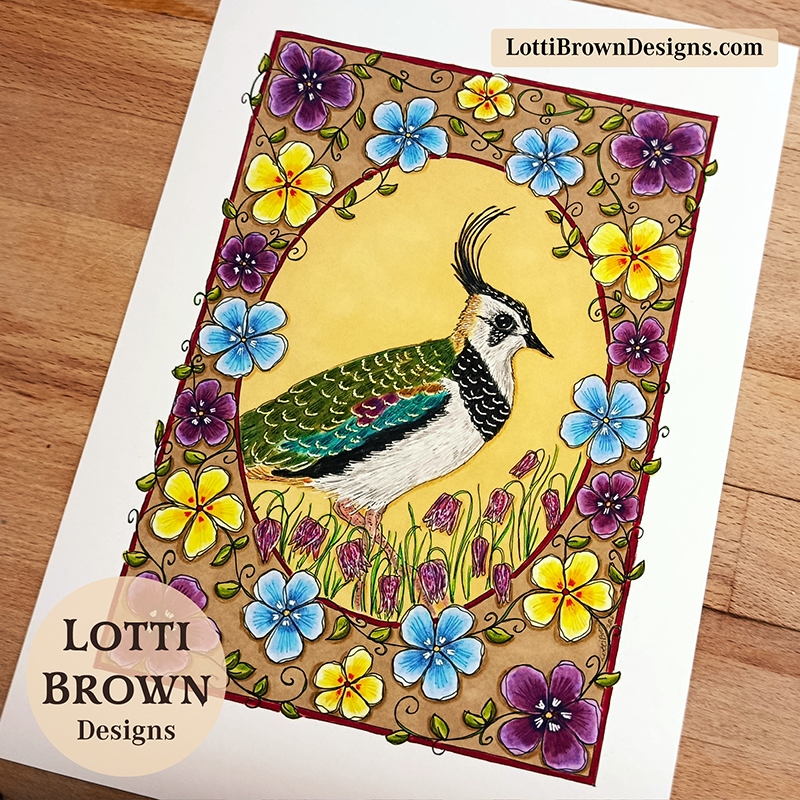 Lapwing art print
Bird of the Full Moon
Although normally a daytime bird, lapwings are known to feed by night for several nights either side of a full moon, resting during the day.
When I learned this, I realised that this is why we sometimes hear lapwings calling out in the darkness. It seems that this is particularly during spells of harsh weather, likely as it allows the bird to extend their feeding hours and gain more energy for the rigours of the cold winter weather.
It seems fitting that a bird so tied to tides, weather, and winter survival should also be linked to the moon - another presence that quietly governs the rhythms of the natural world.
Bird of Easter
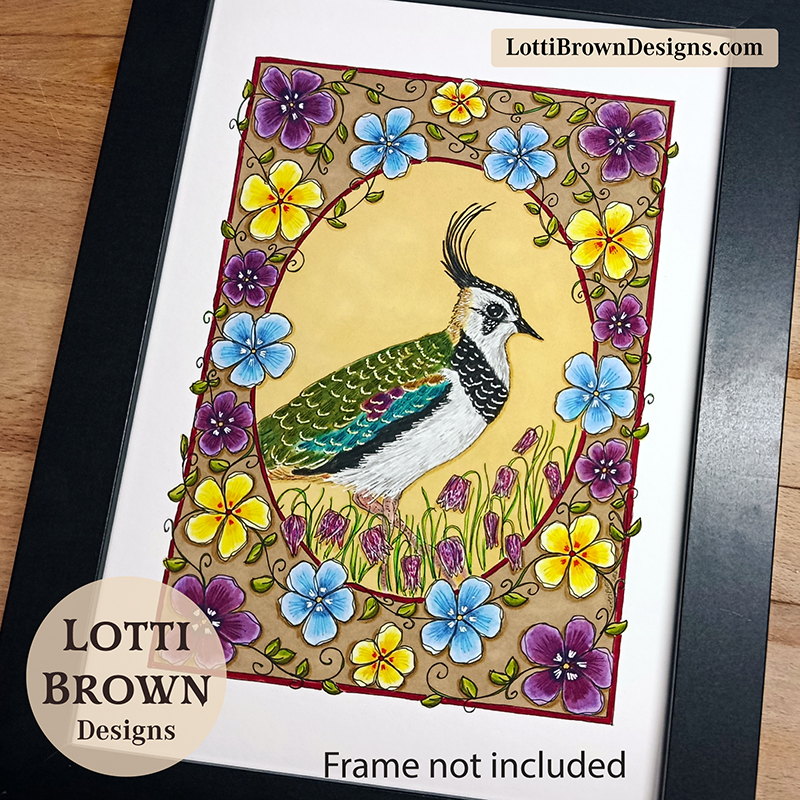 Lapwing original art detail - coloured pencil and pen
Explore the lapwing artwork collection here...
The lapwing is associated with Easter and lapwing’s eggs may be the original Easter eggs…
The Spring hare goddess Oestara in her kindness saved a wounded lapwing by gently transforming it into a hare.
It was believed at one time that hares laid eggs – likely because at the same time that brown hares were seen out in the fields in Spring, the lapwings’ eggs were found in their nests in hollows in the ground...
Both lapwings and brown hares thrive in the same large, flat, open fields that we have here in East Yorkshire. It’s thought that people assumed that the eggs must come from the hares and they began to be associated with Oestara and Easter in this way.
There’s also the history of collecting eggs in times past. Lapwings and lapwing eggs were seen as a real delicacy, eaten in the finest homes and restaurants in London. In Spring, country folk would take to the fields to hunt for the valuable eggs, gathering them by the hundreds as the lapwing flocks were so huge in those days...
This seasonal habit may have developed into our own folklore tradition of the Easter Egg hunt. Thankfully, in 1926 the Lapwing Act was passed to protect the lapwings, and these days our eggs are chocolate and we do not need to harm these beautiful wild birds to enjoy our Easter traditions.
Read all about the other folklore animal symbol of Easter, the hare, here...
The Crying Bird – Voice, Loss and Longing
The lapwing’s call has a mournful quality, like a wail, and this often has led to them being linked to folklore tales of sorrow and longing…
One lapwing folklore tale tells of a young princess who, believing her favourite brother was arriving after a long absence, ran excitedly out to greet him...
She took up a pot of hot milk to bring her brother some refreshment, but in her hurry spilled some of the hot milk on herself and was scalded. Even worse, her brother was nowhere to be seen and she cried out in her sorrow, searching for him in all directions, not wanting to abandon the hope of seeing her beloved brother again...
She was turned into a lapwing so that she could continue her search for her brother from the skies, where we can still see her today, wheeling through the air and calling out plaintively for her brother.
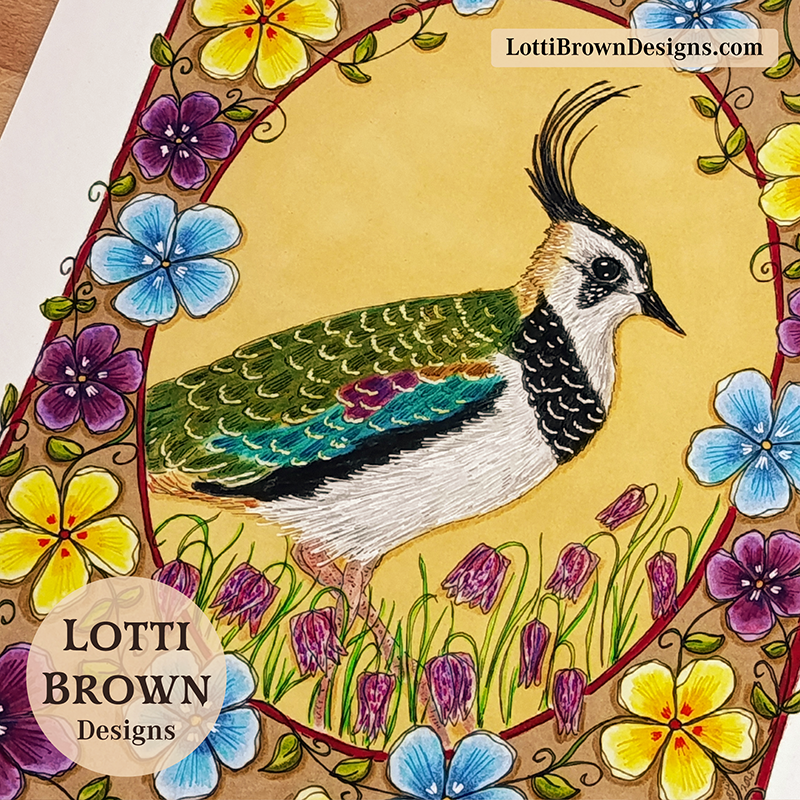 Lapwing art print
European Lapwing Folkore Tales
In areas of Germany, the lapwing was known as ‘Virgin Mary’s Dove’ showing this is a sacred and well-loved bird.
In Swedish folklore tales, it’s said that the lapwing was once one of the Virgin Mary’s attendants but had stolen a pair of scissors. In punishment, she was turned into a bird with a scissor tail and soared the skies, crying out in her regret, ‘Tyvit’ (I stole them!).
Bird of Boldness
The baby lapwings are amazing little birds. As ground-dwellers, they are able to run about within just a few hours. This habit became linked with traits of great forwardness and boldness, shown in the phrase used by Shakespeare in his play Hamlet:
“the lapwing runs with the shell on his head,”
Bird of Hearth and Home
Although we associate lapwings now with the wildness of big skies and open fields and marshlands, in the 18th and 19th centuries, lapwings were kept in gardens as ornamental birds for their beauty and to eat unwanted grubs and insects.
A heartwarming tale collected by the 18th-century natural historian Thomas Bewick tells of a lapwing kept in the garden of the Reverend Carlyle of Newcastle...
While at first the lapwing kept to the beautiful gardens, when winter arrived, the lapwing drew closer to the house. The servants noticed that the lapwing was calling to come into the house and let him into the kitchen...
Before too long, the lapwing was enjoying warm winter evenings sat by the fire alongside the cat and dog of the home and would sleep the night as part of the family, too. He would frequently enjoy washing himself in the dog’s water bowl, ignoring the consternation of both the dog and cat as he continued in his ablutions.
Such a charming tale of a genuine and heartfelt connection between the our domestic world and the wild creatures of nature - friendship crossing barriers of species and culture in shared community in the harsh days of winter.
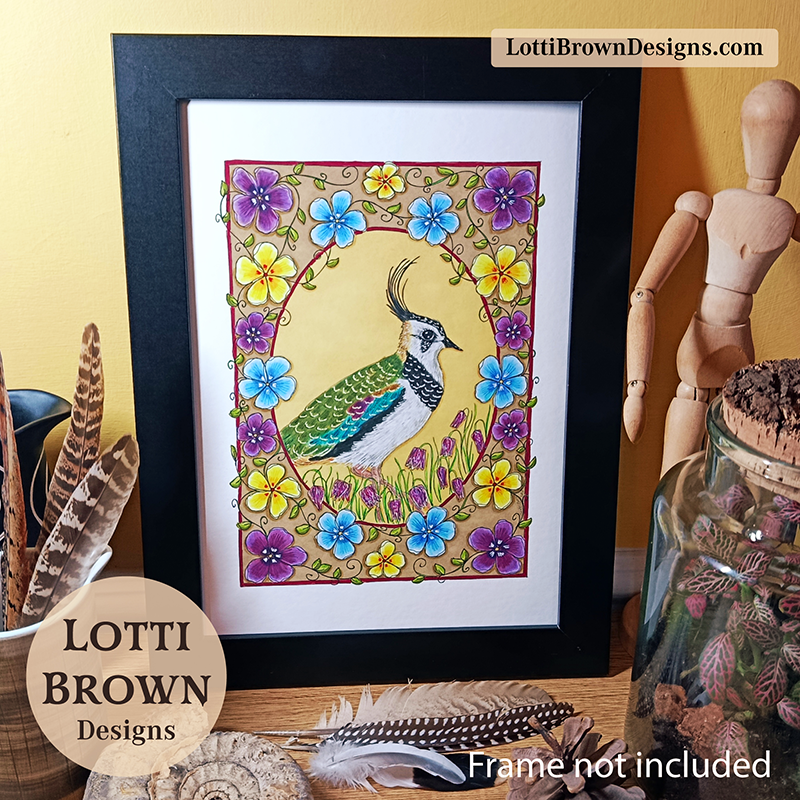 Lapwing art print
A Tale of Give and Take – Lapwings and Other Birds
The lapwing has an interesting cross-species relationship with the black-headed gull. The two birds are often seen together, especially over winter – I have seen them together in ‘our’ fields for a few years now. It seems that the black-headed gulls steal grubs that the lapwings have unearthed as they forage the wet winter earth – and in return, the gulls offer an early warning system to help protect the lapwings from threats.
A symbiotic relationship that helps both species and gives us inspiration to reach out to others, even those who might seem different.
Lapwings and the Future
Knowing all this about the lapwing - the stories, the companionship, the deep history we share - makes their decline in recent years feel especially poignant…
As a child, I can remember watching lapwings out of the window in class (maths). They gathered in huge flocks numbering thousands in the fields then and they were one of the first birds I learned the name of. I can remember the teacher asking me what I was looking at out of the window. “Peewits,” I answered. “What?” - "Those flocks of birds in the fields!" (I was given a bird project to do in the playground, rather than be in the maths class – how cool!).
Now, more than 40 years later, I don’t see the huge flocks of peewits (lapwings) anymore. The RSPB notes that (as of 2025) the population of lapwings in the UK is down by 55% although our resident, breeding, lapwings are joined by much larger migrant flocks in winter.
Changes in farming practice may have contributed to the population decline. Lapwings need areas of short grass or vegetation where they can nest, and not to be disturbed by farming operations during the crucial nesting period. Small fallow areas and wet areas in fields can help them thrive.
Lapwings are a conservation red-listed bird in the UK and globally now, due to their decline in numbers - so they really deserve our love and attention, as we hope that we can enjoy their evocative calls and beautiful tumbling flight in future generations.
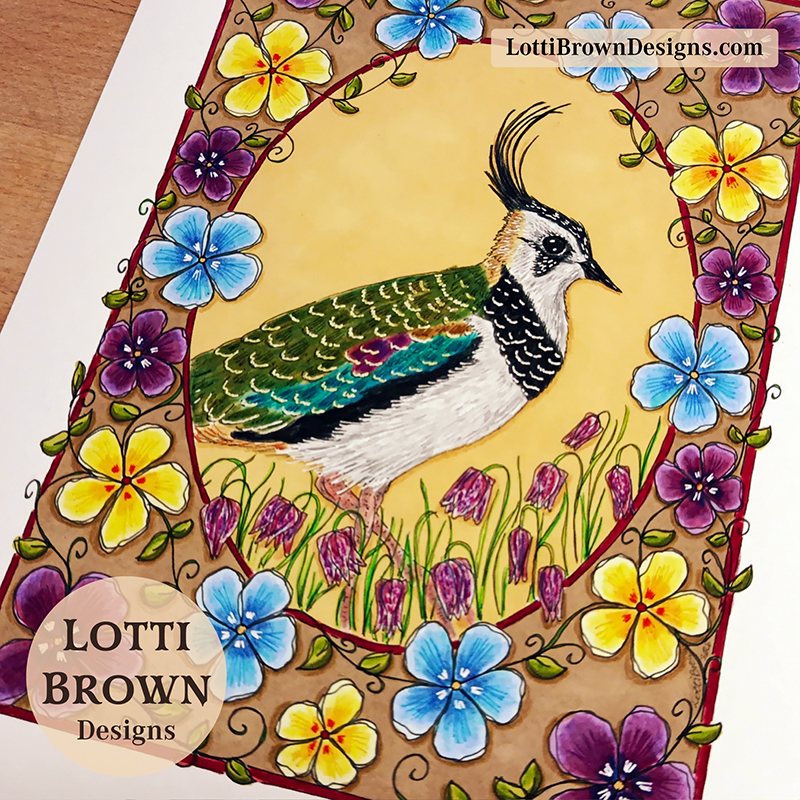
Lapwing Meaning and Symbolism
The lapwing is a bird for Winter as it gathers in huge flocks, huddling together for community and safety as it seeks food and warmth in the cold landscape, flocks of migrant birds often arriving ahead of snow - and it’s a bird for Spring, calling out to herald the warmer days and the promise of new life with its eggs that tell a tale of Easter traditions of yore.
Lapwing symbolism and meaning encompasses:
- Resilience – surviving in the barren winter landscapes
- Liminality – a bird of the magical liminal places, the marshlands, wetlands, and flooded fields that are not quite land and not quite water but somewhere inbetween
- New life and rebirth – with connections to Easter, the hare, and the Spring goddess Oestara
- Community – a communal bird, whether in large flocks, in partnership with other species, or finding companionship at the domestic hearth
- Boldness
- Prophecy and protection
- Longing
- The full moon
For me, the lapwing feels like a reminder that even in the bleakest landscapes, there is movement, voice, and quiet community.
Drawing the Lapwing
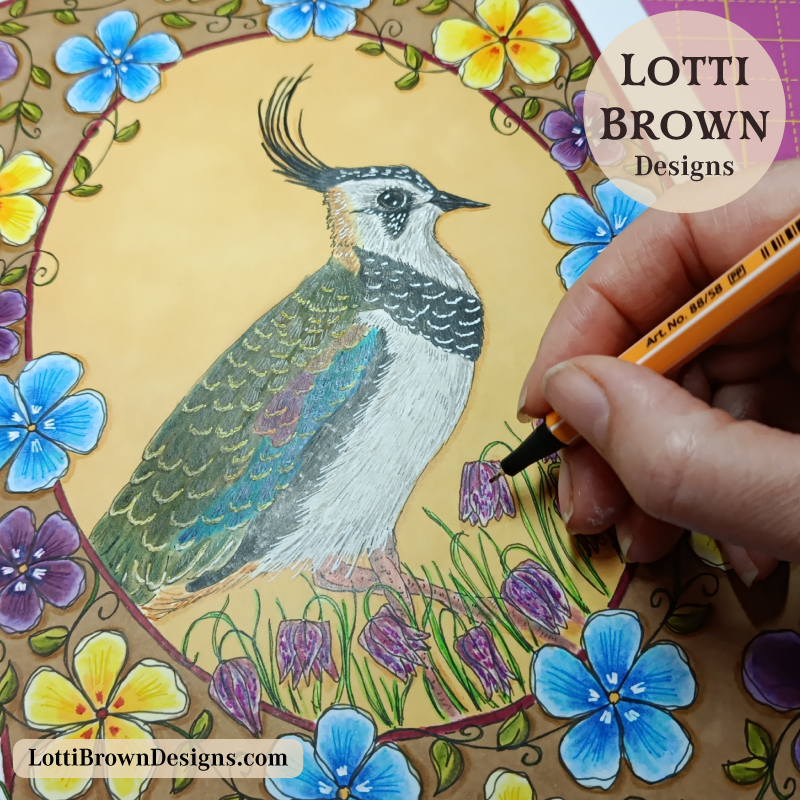 Drawing my lapwing multimedia art - created with pens and coloured pencils
I loved drawing the lapwing who I chose to depict in her Spring finery with these pretty Fritillaria meleagris also known as the Lapwing Flower due to its similarity with the lapwing’s beautiful plumage. She’s here to celebrate Spring and part of her heritage in the folklore of our Easter customs.
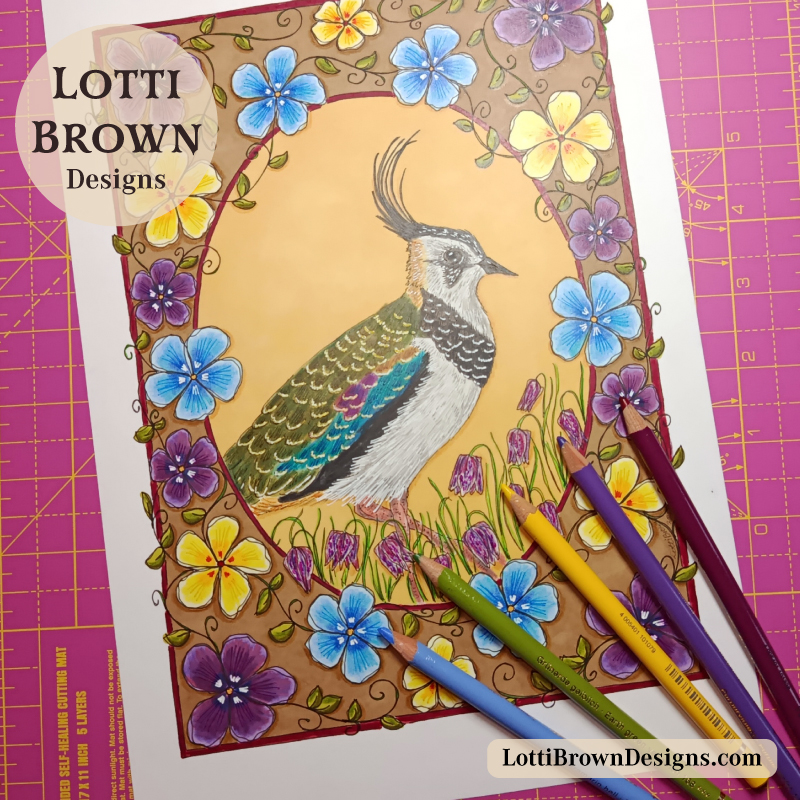 Lapwing coloured pencil drawing
She’s a bird that seems to belong to the flat open fields here where I live, so drawing her seemed like drawing a part of my own soul – the part that’s wild and belongs in the fields out in nature, calling into the huge skies, and gaining a kind of spiritual nourishment from the full moon.
The part that has the resilience to see me through tough times, and the part that knows when to seek companionship, comfort and community.
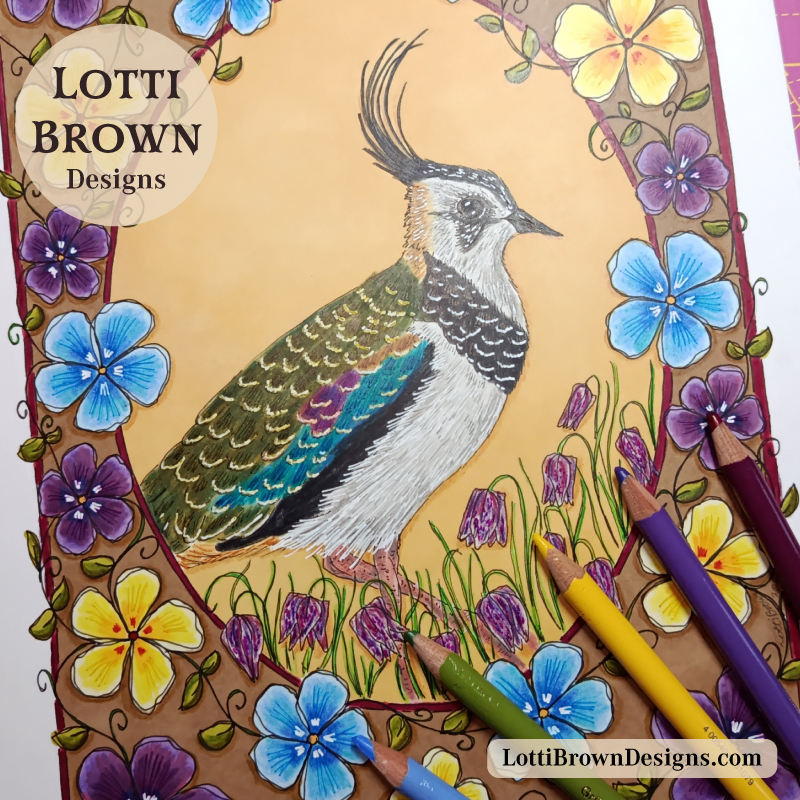 Lapwing coloured pencil art (detail)
The lapwing is a beautiful and precious bird that’s part of our landscape and culture, and I wanted to celebrate her in my artwork.
If my hand-drawn lapwing art resonates with you too, you might like her as your quiet companion as the winter days turn to Spring, to remind you of that wild part of your own soul that belongs in the landscape, too…
My Lapwing Art Print
Lapwing (Wildness, Movement, Farmland, Cry of the Land)
If the lapwing has stayed with you - that tumbling flight, that distinctive, echoing call across open fields - this piece was created to reflect that sense of wild movement and space.
It grew from moments of watching them wheel and turn over the land, their presence carrying something both lively and ancient within it.
Take a closer look at the lapwing artwork collection in my Teemill store, here...
A piece like this brings a sense of openness and wild landscape into a space.
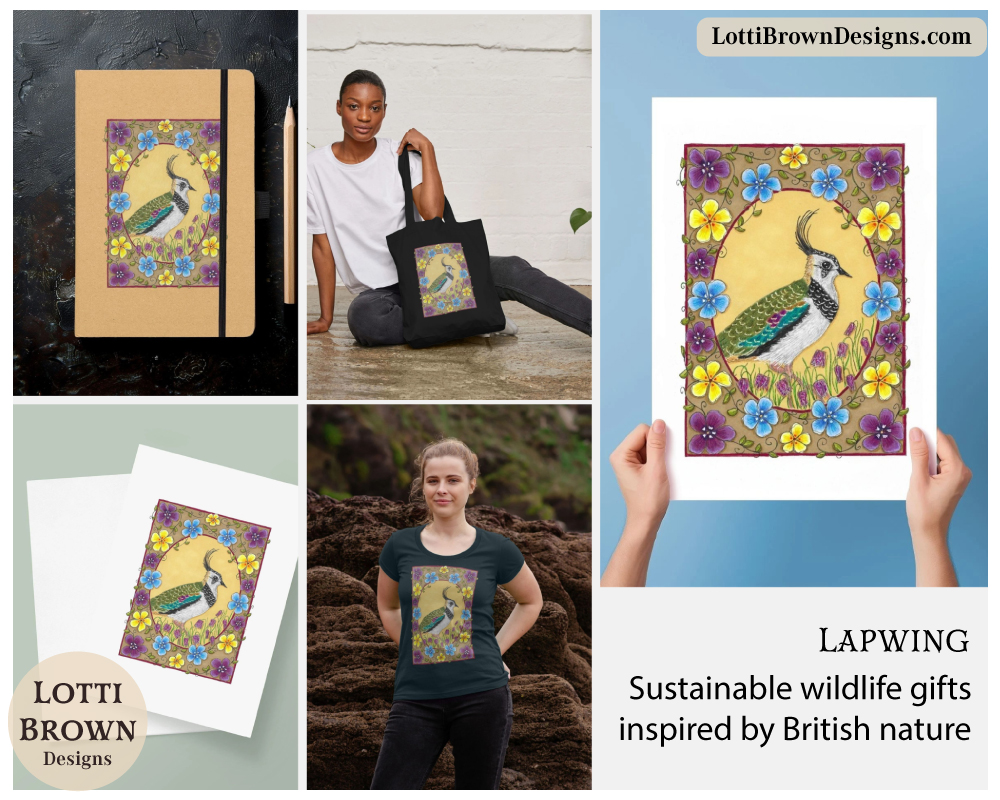
My lapwing artwork is available as sustainable art prints, notebooks, greetings cards, tote bags and clothing in my Teemill shop...
Explore more British birds folklore
You might also like to explore:
- Barn owl myths & meanings
- Goldfinch folklore page
- Skylark folklore page
- Song thrush folklore page
- Wren folklore page
- Kingfisher folklore page
- Blackbird folklore page
- Raven myths and folklore
- Rook myths & folklore
- Swallow myths & folklore
- Swift myths & folklore
- House martin myths & folklore
I also have lots more British wildlife and nature folklore and meaning in my Folklore Hub here...
You might enjoy seeing more of my hand-drawn British birds art in my new art collections on this page...
Plus - you can also browse through my earlier artworks of birds, wildlife, and Celtic wildlife here - or dive into my collection of all my artworks here...
If you love nature, have you ever considered keeping your own nature journal? Discover more about nature journaling and peek into my own nature journals here...
Or perhaps learning to listen to birdsong?
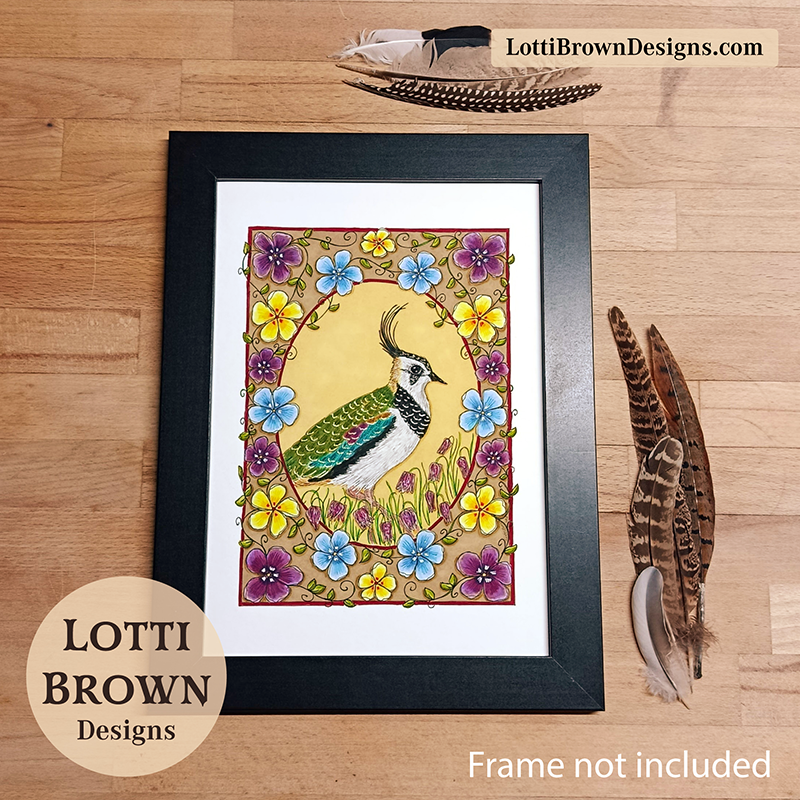 Lapwing eco-friendly art print (frame not included)
Further Reading/Resources
- Discovering the Folklore of Birds and Beasts - book by Venetia Newall
- The Folk Lore and Provincial Names of British Birds - book by Charles Swainson
- A Dictionary of English and Folk-Names of British Birds - book by H. Kirke Swann
- British Birds: Names - Facts - Myths - book by Geoff Green
- Favourite Countryside Birds – 'Dairy Diary' book
- A History of Birds - book by Simon Wills

Shall we stay in touch..?
Each month, I share stories from my own nature journal, new art from my studio, and simple seasonal inspiration to help you feel more connected with the turning year - if you'd like to stay updated, please sign up with your email address below...
Recent Articles


-
Barn Owl Folklore & Meaning - Symbolism of the Barn Owl
Sep 15, 26 03:34 AM
 Explore barn owl folklore, symbolism and meaning, from ancient myths to British traditions. Discover the quiet wisdom and mystery of this ghostly bird.
 -
Bramble Meaning, Myth & Symbolism - Celtic Tree Calendar Art
Sep 02, 26 11:32 AM
 A look at bramble meaning, myth and symbolism as I share my bramble Celtic Tree Calendar art for the month of 'Vine'...
 -
Nature Journal Prompts
Aug 26, 26 04:05 AM
 Easy nature journal prompts to inspire and encourage you - one per week...
Shop My Current Artwork Collections

My art is available as sustainable art prints, notebooks, greetings cards, tote bags and clothing in my Teemill shop.
Find my stockists for all my earlier artworks here...

Lotti Brown is a self-taught nature artist and nature journaling educator whose hand-drawn work is inspired by wildlife, folklore, and close observation. With 18 years in creative fields and 10 years creating nature art, she brings deep practical experience to her work. Trained by the Wild Wonder Foundation, she shares nature journaling courses and guides online. Her artwork has been licensed internationally and exhibited at Goole Museum and Bridlington Spa in the East Riding of Yorkshire, UK.
Follow me:
Share this page: