
- Home
- Art
- British Birds Art
- Song Thrush

Song
Thrush Folklore, Meaning
&
Hand-Drawn British Nature Art
By Lotti Brown
Explore song thrush folklore and meaning with me, as I share my hand-drawn song thrush artwork...
The song thrush has one of the sweetest voices of the winter hedgerows – this is a bird whose bright notes often greet us on our dawn walks in late winter and early spring. Its song seems to bring the promise of light and hope in the greyest days…
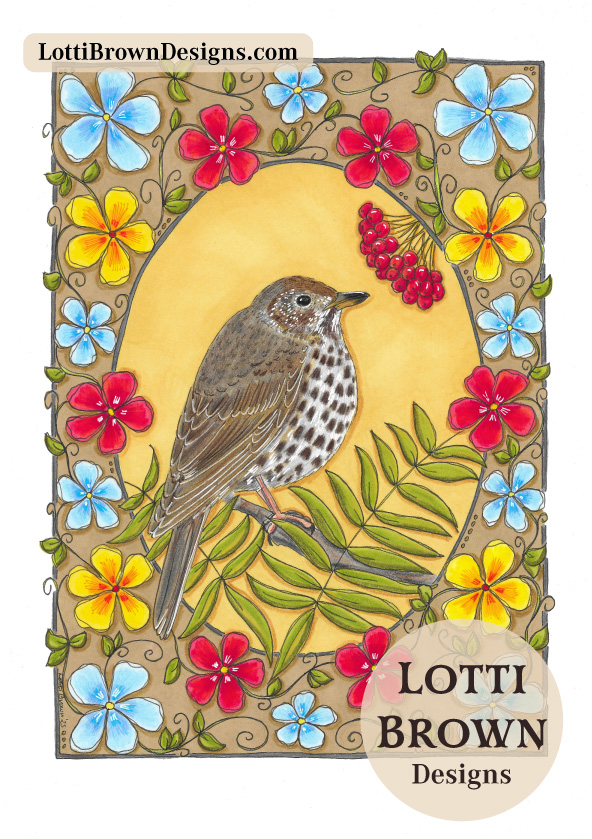 Song Thrush - hand-drawn illustration by Lotti Brown
As I worked on my hand-drawn song thrush artwork, I found myself drawn into the folklore surrounding this very special, magical little bird…
Meeting the Song Thrush (Turdus philomelos)
The gentle song thrush, with soft speckled breast and warm brown feathers, is an elegantly beautiful bird, similar in appearance to its larger cousin the mistle thrush, although the song thrush has warmer tones in its feathers and more pointed speckles on its breast compared to the mistle thrush’s softer and more rounded markings.
While the mistle thrush’s song is often described as melancholy, the song thrush’s voice is sweet and uplifting. Its song consists of up to 130 different song phrases, each repeated two or three times – a pattern that makes its song feel deliberately joyful...
“That’s the wise thrush: he sings each song twice over,
Lest you should think he never could recapture,
The first fine careless rapture!”
Robert Browning
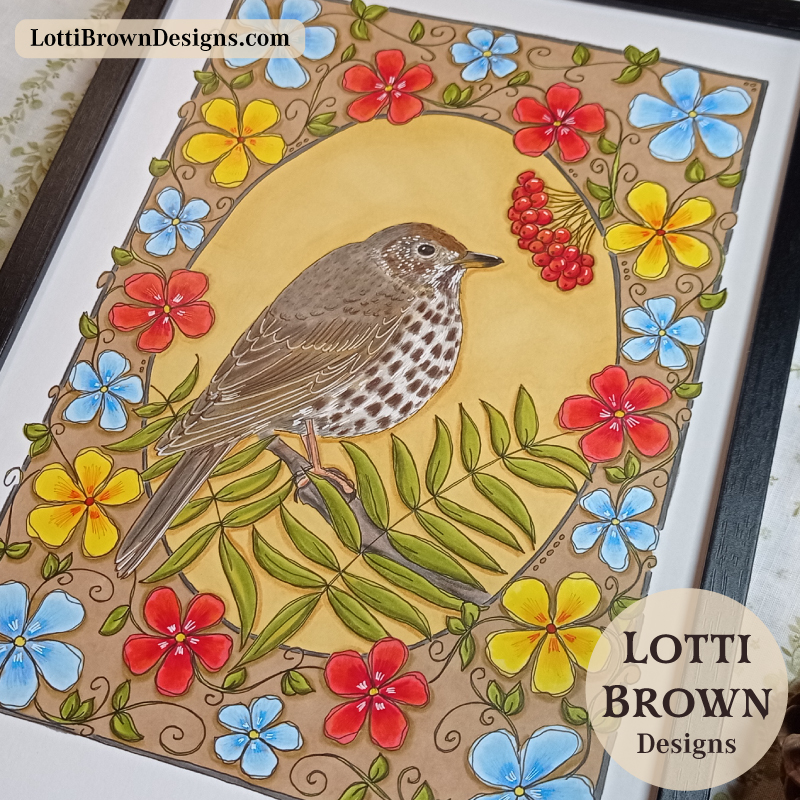 Song thrush perched among winter berries - folklore-inspired British nature artwork
Through winter, we often see our song thrushes in the hedgerows or on fenceposts. In winter, they gather in larger flocks as migratory birds arrive from northern Europe to join our resident birds. The birds take turns where one individual bird will will stand guard, leaving the others to feed peacefully – a small and touching act of community in the cold months.
The song thrush has its own toolbox – it will often use a particular stone to access the inside of a snail to eat, bashing the snail against the stone until the shell breaks – the stone known, now, as the ‘thrush’s anvil’.
Song Thrush Folklore in Britain
What's in a name?
The name ‘thrush’ comes from the Anglo-Saxon ‘thrysce’ (from the Old German, ‘drosca’ meaning ‘thresh’) and has been used since the 8th century.
Through the centuries, the song thrush gathered many different regional and common names:
- ‘throstle’ - a name which also dates from Anglo-Saxon times (and links to the German ‘drossel’) - in fact, previously, the song thrush was usually known in Britain by the name ‘throstle’, while ‘thrush’ was just for the mistle thrush.
- variations of ‘throstle’ - ‘thrustle’, ’thrushel’, ’thirstle’
- ‘thrush drush’, ‘thrusher’, ‘thrasher’, ‘dirsch’, or ‘thrushfield’
- ‘thrice cock’ - for its habit of repeating parts of its song three times
- ‘throggie’
- ‘Mavis’ – particularly in Scotland (similarly, it’s known as the Mauvis in France and Malvis in Spain)
- ‘Grey bird’
- ‘Whistling thrush’ or ‘Whistling Dick’ - for its song
Its Latin name ‘Turdus philomelos’ (meaning ‘lover of song’) links the song thrush to the Greek myth of Philomela who was turned into a nightingale to sing her story in beautiful song – so this is the thrush with the voice of the nightingale.
Herald of Spring - Bird of Song and Hope
As the song thrush begins its uplifting songs early in the year, from late winter, the bird has long been seen as a herald of the return of Spring - a symbol of hope, light, and renewal of joy.
The poet Thomas Hardy describes its song as ‘joy illimited’, bringing hope.
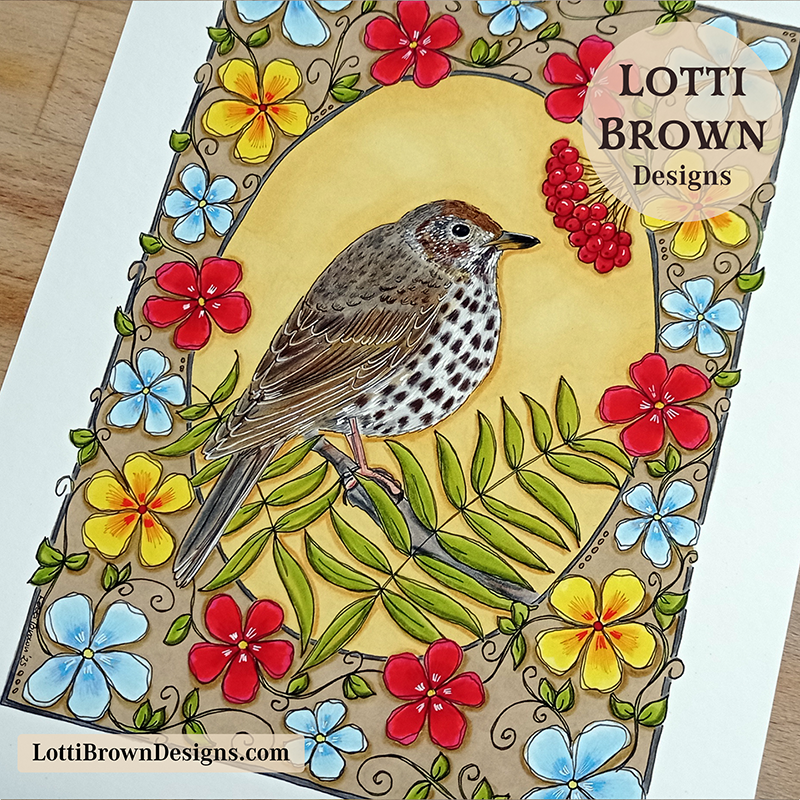 Nature-inspired art print featuring a song thrush - hand-drawn in Yorkshire
The Victorians would sometimes keep the song thrush in a cage, for its beautiful voice – hard to imagine now, when hearing one wild in the hedgerow feels like such a gift - it was thought that if a song thrush’s song was particularly insistent, it foretold a storm.
Amazingly for such tuneful birds, folklore insisted that song thrushes were born deaf. It was also thought that around the age of 10, they cast off their old legs and acquired a new pair – a wonderfully strange belief, hinting at how people saw the Song Thrush as a bird touched by magic and mystery.
Bird of the Fairies
In Irish folklore, the beautiful song of the song thrush was known to be a favourite of the fairies – and it was for the little folk that the song thrush chose to build its nest low down in the hedgerows, so that the fairies could enjoy its melodies. If the song thrush ever built its nest high up in the bushes, it was a sign that misfortune was sure to follow.
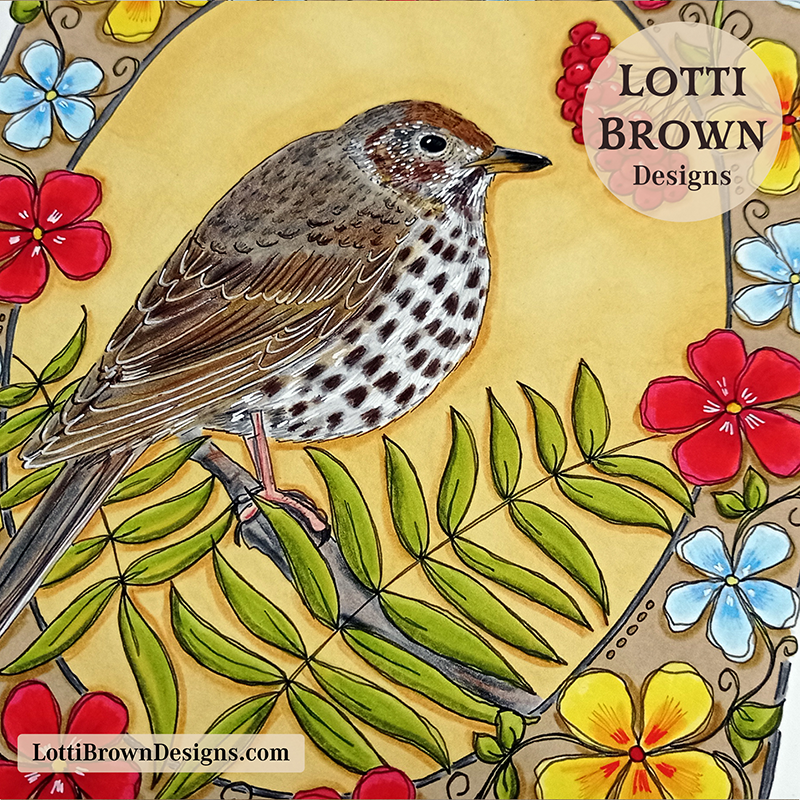 Close-up of hand-drawn song thrush feathers and speckled breast - fine art print
Explore the song thrush artwork collection here...
Bird of Creativity
The song thrush belonged to the Greek goddess Euterpe, muse and patron of music and poetry – its song was believed to inspire creativity and lyrical expression, a symbol for clear communication and creativity.
In Celtic mythology, the song thrush was a messenger from the Otherworld – offering the power of intuition and emotional insight to those who listened closely to its song.
Bird of Freedom – a Folklore Tale
A charming tale from India, tells of a song thrush captured and prepared for the king’s table. As the bird is brought into the kitchen to pluck, its feathers fly one by one out of the window while the bird continues to sing. As the dish is set before the king, the bird sings out, and a flock of birds arrives at the window, each carrying one of the song thrush’s feathers. The feathers return to the song thrush, who becomes whole again and escapes, to sing his song of joy, once more free in nature.
A reminder, perhaps that wildness and joy should not be contained.
Song Thrush Meaning and Symbolism
Across folklore traditions, the song thrush symbolises:
- hope, joy and freedom
- a herald of Spring and the return of light in the dark winter months
- creativity
- clarity of expression and ease of communication to make our voice lyrical and true
- messages from the Otherworld
It’s a messenger of brighter days, even when the world feels wintry and still.
Drawing the Song Thrush
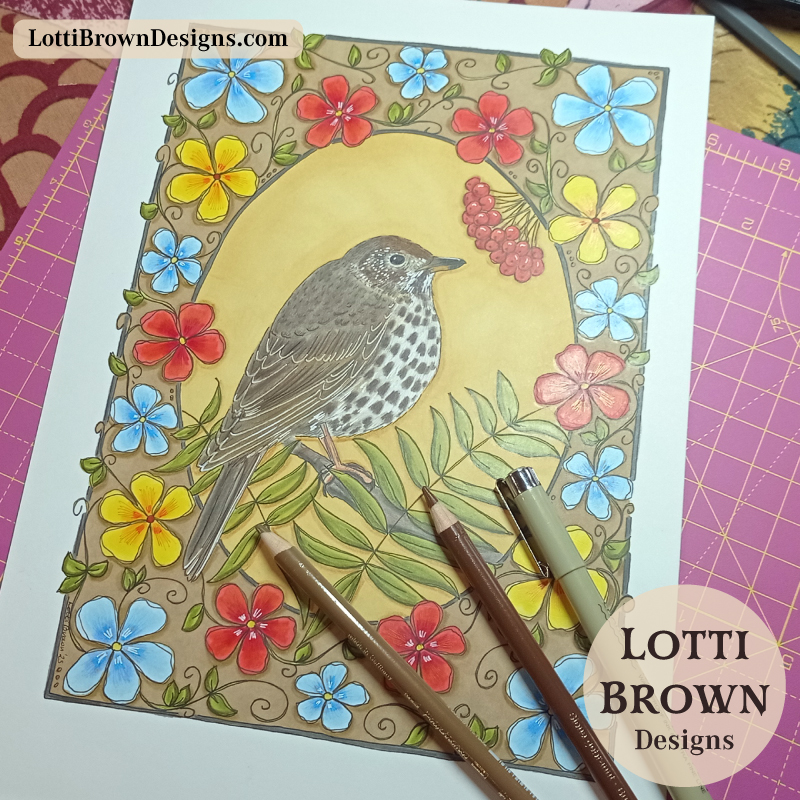 Drawing my song thrush in pens and coloured pencils
I chose to draw the song thrush for its beautiful voice – it’s a real treat to hear the song, and it’s one of those birds that makes stop you in your tracks. When you hear it, it feels as if the bird is singing just for you, telling you of hope and joy - a story of presence, and light held gently inside the dark.
As I worked on drawing the delicate brown feathers, I kept wanting to reach out and stroke them - they seemed so soft, so velvety. Even in the act of drawing, I felt some of the song thrush’s brightness lift my own spirits.
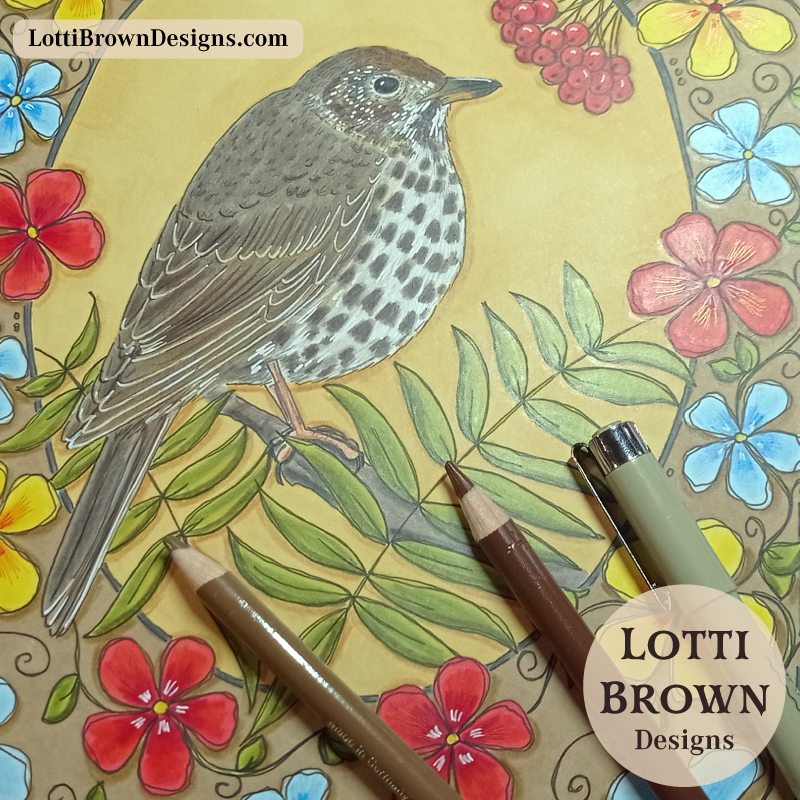 Showing detail of my drawing
My Song Thrush Art
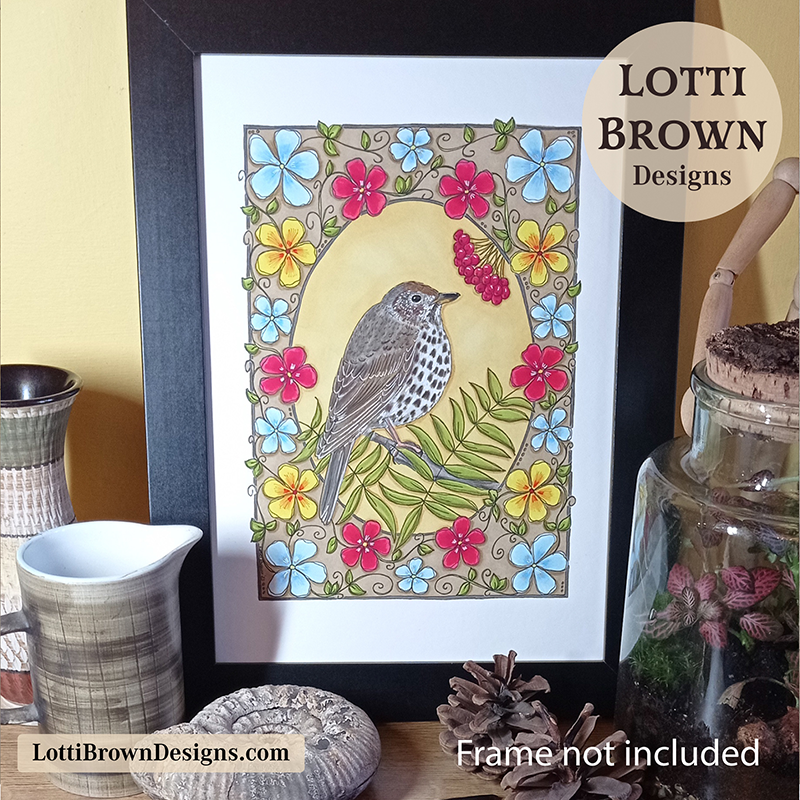 Fine art giclee print 'Song Thrush' - displayed in a wooden frame
Creating this piece felt like a small celebration of winter brightness - warm feathers, gleaming berries, the hush of the hedgerows settling into the colder months.
If the song thrush carries its own quiet kind of magic for you too, you can take a closer look at the finished artwork below...
Showing detail of the art printSong thrush art print - sustainably printedSong Thrush (Song, Repetition, Comfort)
If the song thrush has stayed with you - that repeated melody, that steady presence in the garden - this piece was created to reflect that sense of familiarity and comfort.
It grew from listening as much as watching - noticing those patterns and rhythms that return again and again.
Take a closer look at the Song Thrush art work collection in my Teemill store
A piece like this brings a gentle sense of calm and continuity to a space.
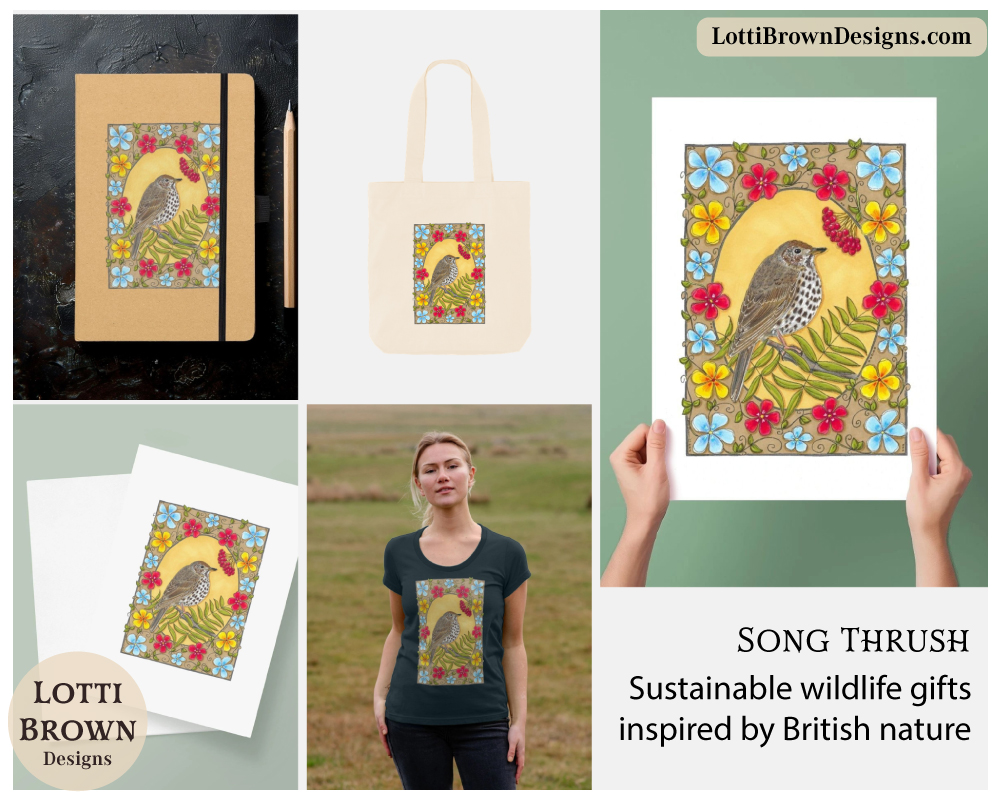
The song thrush has always felt to me like a tiny lantern in the hedgerows - a bright voice carrying through the darker days. I hope its folklore and story bring you the same spark of midwinter magic that I felt while drawing it...
My song thrush artwork is available as sustainable art prints, notebooks, greetings cards, tote bags and clothing in my Teemill shop.
More Nature, Art & Folklore
More British Bird Folklore
- Goldfinch folklore page
- Blue tit folklore
- Kingfisher folklore
- Swallow folklore
- Skylark folklore
- Wren folklore
- Chaffinch folklore
- Blackbird folklore
- Lapwing folklore
- Birds and Berries
- September birds
Visit my folklore hub here...
More Nature and Art
If you enjoy seasonal nature stories, you might like my Nature Journaling pages - quiet moments from my sketchbook through the year.
If you love British birds, explore my other British bird art prints, hand-drawn and inspired by the magic of our fields and hedgerows.
You might also enjoy exploring learning to listen more deeply to birdsong here...
You can also browse through my earlier bird artworks in my large collection of earlier bird art and Celtic nature art.
Have you ever thought about nature journaling..?
If you like nature, you might like to start your own nature journal!
Find out all about nature journaling here...
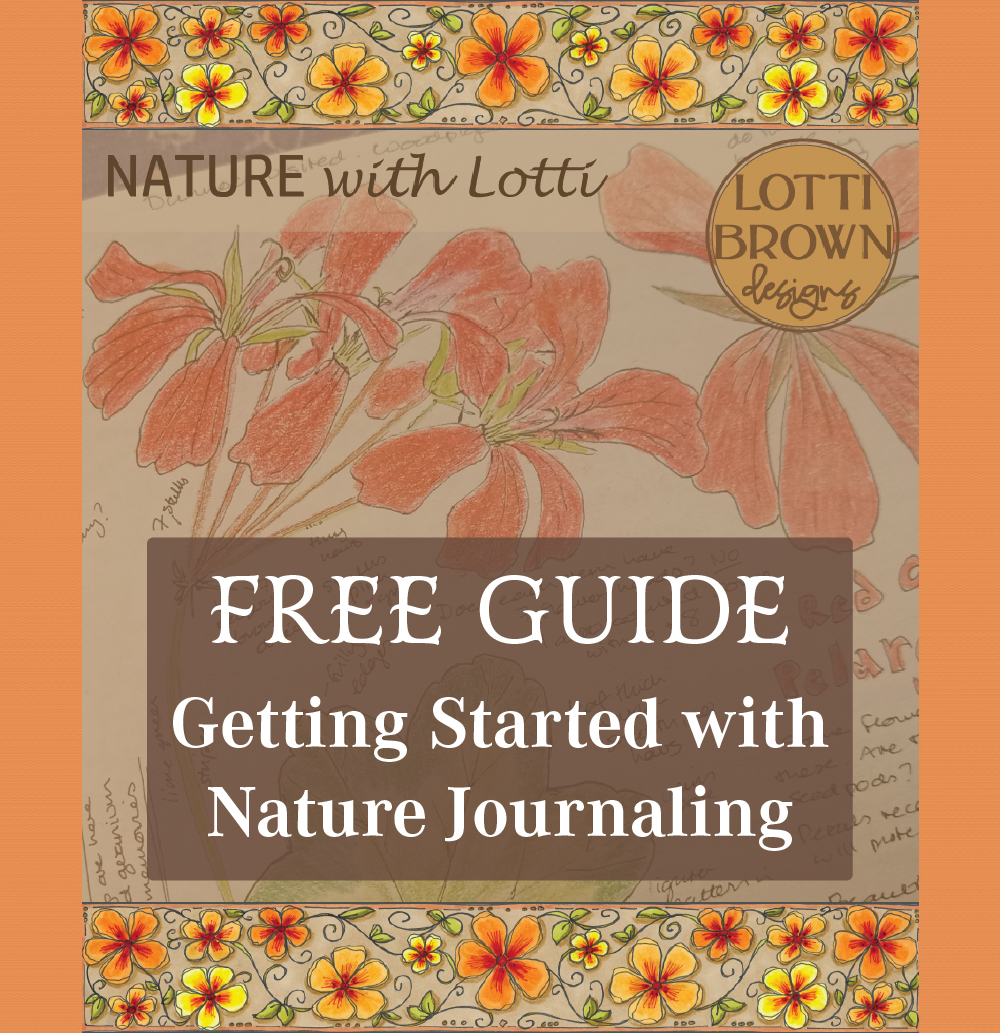
You can get started with my free guide here.
Or explore my gentle self-paced nature journaling course with nature journaling exercises to get you confident with nature journaling - take a look here...
Resources/Further Reading
- Discovering the Folklore of Birds & Beasts - book by Venetia Newell
- The Folk lore and Provincial Names of British Birds - book by Charles Swainson
- British Birds: Names - Facts - Myths - book by Geoff Green
- RSPB: Bird Tales - book by Dawn Casey
- https://irishhedgerows.weebly.com/folklore.html - website, accessed 4th December 2025
- https://www.countrylife.co.uk/nature/spheres-with-tails-our-enduring-love-affair-with-the-thrush-273584 - website, accessed 4th December 2025

Shall we stay in touch..?
Each month, I share stories from my own nature journal, new art from my studio, and simple seasonal inspiration to help you feel more connected with the turning year - if you'd like to stay updated, please sign up with your email address below...
Recent Articles


-
Barn Owl Folklore & Meaning - Symbolism of the Barn Owl
Sep 15, 26 03:34 AM
 Explore barn owl folklore, symbolism and meaning, from ancient myths to British traditions. Discover the quiet wisdom and mystery of this ghostly bird.
 -
Bramble Meaning, Myth & Symbolism - Celtic Tree Calendar Art
Sep 02, 26 11:32 AM
 A look at bramble meaning, myth and symbolism as I share my bramble Celtic Tree Calendar art for the month of 'Vine'...
 -
Nature Journal Prompts
Aug 26, 26 04:05 AM
 Easy nature journal prompts to inspire and encourage you - one per week...
Shop My Current Artwork Collections

My art is available as sustainable art prints, notebooks, greetings cards, tote bags and clothing in my Teemill shop.
Find my stockists for all my earlier artworks here...

Lotti Brown is a self-taught nature artist and nature journaling educator whose hand-drawn work is inspired by wildlife, folklore, and close observation. With 18 years in creative fields and 10 years creating nature art, she brings deep practical experience to her work. Trained by the Wild Wonder Foundation, she shares nature journaling courses and guides online. Her artwork has been licensed internationally and exhibited at Goole Museum and Bridlington Spa in the East Riding of Yorkshire, UK.
Follow me:
Share this page: