
- Home
- Art
- British Birds Art
- Swift Folklore

Swift Folklore
The Meaning & Magic of Summer’s
Wildest Bird
By Lotti Brown
Discover the folklore and meaning of swifts - birds of summer skies, movement and migration - alongside old traditions, myths and personal reflections and art inspired by Yorkshire evenings filled with screaming swifts.
 Swift art by Lotti Brown
On sultry summer evenings, I love to hear the high-pitched screeching of the swifts, glimpsed racing across brilliant blue skies – wheeling and dodging in noisy groups high overhead…
They seem to embody those dog days of summer - when the heat hangs heavy and still, and the whole world feels briefly paused beneath the blue sky.
And the elegant swifts, like dark arrows, shoot across the sky in elegant curves, their wings like long scythes cutting the air – their voices cutting through the stillness with their restless energy.
Swifts are one of our most unusual birds, living most of their lives without ever touching the ground or settling to perch…
It’s no wonder that Across Britain and Europe, swift folklore recognises the bird’s restless energy, mysterious migrations, and connection with summer.
Swift - What's in a Name?
The swift is named for its fast flight – it’s the fastest bird in level flight, reaching almost 70mph – with the name deriving from the Old English ‘swifan’ meaning ‘moving fast’.
 Swift drawing, detail
Folk Names
Some folk names reflected the swift’s incredible speed:
- Black swift
- Harley
- Whip
Other names linked the swift to swallows:
- Brown swallow
- Swift swallow
- Cran/Crane swallow
- Hawk swallow
- Tile swallow
And many names reflected their eerie screaming calls:
- Screecher
- Screamer
- Squealer
- Screek
- Jack squealer
- Black screech
- Devil’s screecher
- Devil’s shrieker
- Devil’s bird
The swift's Latin name is Apus apus, meaning ‘foot-less, foot-less’ – an ancient belief was that the swift had no feet – likely due to the fact that the swift never lands anywhere, other than when nesting.
It does have feet, but these are small and weak, as seldom used – and due to the formation of the toes it’s unable to perch on horizontal surfaces, but it able to cling vertically, which allows it to access nesting areas in buildings.
Their habit of clinging vertically to church towers and old buildings may have helped inspire some of the darker folklore around swifts - tiny dark birds screeching and circling high above the rooftops like restless spirits.
Indeed, in Lincolnshire, the swifts’ screeching as they wheeled around the church tower led to a belief that they were lost souls seeking redemption.
Swift Folklore & Sacred Birds
Some traditions see the swift as a cherished bird symbolising the coming of summer – a saying from Britain declares:
“The swallow and the swift,
Are God Almighty’s gift.”
And it was believed unlucky to kill a swift. A folk tale tells of one farmer who once cruelly killed 17 swifts – and lost 17 cows within 7 weeks.
Even with their strange cries and wild flight, swifts were still deeply woven into the rhythms and blessings of summer.
 Swift art print
Bird of St. Martin
In France, the swift is known as the ‘martinet’.
One folk tale tells how birds had been eating a farmer’s crop, meaning he was unable to leave the crop unguarded to attend mass. He prayed to St. Martin for help, who kept all the birds away from the crops, aside from St Martin’s own bird, the martinet (swift) who was allowed to fly freely, but did not damage to the crops.
A Swift's Life on the Wing
Much swift folklore reflects the bird’s unusual life almost entirely spent in flight.
The old myth that swifts have no feet is perhaps an understandable belief when we discover that aside from nesting, swifts live their whole lives on the wing in a quite amazing life of movement.
They eat in flight, drink raindrops or swoop low to water to quench their thirst.
Perhaps the most astonishing thing about swifts is that they even sleep in flight…
At night, they rise thousands of metres into the sky, gliding almost motionless on air currents high above the earth - one half of the brain asleep, the other still awake enough to guide them safely through the darkness.
Swifts even mate in flight, and gather nesting materials as they fly – feathers and light straws blowing in the breeze.
Swifts fly fast – and this means they can easily fly long distances too. Swifts will often fly hundreds of miles just to feed.
Their senses are so finely tuned to the weather, that they can sense a cold front from 300 miles away – they fly to these locations where large quantities of insects gather, so that they can feed.
This means that swifts in southern England might feed in France, while swifts in the west of Scotland could feed in Ireland.
It’s little wonder that swifts have always felt slightly unreal - birds more at home in the sky than on the earth itself.
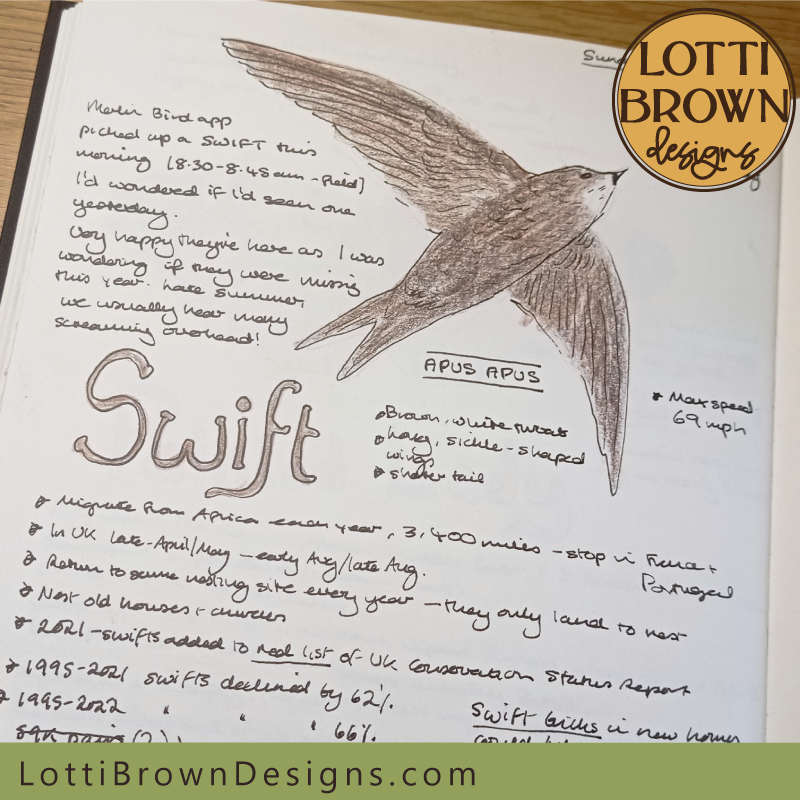 Swift recorded in my nature journal
Because the swifts fly such long distances to feed, their young have the incredible ability to go into a state of torpor for up to 5 days to conserve energy, both as tiny birds and even in the egg – essential when the parents are sometimes absent for several days as they find the best feeding areas.
Once the baby swifts fledge, the young birds get to know local landmarks and territories, racing around in those noisy ‘screaming parties’ that fill the summer skies.
Only a few days after they fledge, the young leave for their long migration to Africa, followed by their parents.
The Migratory Swift
The swifts are only with us for a short time – they normally arrive in April or May and all swifts will have left us by the end of August.
Because of their short stay with us, they are widely viewed as a summer bird, bringing the summer in on their long curved wings – with their departure marking the moment that the hot days of August start to slip towards autumn…
The swift’s migration journey is around 6-7,000 miles, to Africa. They may travel more than 600 miles in a day, and never touch down once. They eat, drink, sleep, and travel entirely on the wing.
And as they fly over the Sahara, they use a special membrane, pulled over their eyes, to protect them from the sand.
Swifts do not breed until their third or fourth summer – and in all those years, they will have lived their whole life in flight and never once landed and may have flown more than 300,000 miles in that time. Over a lifetime, a swift might fly two million miles.
 Swift illustration, print
Saving the Swift
It feels hard to imagine our summer skies without swifts. And yet, these remarkable birds are now in serious decline…
The swift has lived with us in our homes for over 7000 years and these remarkable summer birds have inspired folklore and affection for centuries…
They like to nest in gaps and crevices which are common in older buildings but increasingly rare in more modern buildings.
The population of swifts have fallen by more than 60% between 1995 and 2021 - I know that I’ve personally heard less swifts in the skies over the last couple of years.
At the moment, the complete reasons for this decline are unclear – the loss of insects and build-up of toxins in their bodies may be contributory factors but it’s also believed that the loss of nesting locations is having a big impact on the population.
You can help by:
- Noticing swifts and recording their nesting locations - you can use Swift Mapper to do this
- Installing a swift box - find out how to make your own here
- Using and/or promoting use of swift bricks in new buildings or when renovating - find out more here
- Donating to charities and programmes that help swifts, such as Swift Safe Havens (RSPB)
- Planting wildlife-friendly plants and flowers to encourage insects
- More information about how to help here
Swift Meaning & Symbolism
 Swift drawing, showing detail
In folklore, swift symbolism is closely connected to freedom, movement, resilience and return.
The swift is a remarkable bird – flying millions of miles in her lifetime and living virtually her whole life in flight…
She’s a bird of movement and energy – of arrivals and departures – a life where change is the constant…
The swift is the bird of journeys – a reminder that our lifetime too is our own journey…
And a recognition that, sometimes, you need to travel further than expected to get what you need or find your home.
She’s a bird of soaring highs – bringing screaming joy and hope as she races across the skies.
And yet she also recognises the importance of stillness and rest, even in her busy seasons, as she sleeps motionless even while soaring high above the earth.
Drawing my Swift Art
 Drawing my swift with coloured pencils and pens
I was inspired by the swifts’ screeching summer calls as I drew her soaring high in the summer sky, far over our homes and fields…
Her gentle brown feathers look soft and downy – and I concentrated on the amazing journey she makes each year to return to her spiritual home, here in our British homes and buildings, where she raises her young…
So that they in their turn can take to the skies – seeking adventures across continents – and finally returning to their places of birth to make new generations of swifts.
It’s easy to understand why swifts became such powerful symbols of summer, freedom and return in folklore traditions across Europe.
It’s so important that we cherish these tiny birds that have been part of our lives and traditions for hundreds and even thousands of years.
Swifts feel like one of the great symbols of summer to me - wild, fleeting, joyful, and always in motion.
I wanted my swift artwork to capture a little of that feeling: the freedom of open skies, warm evenings out in the poppy-filled fields - and the restless energy of these extraordinary birds.
If the story of the swift resonates with you, you can find my swift art prints and products in my Teemill store below…
Swift & poppies by Lotti Brown
My swift artwork is available as sustainable art prints, notebooks, greetings cards, tote bags and clothing in my Teemill shop.
 Birds of summer skies
You might also enjoy more of my birds of summer skies:
- swallow folklore & my swallow art
- house martin folklore & my house martin art
- skylark folklore & my skylark art
You can also:
- read about my year of birdsong
- explore the folklore of nature in my folklore hub
- explore my seasonal summer journaling pages
- discover more of my British birds art
- take a look at bird migrations in my April journal pages and September birds nature journal pages
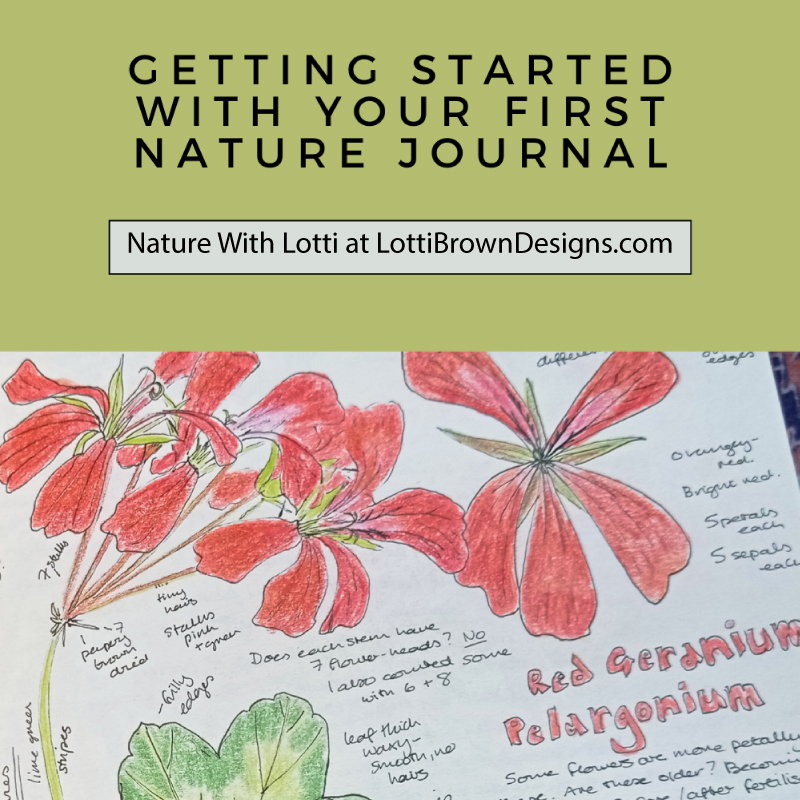
Have you ever thought about nature journaling..?
If you like nature, you might like to start your own nature journal!
Find out all about nature journaling here...
You can get started with my free guide here.
Or explore my gentle self-paced nature journaling course with nature journaling exercises to get you confident with nature journaling - take a look here...
Further Reading/Resources
- Discovering the Folklore of Birds and Beasts - book by Venetia Newell
- The Folk Lore and Provincial Names of British Birds - book by Charles Swainson
- A Dictionary of English and Folk-Names of British Birds - book by H. Kirke Swann
- British Birds: Names - Facts - Myths - book by Geoff Green
- RSPB Bird Tales - Traditional Stories, Folklore & Activities - book by Dawn Casey

Shall we stay in touch..?
Each month, I share stories from my own nature journal, new art from my studio, and simple seasonal inspiration to help you feel more connected with the turning year - if you'd like to stay updated, please sign up with your email address below...
Recent Articles


-
Magpie Folklore and Meaning - Symbolism & Superstitions - Magpie Art
Oct 06, 26 05:02 AM
 Discover magpie folklore, symbolism, and superstitions from around the world. Explore the meaning of this intelligent and mysterious bird.
 -
Nature Journal Prompts
Oct 05, 26 04:42 AM
 Easy nature journal prompts to inspire and encourage you - one per week...
 -
Meaning and Symbolism of Ivy in the Celtic Tree Calendar
Sep 29, 26 05:05 AM
 Explore the meaning and symbolism of ivy as part of the Celtic Tree Calendar...
Shop My Current Artwork Collections

My art is available as sustainable art prints, notebooks, greetings cards, tote bags and clothing in my Teemill shop.
Find my stockists for all my earlier artworks here...

Lotti Brown is a self-taught nature artist and nature journaling educator whose hand-drawn work is inspired by wildlife, folklore, and close observation. With 18 years in creative fields and 10 years creating nature art, she brings deep practical experience to her work. Trained by the Wild Wonder Foundation, she shares nature journaling courses and guides online. Her artwork has been licensed internationally and exhibited at Goole Museum and Bridlington Spa in the East Riding of Yorkshire, UK.
Follow me:
Share this page: