
- Home
- Art
- British Birds Art
- Blue Tit

Blue
Tit Folklore, Meaning &
Hand-Drawn British Nature Art
By Lotti Brown
Explore blue tit folklore, symbolism and seasonal meaning, illustrated with my own hand-drawn British nature art inspired by gardens, hedgerows and spring.
A little flash of blue and a cheeky chirp - you know that there’s a blue tit in your garden!
I love to see these tiny, colourful birds close to home. Each time I notice one, I’m surprised anew by just how small they really are - soft, fluffy, and full of character. They always make me think of sweet little chicks, with their yellow feathers and curious expressions.
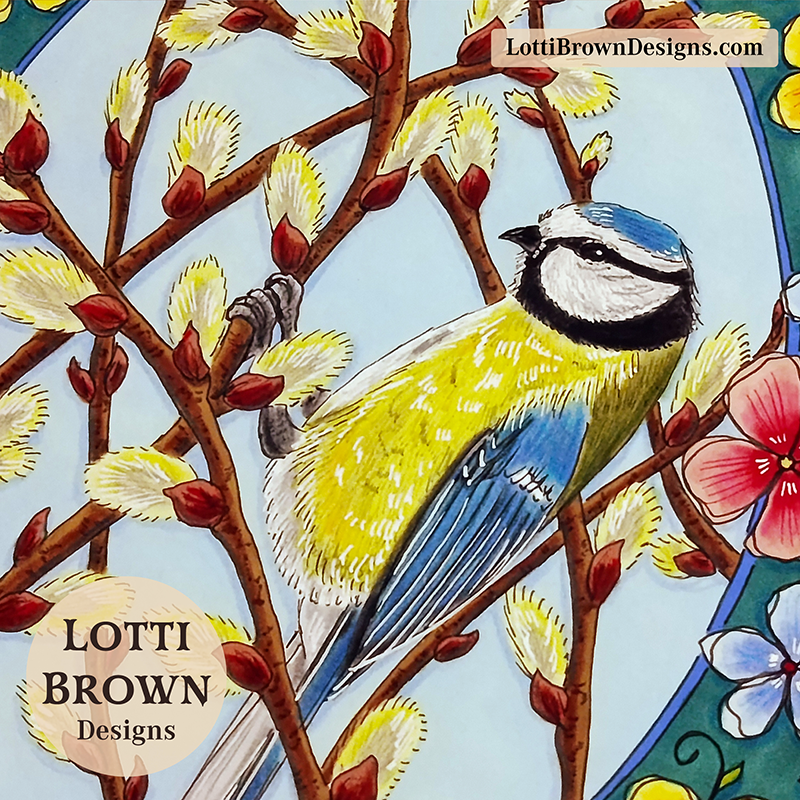 Blue tit art (detail) by Lotti Brown
We sometimes get baby blue tits in our garden, and it’s a quiet joy to watch them learning how to take food from the feeders, practising their landings, and finding their confidence. These small, everyday moments are some of my favourite experiences of watching blue tits at close quarters.
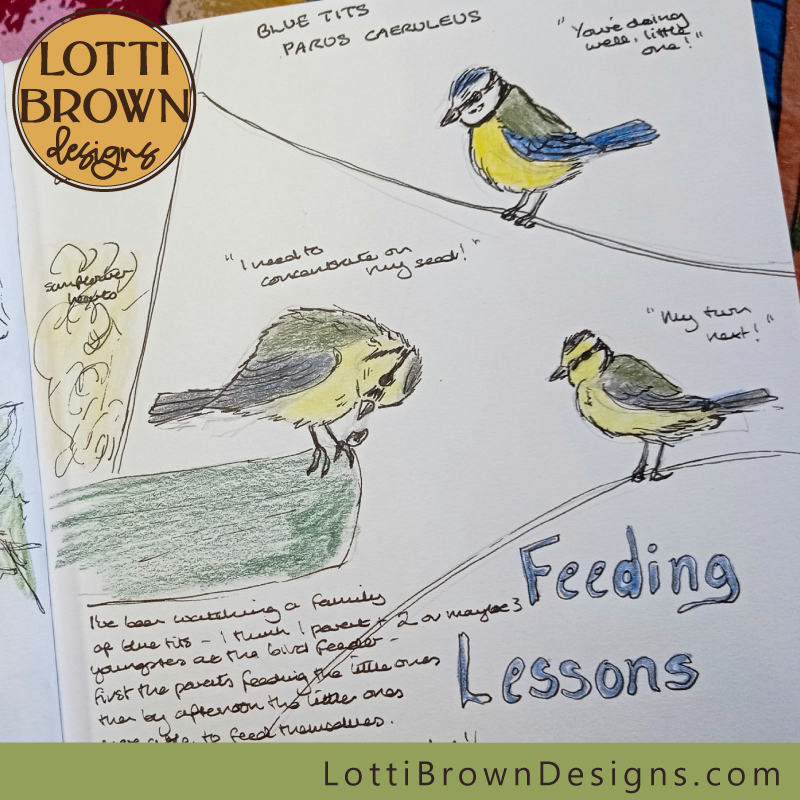 Page from my nature journal - time spent watching baby blue tits learn how to feed from the bird feeder
Blue tits are one of the most acrobatic of all our birds and it’s amazing to see them balance and hang as they flit between branches, searching for food amongst the buds and leaves, or discover prime position on a feeder - it’s no wonder that blue tit folklore is filled with stories of joy, cleverness and care...
Meet the Blue Tit
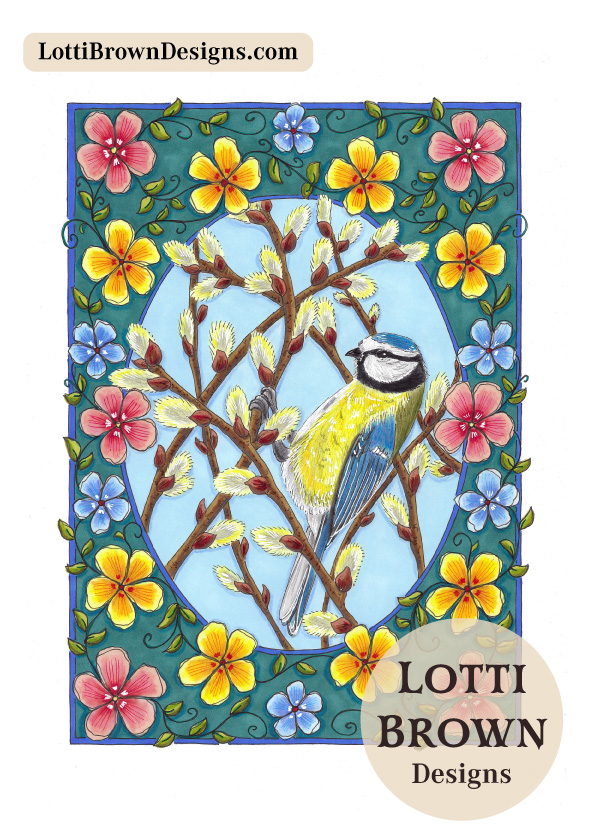 Blue tit and willow hand-drawn art by Lotti Brown
Named for its unusual blue colour, the blue tit was traditionally known as the blue titmouse from the 14th century until the early 20th century.
Confusingly, as it’s a bird and not a mouse, the name ‘titmouse’ was given to birds in the ‘tit’ family, becoming shortened to ‘tit’ in the 20th century to try to avoid such confusion.
- The origins of the name titmouse for birds in the tit family began with the use of the Anglo-Saxon word ‘mase’ (meaning ‘little’) for these little birds – later becoming ‘mose’.
- In the early middle ages, the diminutive ‘tit’ was added to ‘mose’, meaning ‘small’ – so the birds were known as ‘titmose’ (small, little birds) which became ‘titmouse’.
- In the early 20th century, ‘titmouse’ became shortened to ‘tit’ to avoid the obvious confusion between mice and birds – so the blue titmouse is now known as the blue tit.
A Blue Tit by Many Names in British Folklore
The blue tit is a distinctive little bird and also has many common names which let us know how important the blue tit has always been in the lives of the humans that it lives amongst.
Some of the other names for the blue tit are:
For its colour
- Blue cap
- Blue bonnet
- Blue yaup
- Blue ox-eye
- Blue spick
- Bluey
For its chirping call
- Yaup
- Tinnock
- Tidife
- Chintree
- Jitty-fa
- Pedn-paly and Pridden pral – meaning ‘tree babbler’
- Pinchem
For its habit of pecking
- Billy biter or Biting Tom – for its habit of biting anyone who disturbed it
- Hickmall, Hackmal, Heckymal, Hagmal, Hackeymal
- Titmal
Also
- Nun – for its white 'whimpel'
- Tom tit
- Tittymouse
- Jenny tit (or Jenny wren)
- Tiddley – for its small size
- Nope
- Pickcheese – for its liking for pecking cheese
- Pickatee
- Tomnouf
- Ox-eye
- Bee bird – as it’s said to wait at the entrance to beehives to destroy bees as they emerge
A Colourful Bird of Spring & Renewal
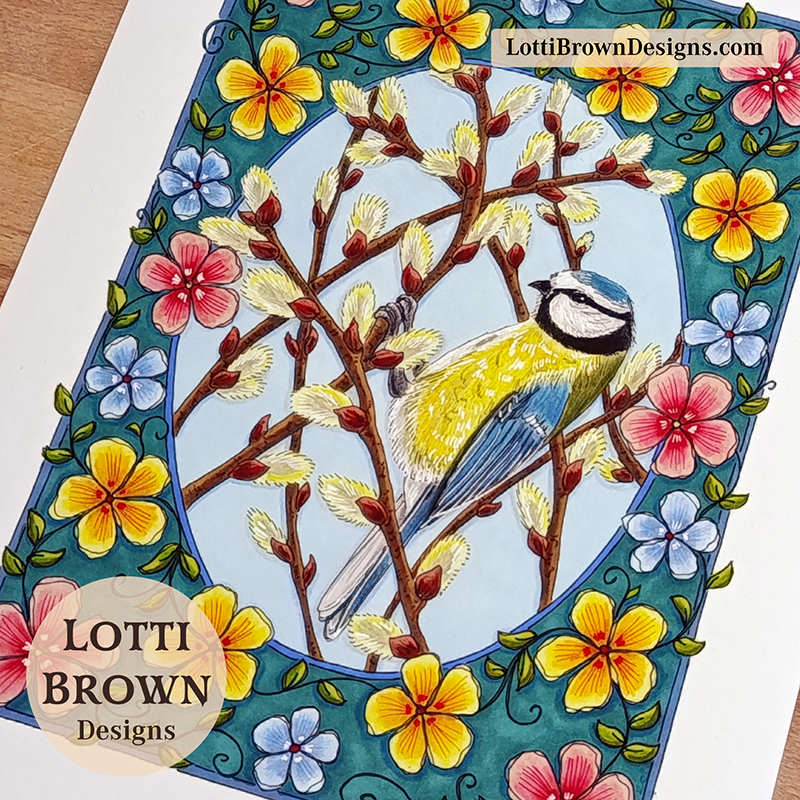 My blue tit hand-drawn illustration (print)
The blue colour of the blue tit is relatively unusual amongst the natural world and it’s attractive, reminding us of the colour of the blue skies of Spring, with the yellow of the sun, meaning that we often associate blue tits with Springtime.
This is particularly so as we are more likely to see blue tits in Springtime, as they have just one brood of chicks per year, but each brood could have up to 14 eggs – and each blue tit chick can eat 100 caterpillars in a single day.
This means that for a few weeks in Spring, the blue tit parents are very busy finding caterpillars and other small insects for their hungry offspring, and we will often be able to see them exploring the new buds, blossoms, catkins and shoots of the trees and hedgerows as they search for more food to feed the chicks and themselves.
The blue colour of the blue tit is also visible on the ultra-violet spectrum – particularly so the male’s blue cap whose vivid blue colouring seen by the female glows with brilliant UV light, helping her choose a mate.
The female also selects her mate according to the strength of yellow on the male’s breast feathers – a diet of many caterpillars turns the feathers a stronger shade of yellow, signifying a male who has the resilience and ingenuity to provide many caterpillars for the family to eat.
The Acrobat Bird
Blue tits are famous for their agility and acrobatics – seemingly hanging upside down with ease - twisting, turning, and flitting between branches effortlessly. I think this is one of the reasons we admire them so much – and it makes a wonderful back garden show just to sit and watch them.
“Lithest, gaudiest Harlequin!
Prettiest Tumber ever seen!”
William Wordsworth
The Milk Thief
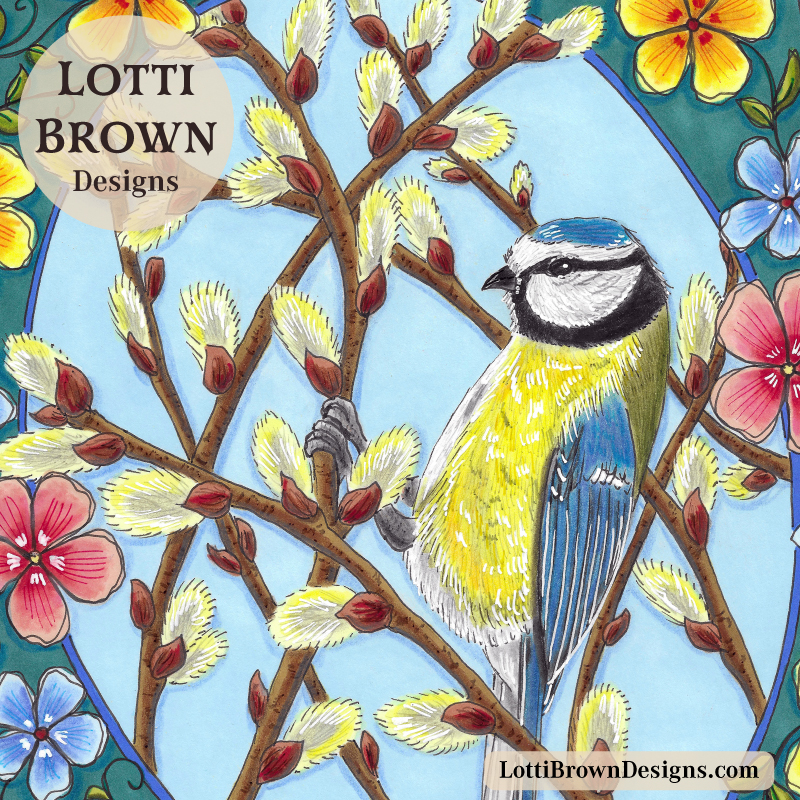 Bluetit illustration detail
Explore the blue tit artwork collection here...
In Britain, blue tits are famous for their habit of stealing milk from milk bottles left outside the front door.
When I was a child, milk was delivered by the milkman and left in glass bottles outside the front door, early each morning, each bottle topped in a shiny silver cap.
Blue tits would peck through the foil cap to drink the cream which had settled at the top of the bottle – the good stuff!
It shows an amazing intelligence and resourcefulness – the true mystery being how blue tits all over the country learned this behaviour…
Blue tits don’t really travel more than a few miles from their home territories, yet behaviour which had first been observed in the 1920s in Southampton had soon spread to the whole country in just 20 to 30 years – likely due to their habits of congregating in flocks in autumn and winter.
These days, however, blue tits don’t steal milk from bottles anymore. Sometime over the past 20 to 30 years, this skill has been lost – likely due to different human buying behaviours, not getting milk delivered in bottles, and not favouring full milk with the cream on top.
The blue tit as the milk thief has become a piece of living folklore - a reminder of how closely we once lived alongside these small wild birds, sharing our doorsteps, our routines, and even the very top of the milk bottle!
The Gardener’s Friend
Blue tits were once blamed for pecking the buds and blossoms of fruit trees, but in fact are very much the gardener’s friend. They are searching for tiny insects and grubs to feed their chicks – and are the perfect little helpers to rid rose bushes of greenfly in the summer.
In this way, the blue tit quietly works in partnership with the garden itself - tending, balancing, and caring for the living world around it.
The Blue Tit as Weather Forecaster
The Blue tit’s cry is said to foretell cold weather...
“The titmouse foretells cold when crying, Pincher”
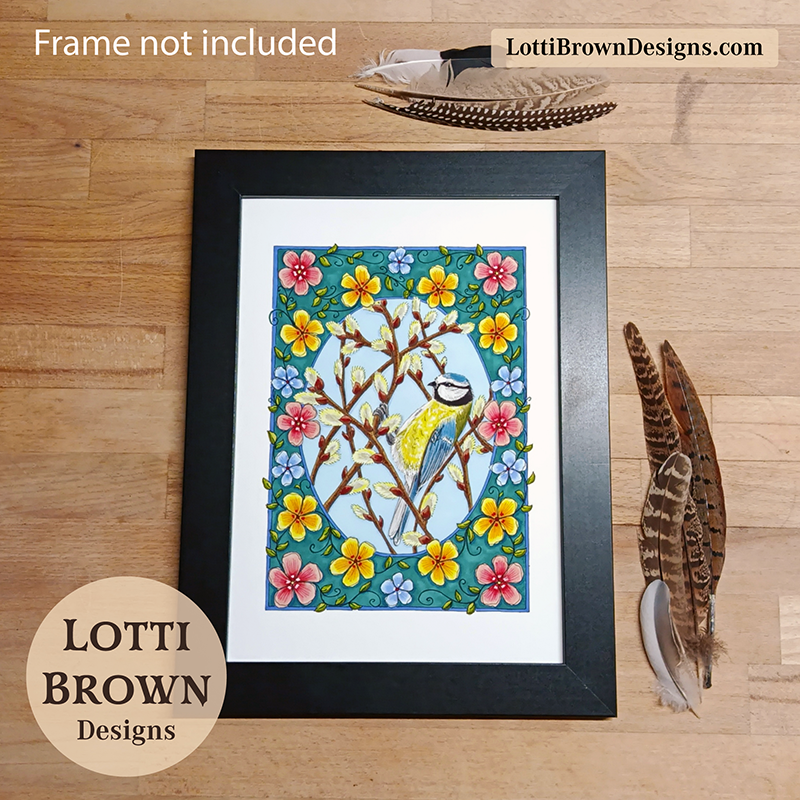 Blue tit art print
German Folktale ‘The Titmouse and the Bear’
Blue tits are well-known for making their nests inside tiny holes in unusual places such as pump handles, boots, or even inside a bottle.
They are also very protective of their nests – a quality which this beautiful German folktale appreciates.
It’s the tale of a bear, trying to get to the young in a blue tits’ nest. As the bear tried to reach inside the nest, the mother and father bird flew around desperately and called out in an attempt to scare the bear away. This attracted the attention of all the other birds around, who all joined in on the attack.
The bear ran off, but swore to return at dawn to fight the birds, alongside his own friends: wolf, weasel, stag, and stoat.
The blue tits gathered together all the flying creatures of the air, and sent the gnat, the smallest, to eavesdrop, unseen, on the bear’s plan.
In the morning, as the animals arrived and charged towards the blue tits’ nest, the hornet flew up to the fox and stung his tail as he held it aloft as he began the charge. The animals, in fear of also being stung, all ran away.
The bear, nursing the defeat, thought about what had happened. He realised that the blue tits were only trying to protect their babies, just as he and his own mate would.
The next day, the bear went gently towards the blue tits’ nest and apologised to them for disturbing their family – and promised never to disturb them again.
This is a lovely tale of family, community, empathy, respect, and a recognition that if we can put ourselves in the other side’s shoes for a while, we might find we’re not so different after all.
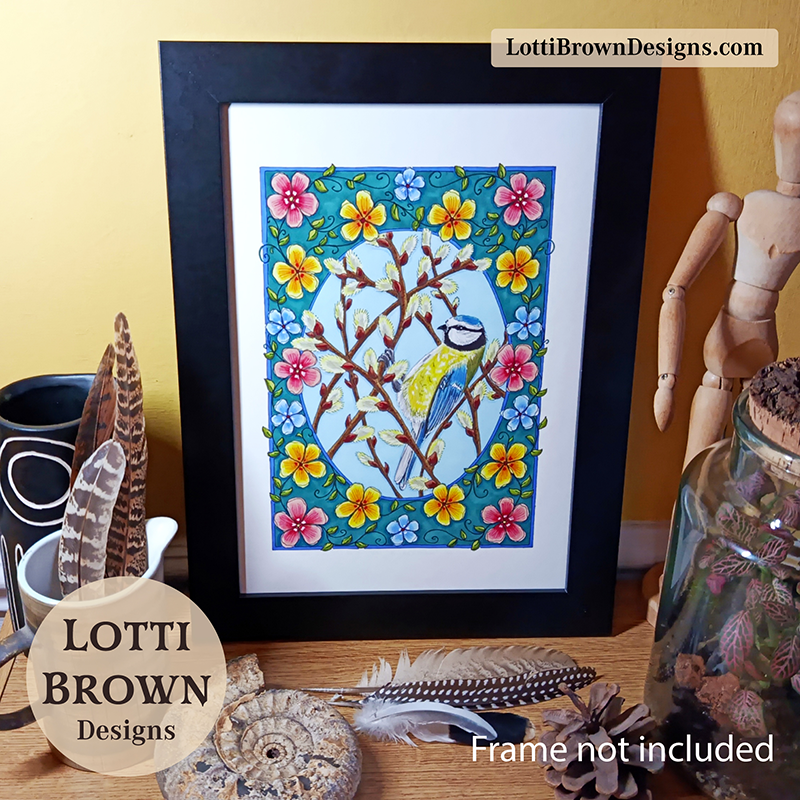 Blue tit art print (in my home)
Blue Tit Meaning & Symbolism
The blue tit is a bird of Spring and renewal – its plumage the colour of blue skies and sunshine, reminding us that brighter days will come again.
The blue tit is a bird of colour, song, joy, and movement – its acrobatics amongst the branches or bird feeders bring admiration, happiness and wonder.
The blue tit is a bird of resilience and intelligence – learning to find sustenance and shelter in the most unlikely places, teaching us to keep going and to sometimes have the courage to think about things a little differently which may help us to find what we seek.
The blue tit is a bird of protection, community and bravery – learning and surviving together.
The blue tit’s symbolism reminds us that joy often lives in small, everyday encounters – a flicker of colour at the feeder, a burst of song from the hedge, a moment of movement and life that lifts the heart.
Clever, resilient, and endlessly curious, the blue tit carries a quiet wisdom about adaptation, care, and community. To notice one closely is to be reminded that even the tiniest lives are full of purpose, beauty, and devotion.
Drawing the Blue Tit
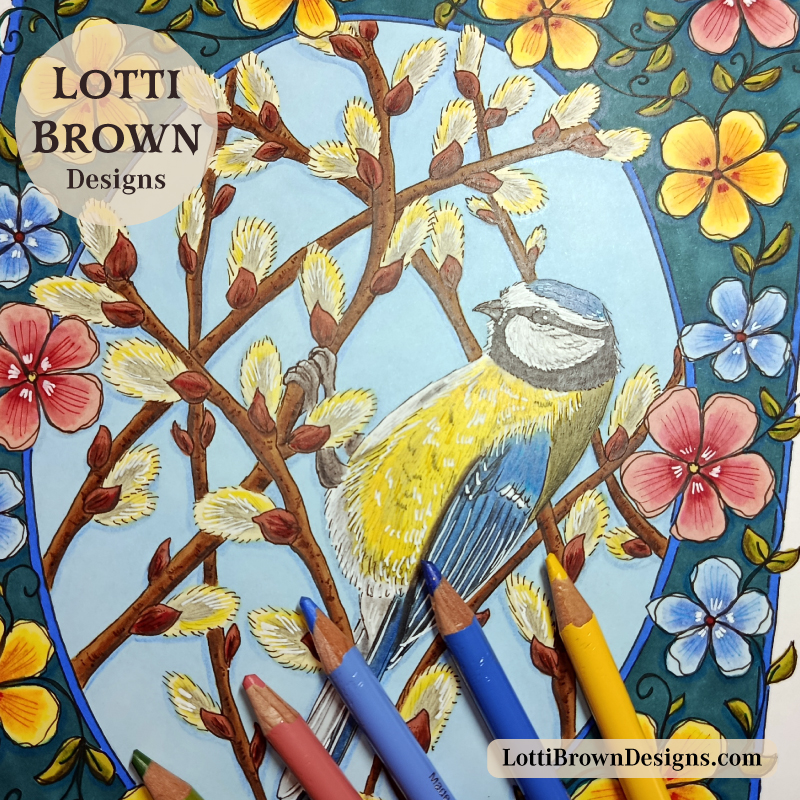 Blue tit art - hand-drawn in coloured pencil and pen
I chose to draw my blue tit together with fluffy yellow catkins from the willow as the fluffy yellow feathers remind me of the catkins and they are both heralds of Springtime, the blue tit searching amongst the catkins for tiny insects.
My hand-drawn blue tit artwork is displaying an acrobatic pose, showing off the agility its famous for, poses which we all know and love.
As I was drawing my blue tit, I found myself thinking about the return of Spring, warmth, and sunshine, and how this marks the busiest time for these amazing tiny birds with their big families, working hard from dawn to dusk to feed and care for their chicks and even taking the time to teach them these same acrobatic skills as the little ones grow up.
Every moment of each day is filled with love and service for these sweet little birds.
My Blue Tit Art Print – Inspired by Folklore
Creating my blue tit artwork, across many days and layers of coloured pencils and pens, reminded me of the countless trips the parents must make to feed their young…
And filled me with joy at the prospect of the coming warm and sunny days of Spring...
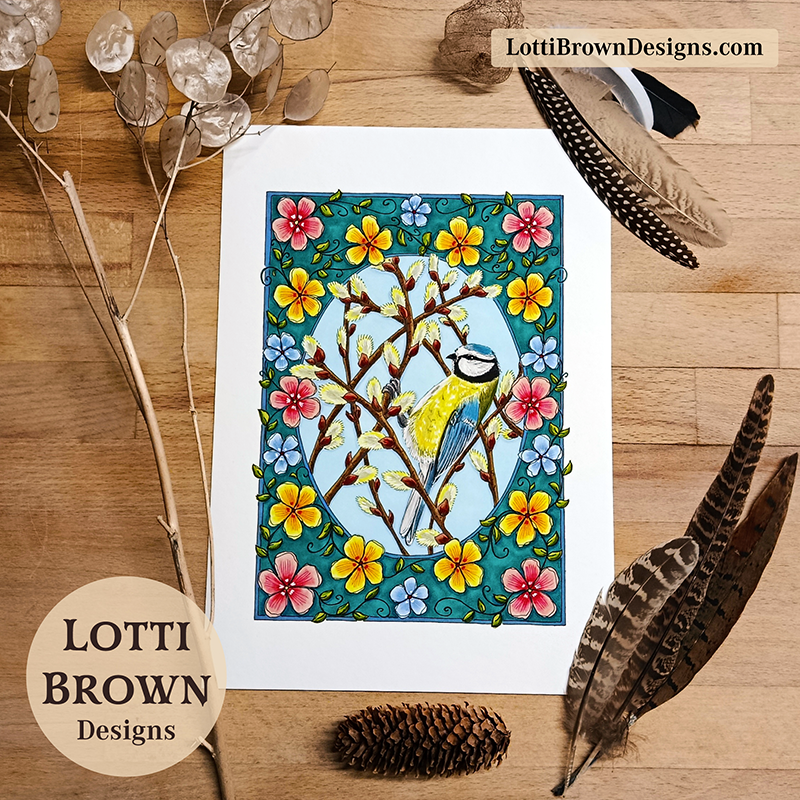 Blue tit art print - from my own hand-drawn artwork
Blue Tit (Curiosity, Lightness, Movement)
If the blue tit has caught your attention - that quick movement, that curious energy - this piece was created to reflect that liveliness.
It grew from watching their constant motion, their lightness as they move through branches and feeders.
Take a closer look at the blue tit artwork collection in my Teemill store
A piece like this brings a sense of lightness and gentle energy into a space.
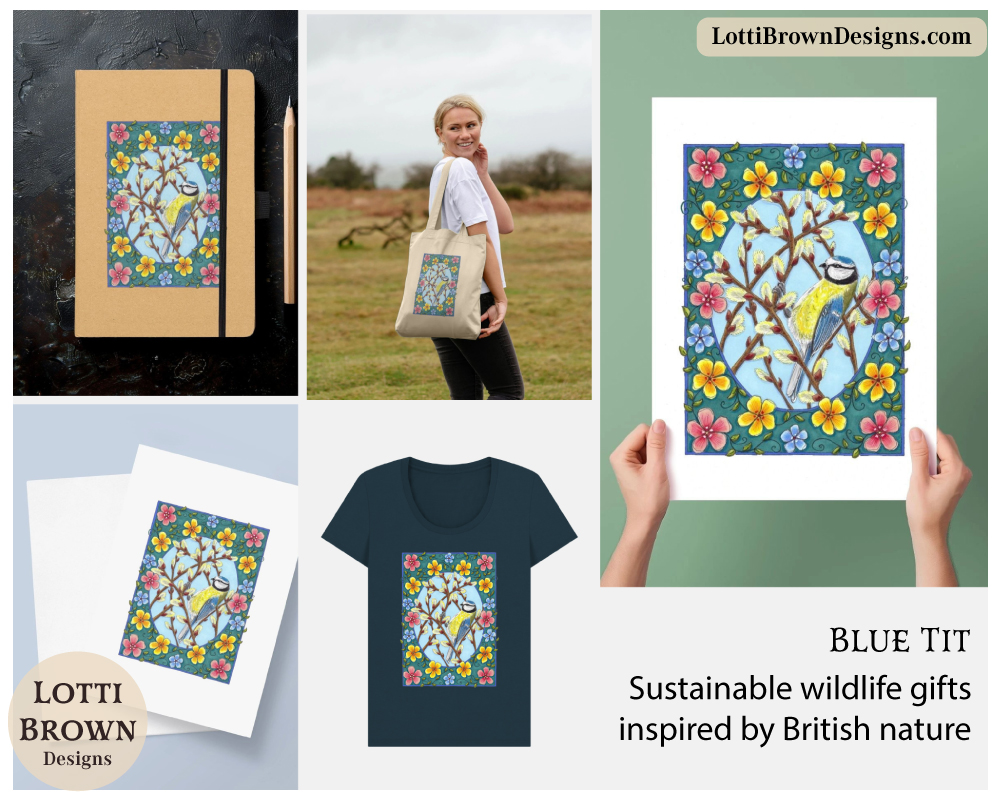
My blue tit artwork is available as sustainable art prints, notebooks, greetings cards, tote bags and clothing in my Teemill shop.
You might also like to explore more British birds folklore in my Folklore Hub, here…
- Wren folklore & art
- Song thrush folklore & art
- Goldfinch folklore, art & nest diary
- Chaffinch folklore and art
- Lapwing folklore and art
- Blackbird folklore and art
- Swallow folklore and art
And see more of my British birds art collection here as well as my earlier bird artworks, as well as wildlife art and Celtic nature artworks here…
You can see all my art here...
If you love nature, you might also enjoy nature journaling – find out more here…
Further Reading/Resources
- The Folk Lore and Provincial Names of British Birds - book by Charles Swainson
- A Dictionary of English and Folk-Names of British Birds - book by H. Kirke Swann
- British Birds: Names - Facts - Myths - book by Geoff Green
- Favourite Garden Birds – 'Dairy Diary' book
- A History of Birds - book by Simon Wills
- RSPB Bird Tales: Traditional Stories, Folklore & Activities - book by Dawn Casey
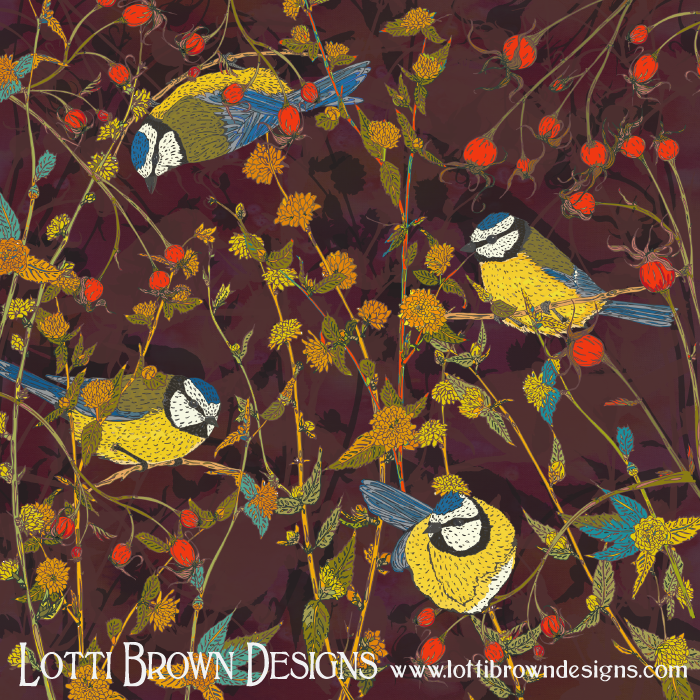
You might also like this earlier blue tits art from 2016, which I created using a mix of traditional and digital art processes - find art prints and other printed products with this art in my Redbubble store here...

Shall we stay in touch..?
Each month, I share stories from my own nature journal, new art from my studio, and simple seasonal inspiration to help you feel more connected with the turning year - if you'd like to stay updated, please sign up with your email address below...
Recent Articles


-
Barn Owl Folklore & Meaning - Symbolism of the Barn Owl
Sep 15, 26 03:34 AM
 Explore barn owl folklore, symbolism and meaning, from ancient myths to British traditions. Discover the quiet wisdom and mystery of this ghostly bird.
 -
Bramble Meaning, Myth & Symbolism - Celtic Tree Calendar Art
Sep 02, 26 11:32 AM
 A look at bramble meaning, myth and symbolism as I share my bramble Celtic Tree Calendar art for the month of 'Vine'...
 -
Nature Journal Prompts
Aug 26, 26 04:05 AM
 Easy nature journal prompts to inspire and encourage you - one per week...
Shop My Current Artwork Collections

My art is available as sustainable art prints, notebooks, greetings cards, tote bags and clothing in my Teemill shop.
Find my stockists for all my earlier artworks here...

Lotti Brown is a self-taught nature artist and nature journaling educator whose hand-drawn work is inspired by wildlife, folklore, and close observation. With 18 years in creative fields and 10 years creating nature art, she brings deep practical experience to her work. Trained by the Wild Wonder Foundation, she shares nature journaling courses and guides online. Her artwork has been licensed internationally and exhibited at Goole Museum and Bridlington Spa in the East Riding of Yorkshire, UK.
Follow me:
Share this page: