
- Home
- Art
- British Birds Art
- Wren Art & Folklore

Wren
Folklore, Meaning &
Hand-Drawn British Nature Art
By Lotti Brown
Celebrating the wren - a tiny winter bird rich in British folklore and symbolism – with my detailed hand-drawn wren art.
On winter days, there’s nothing more magical than the glimpse of a tiny wren bobbing between branches - a treasured spark of life in the hedgerows, darting here and there in search of food.
We may not often see the wren, but we certainly hear her - that bright, rippling song that carries astonishingly far for such a tiny creature. In fact, the wren has the loudest voice for its size of any British bird, despite being one of our smallest birds - weighing less than a £1 coin.
In my little cottage garden, she is a frequent (and very welcome) visitor. I often find her in the fir tree or the acer outside our kitchen window - on frosty mornings, she sips delicately from tiny ice-drops. Once, we were lucky enough to have a wren build her nest in our ivy. It felt like an honour… almost as if we’d been chosen!
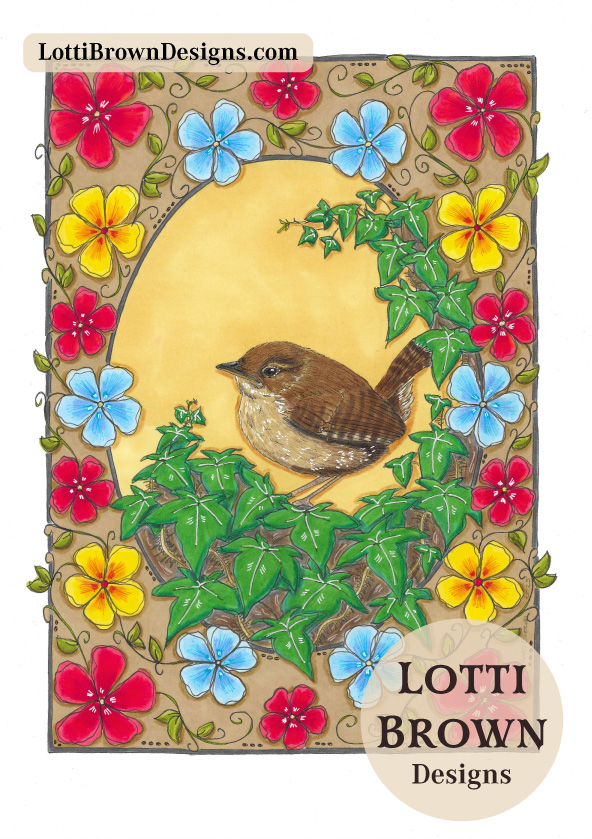 Hand-drawn Wren artwork by Lotti Brown
Meet the Wren - Tiny Winter Bird of British Folklore
Our relationship with the wren stretches back thousands of years, and she features in folklore across Europe and beyond...
The word wren comes from the Anglo-Saxon 'wraenno' meaning lascivious (a playful nod to the wren’s large broods).
Many old names survive:
- Wranny, Wrannock
- Cutty, Scut, Cut (from Welsh cwt — ‘short tail’)
- Puggy Wren, Stumpy Toddy, Bobby Wren, Stumpit
- Tiddy Wren, Tom Tit, Titty Wren, Titmeg
- Cracket, Crackadee, Crackeys, Crackil (for that bright explosive call)
The wren is still often affectionately called ‘Jenny Wren’ and also sometimes took the names Kitty, Tintie, and Sally.
There’s also a long-standing belief that the wren is always female, while the robin is always male - giving rise to the rhyme:
“The Robin and the Wren
Are God’s cock and hen.”
In Scotland she was 'Our Lady’s hen', and in France 'poulette de Dieu' — God’s little hen.
And in much of Europe, the wren is the King of the Birds - whilst in Sweden she was known as the ‘King’s bird’ and in Germany the ‘hedge king’ or ‘snow king’ and in Poland and Ukraine, the ‘mouse king’.…
This leads us beautifully into one of the best-known wren legends…
The Wren as King of the Birds - An Ancient European
Folktale
This wren folklore tale has been told for at least 2,000 years across Europe…
The birds decide that their king must be the one who can fly the highest. Everyone assumes the eagle will win. He soars above all others, beating his vast wings… until a tiny form suddenly rises above him.
It’s the wren - who had hidden in the eagle’s feathers, to quietly conserve strength.
“Birds, look up and behold your king!” the wren cries.
The birds acknowledge the trick, but admit the wren did fly the highest. A second challenge is set - who can descend the lowest? Again, the wren wins by diving into a tiny mousehole.
The eagle, humiliated, flies high in the air, gripping the little bird, and drops the wren from a great height, striking her with his wing as he does so. From that fall, the wren is said to have lost part of her tail and has since never since flown higher than the hawthorn bushes.
The poet Ted Hughes captures the spirit of this myth in his beautiful poem, ‘Wren’:
“The wren is a nervous wreck,
Since he saw the sun from the back of an eagle.
He prefers to creep.”
Because of her trickery, the birds decree the wren must feed only in cracks and crevices - giving rise to her Latin name Troglodytes troglodytes, meaning 'cave-dweller'.
Yet still, she remains the cleverest of the birds, a reminder that wit can outmatch strength.
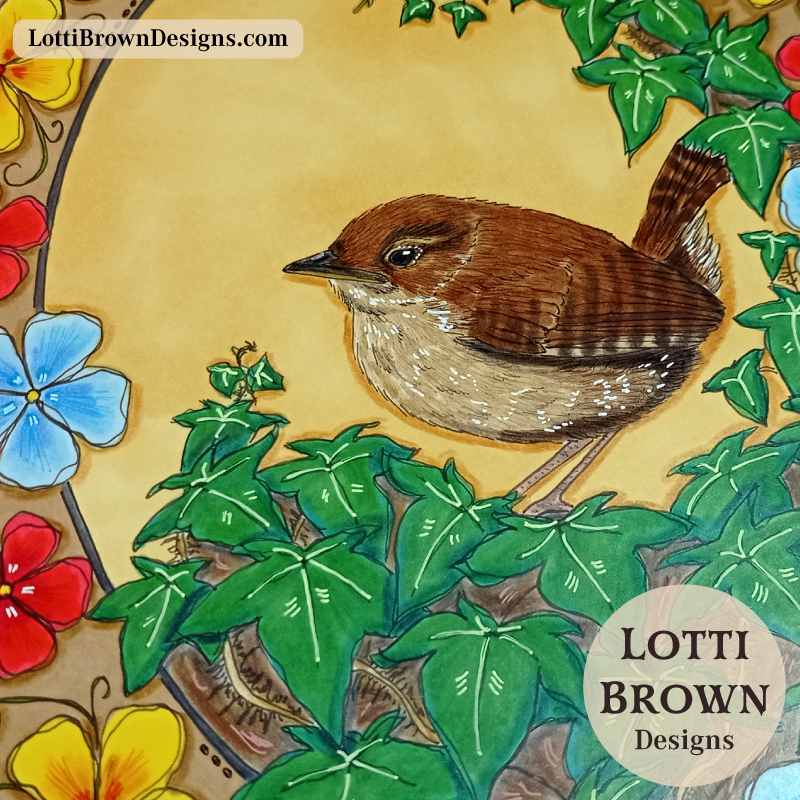 Wren - the cleverest of all the birds - hand-drawn artwork detail by Lotti Brown
The Wren in Celtic Folklore - Sacred Bird of the Druids
The wren appears throughout Celtic folklore and mythology, where she was seen as a sacred bird - a bird of prophecy and wisdom. The Irish word 'dreoilín' comes from the Old Irish dreann, meaning 'Druid bird'.
Wrens were thought to be messengers from the Otherworld. Druids were said to keep wrens for divination.
It was possible to read omens in the direction of the wren’s call:
- From the north: a dearly loved visitor will arrive
- From the south: a fond visitation is coming to you
- From the east: a poet or inspired friend will visit
- From the west: someone unwelcome may be coming
From a Medieval book called ‘Dreanacht’ (Wren Lore)
The wren is also associated with the Celtic giant king Bran, and is sometimes known as 'Bran's sparrow'.
The Wren in Christian Folklore and Holy Traditions
The wren is equally revered in the Christian tradition. She symbolises the Holy Spirit, and medieval writers often call her the divine bird.
Stories tell that the wren was present at Jesus’ birth and brought soft moss and feathers to cover and protect the divine baby in His crib.
One tale describes Saint Malo, who allowed a wren to nest in the hood of his cloak, and watched her raise her babies there.
Another says Saint Calasius spent the night in prayer and thanksgiving when he was so similarly blessed as to have a wren nest in his cloak.
It was thought that a wren family would often return to a nest on Twelfth Night to take part in the holy festival of the Epiphany. This was probably due to the habit of wrens returning to their nests to roost communally during cold winter nights.
The Bird of Fire – A Wren Story from European Folklore
A charming tale of the wren from France tells of the wren as the bringer of fire...
The wren was able to capture fire for mankind from the heavens, but on bringing the fire back to earth, her wings started to burn. She passed the fire to the robin, whose breast was also singed red by the fire. It was the lark who then took over to bring fire to the world – but this is why the wren has such short wings and tail.
Another version of the story tells that the brave little wren lost all her feathers in the quest - but all of the other birds (excepting the owl) each donated a feather to her in thanks - and that is why the wren is said to look scruffy with feathers of different colours and lengths!
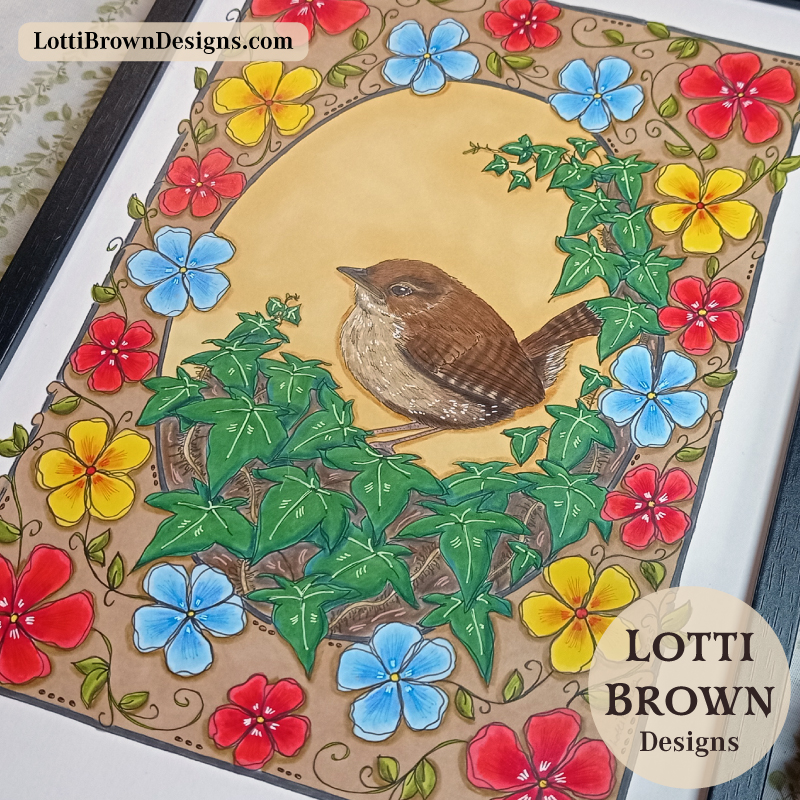 Wren illustration by Lotti Brown
The Wren and Midwinter Folklore - Solstice, St Stephen’s
Day & Ritual
The wren has been woven into winter solstice traditions for thousands of years – possibly dating back to the Bronze Age. These ancient winter tales may be some of the oldest pieces of wren folklore we know…
The wren is protected by lightning (to harm her is to invite disaster), and often nests in oak, the tree most sacred to the Celtic storm god Taranis. This links the wren to fire, renewal, light, and the return of the sun.
The wren once played an important role in the winter solstice rituals - with the wren and holly said to represent the Old Year; and the robin and oak tree, the New Year...
The wren and Holly King would battle against the robin and Oak King in folklore tradition - with the robin and Oak King needing to defeat the wren and Holly King at the winter solstice to carry the turning of the year through into the Spring months.
Communities across Ireland, Wales, and the Isle of Man held 'Wren Day' processions on 26 December (St Stephen’s Day):
- groups carried a wren (or symbolic wren)
- wren feathers were given for luck
- songs were sung door to door
- offerings collected for village needs
It’s thought that the custom eventually evolved into our festive carolling tradition.
In the Isle of Man, there’s a story of a beautiful siren who lured men to their death at sea.
She was captured by a brave knight but managed to escape in the form of a wren.
It’s said that each New Year’s Day she must return to earth as a wren.
The Wren and
Lughnasadh – a Celtic Wren Folklore Tradition
Although the wren is most strongly tied to midwinter, traces of wren folklore appear at the opposite end of the Celtic year too...
In Welsh tradition, the wren is linked to Lleu Llaw Gyffes - a figure associated with the Irish god Lugh, who presides over Lughnasadh, the festival of first harvest on 1st August.
Late July and early August mark the point in the year when wrens fall quiet as they enter their annual moult. This hush in the hedgerows was seen as mirroring the pause of the land after high summer - a moment of stillness before the turning toward autumn, and the time to gather in the crops of the season.
The wren becomes another marker of seasonal change - stitching together the bright abundance of August with the quiet reverence of midwinter.
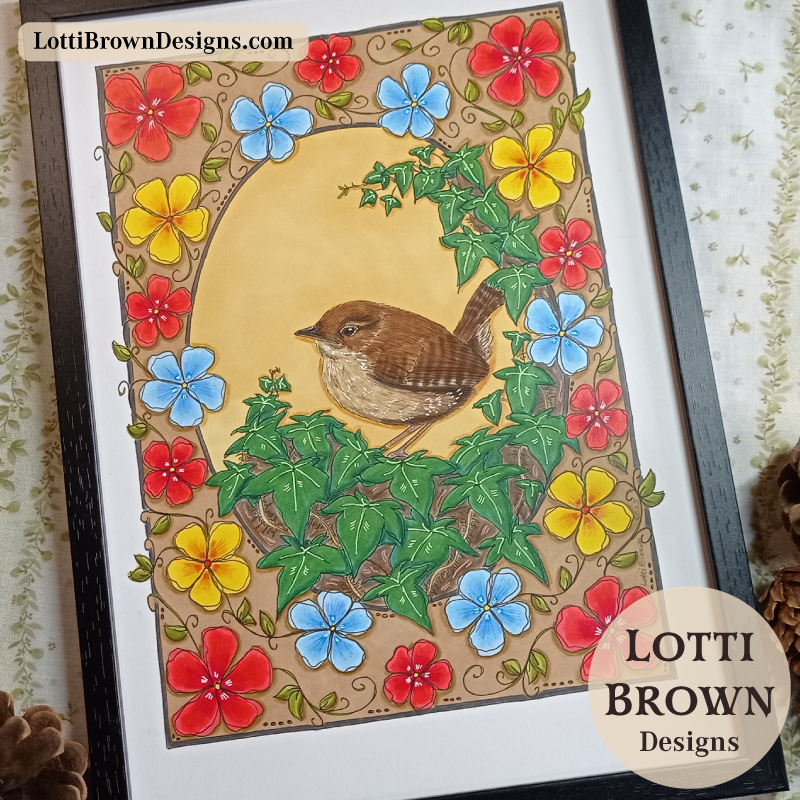 Art inspired by folklore and nature - the tiny wren
Wren Superstitions and Good Fortune in British Folklore
The wren was seen as protective…
To see a wren near your home was extremely lucky.
- A bride who heard a wren on her wedding morning would have a blessed marriage.
- A wren feather could protect sailors, predict fair weather, and even foretell a good fishing catch.
But harming a wren was extremely unlucky - inviting lightning, lingering illness, or house fires. Some even said the hand of he who was guilty would wither!
Wren Meaning & Symbolism - Wisdom, Resilience, Light
& Creativity
Many old traditions link the spiritual meaning of the wren to hope, creativity and resilience…
The wren is:
- Intelligent - using wit and creativity to overcome obstacles
- Resilient - surviving winter through resourcefulness and community
- Spiritual - a messenger between worlds, offering insight and intuition
- Joyful - reminding us to notice the small wonders
- Symbolic of renewal - a herald of the returning light
- Feminine & protective - a talisman of warmth, home, and hearth
She is the small, bright presence who reminds us that courage often comes in tiny forms.
Drawing the Wren
My drawings always begin in my nature journal or sketchbook, where I can work out the composition for my artwork...
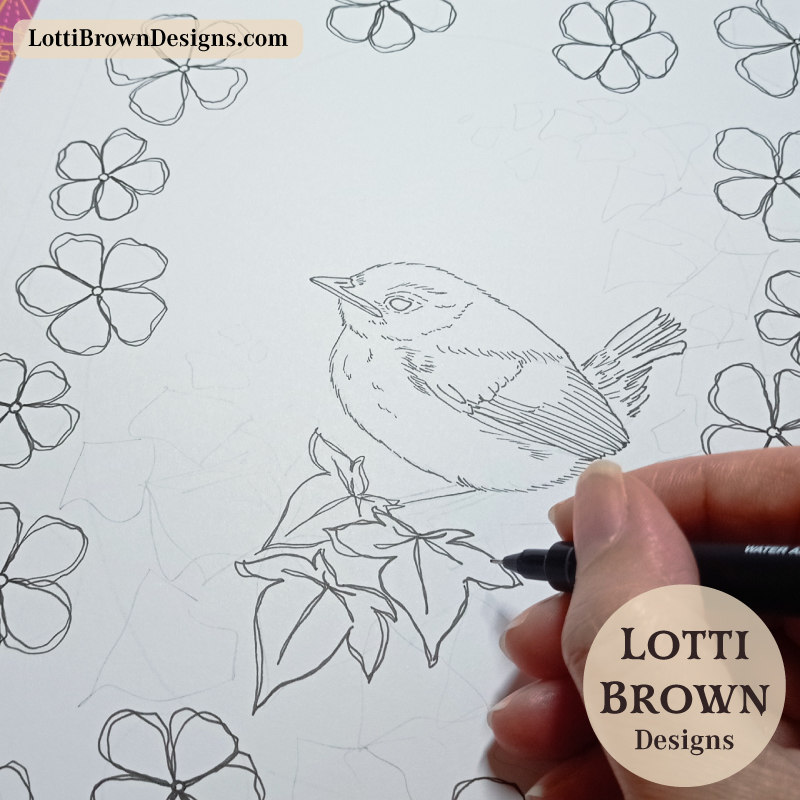 Drawing my wren illustration
I loved drawing my little wren in layers of pens and coloured pencil to build up the depth of colour and add lots of detail to show her perfect tiny feathers...
I placed her nestled among the ivy where she often visits in my garden, and balanced the cool blues of winter with warm touches of yellow and red, - colours of midwinter light and the wren’s ancient association with fire.
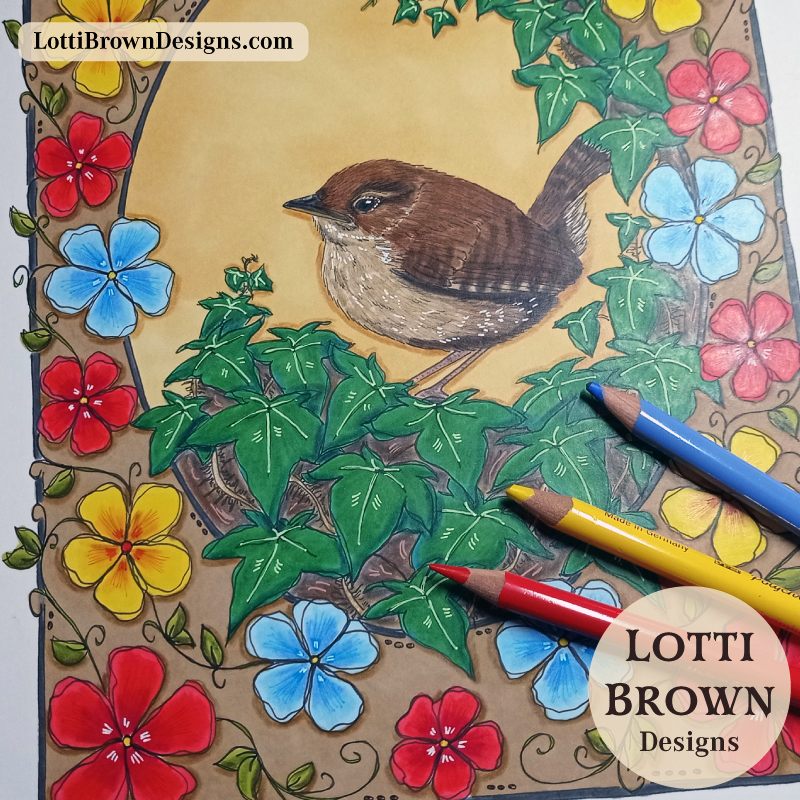 Wren art created by hand in pen and coloured pencils
Even as I drew, I felt her energy - the quickness, the determination, the spark of joy she brings even to the dimmest winter day...
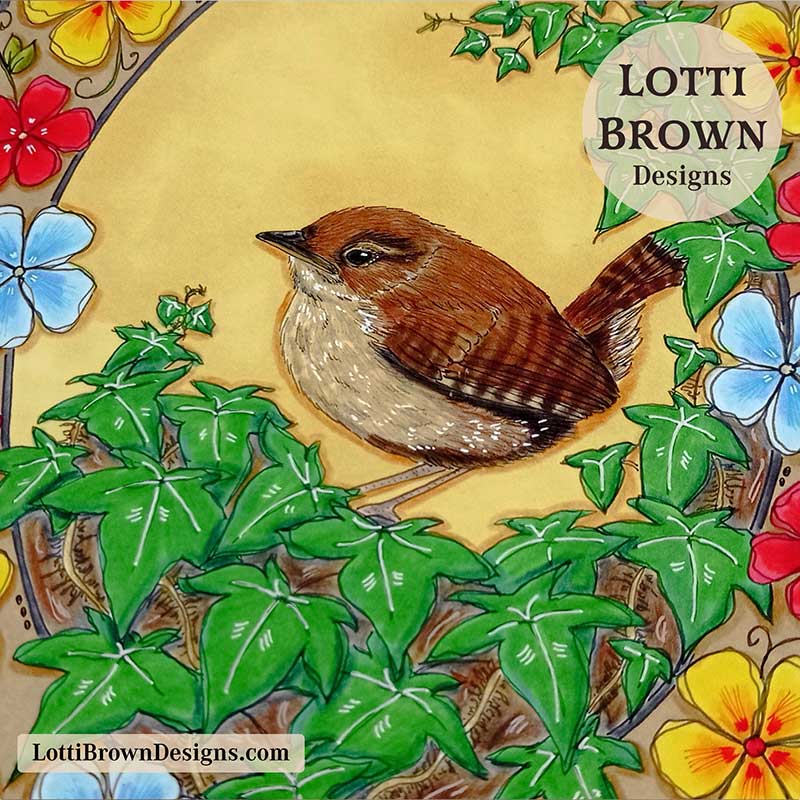 Showing detail from my wren art giclee print
My Wren Art Print
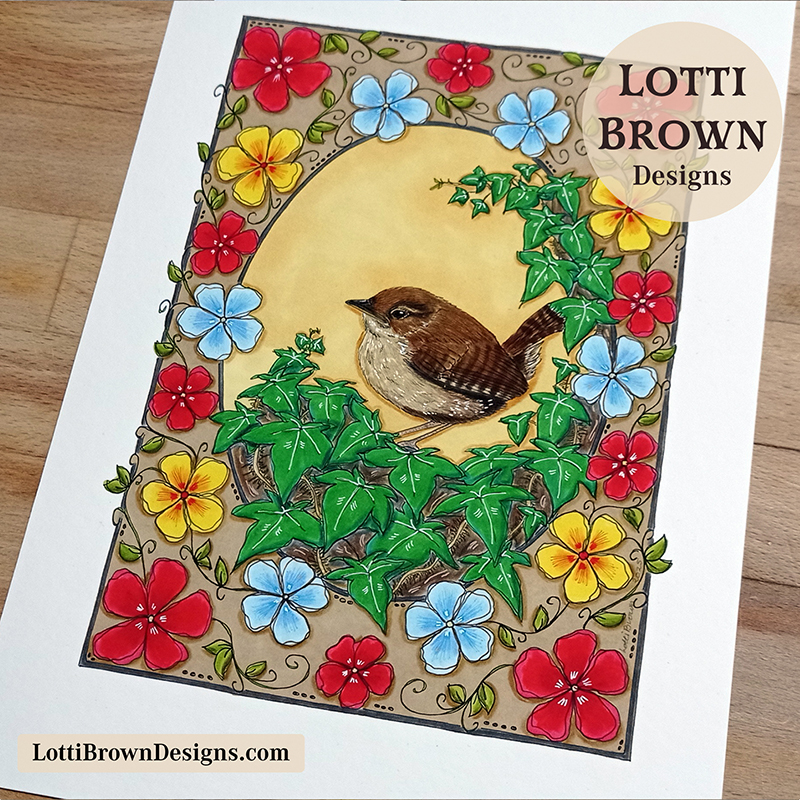 Wren art print, hand-drawn illustration by Lotti Brown, giclee printed on sustainable paper
Wren (Energy, Smallness, Winter Light)
If the energy of the wren has stayed with you - that quick movement, that tiny spark of life in the hedgerows - this piece was created as a way of holding onto that feeling.
It grew from those small moments of observation - the flicker of movement in ivy, the sudden burst of song on a cold morning - trying to capture something of her energy and presence.
Take a closer look at the wren artwork collection in my Teemill store here...
It’s a piece that sits quietly in a space - a small reminder of warmth and life through the winter months.
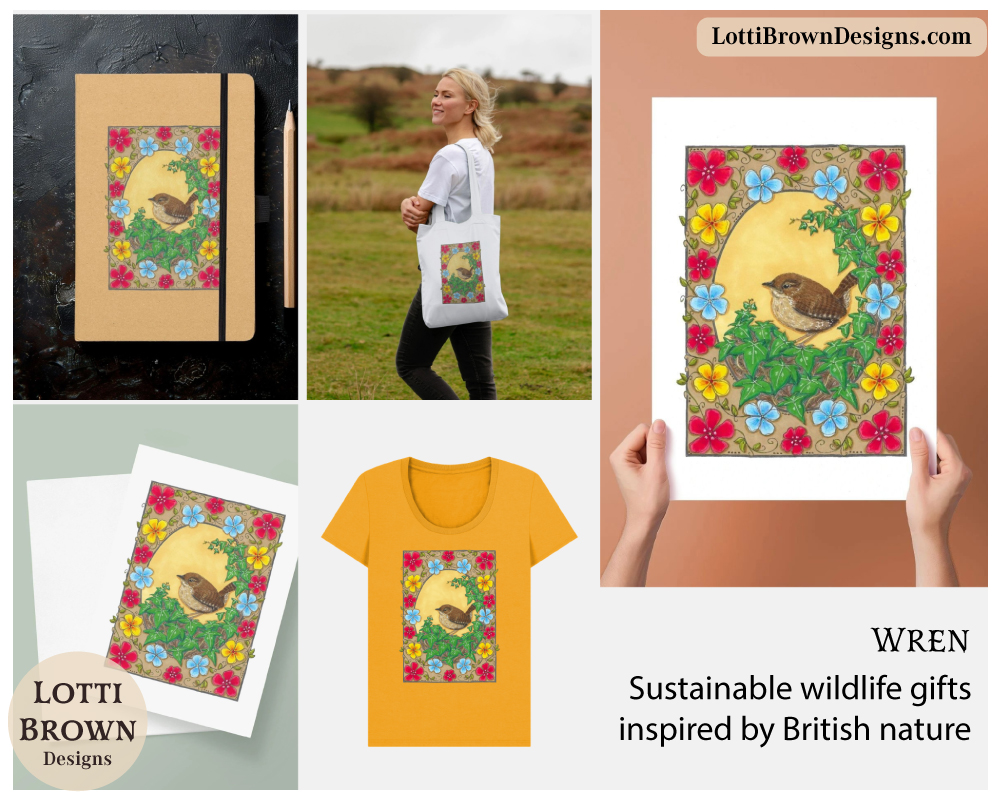
My wren artwork is available as sustainable art prints, notebooks, greetings cards, tote bags and clothing in my Teemill shop.
Explore more folklore, nature & art...
Explore more British bird folklore:
Or wander through the rest of my folklore library - visit my Folklore Hub here...
You can also:
- Explore my seasonal nature journal notes
- Browse more of my hand-drawn British bird art
- See my earlier bird art and Celtic nature artworks
- See all my art here
- You might also like my articles in my Celtic Tree Calendar section
If you love birds, I think you'll like hearing about my year of birdsong - learning to identify birds and listen more deeply...
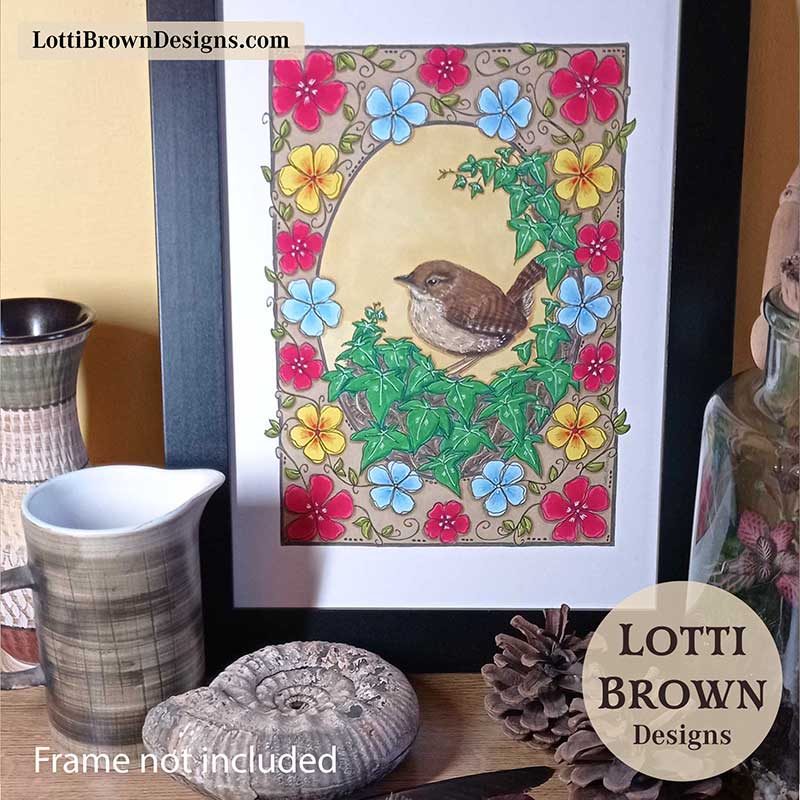 Sustainable giclee Wren art print by Lotti Brown
More Wren Art
If you love wrens, you might also like some of my earlier wren artworks...
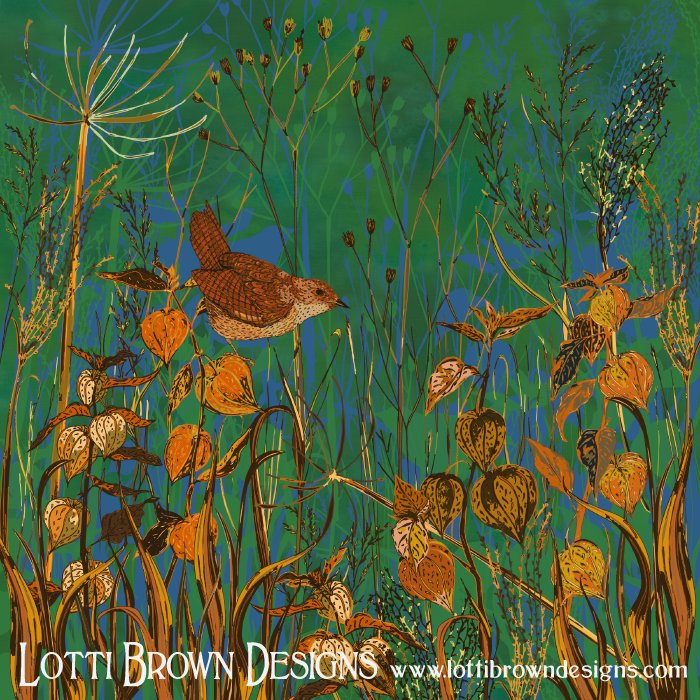
Explore 'Wren & Physalis' prints & products here
International delivery from my Redbubble store
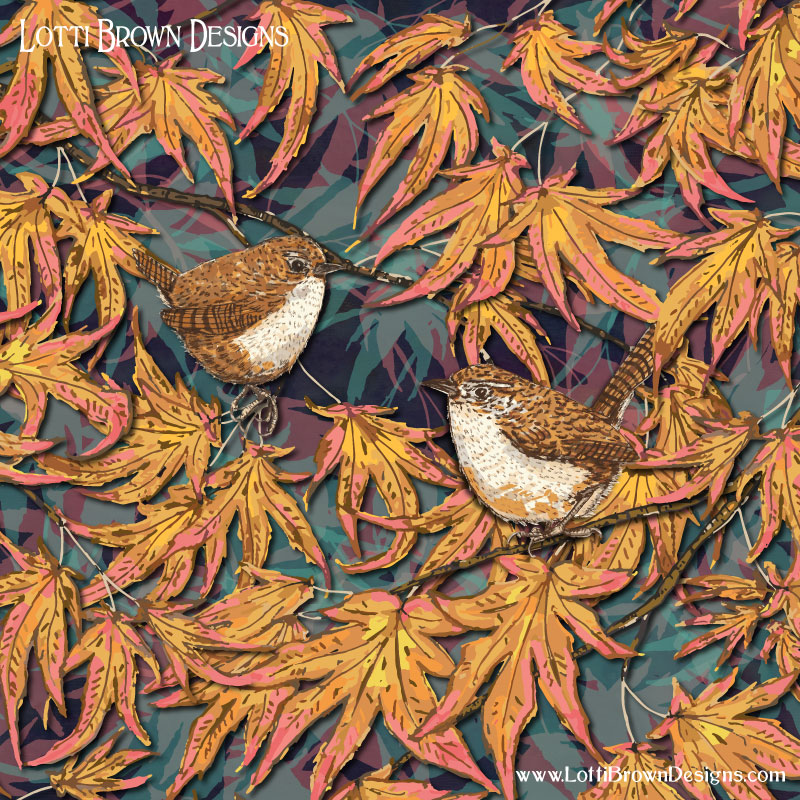
Explore 'Wrens in the Acer' prints & products here
International delivery from my Redbubble store
Have you ever thought about nature journaling..?
If you like nature, you might like to start your own nature journal!
Find out all about nature journaling here...
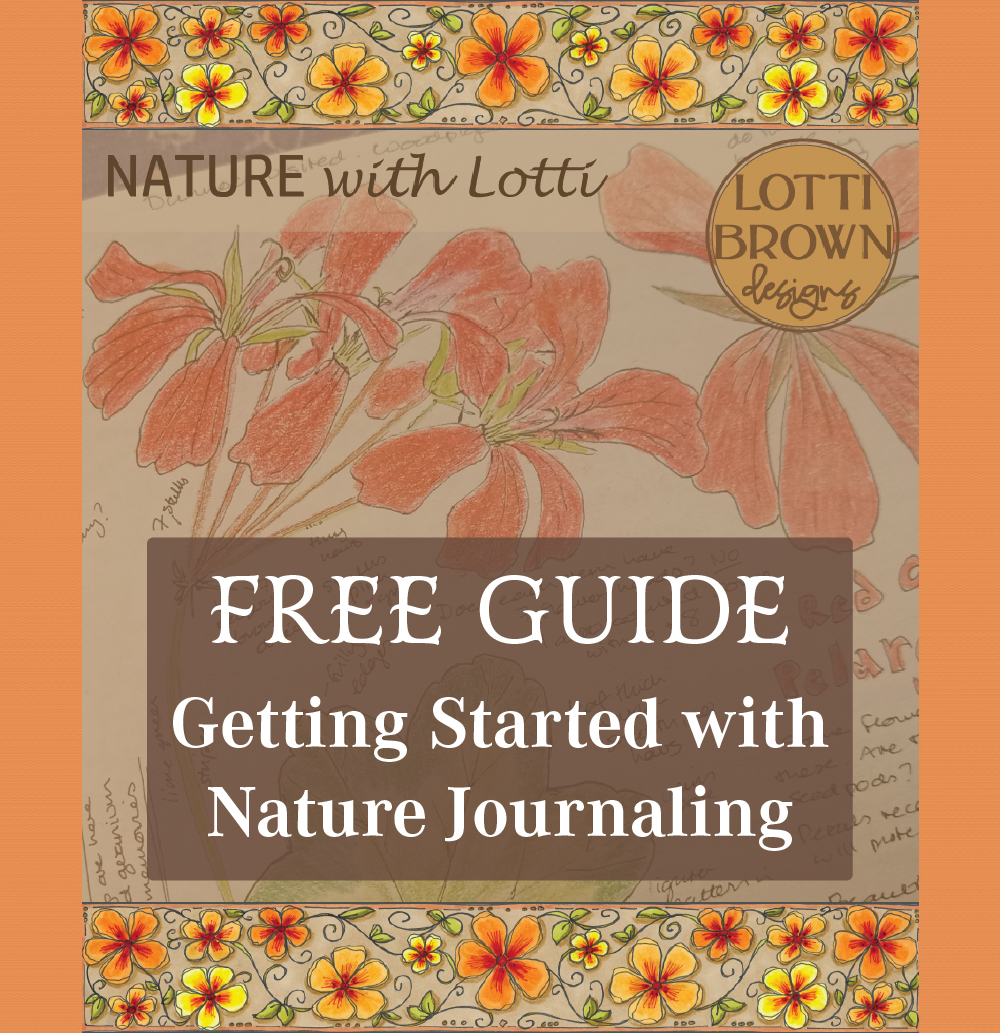
You can get started with my free guide here.
Or explore my gentle self-paced nature journaling course with nature journaling exercises to get you confident with nature journaling - take a look here...
Resources/Further Reading
- Discovering the Folklore of Birds and Beasts - book by Venetia Newall
- The Folk Lore and Provincial Names of British Birds - book by Charles Swainson
- A Dictionary of English and Folk-Names of British Birds - book by H. Kirke Swann
- British Birds: Names - Facts - Myths - book by Geoff Green
- RSPB Bird Tales - book by Dawn Casey
- https://www.maryjones.us/ctexts/auguries2.html - web article 'Two Tracts of Augury' by Mary Jones, accessed 9th December 2025
- https://oldeuropeanculture.blogspot.com/2016/12/wren-or-wran.html - web article 'Wren or Wran' accessed 9th December 2025

Shall we stay in touch..?
Each month, I share stories from my own nature journal, new art from my studio, and simple seasonal inspiration to help you feel more connected with the turning year - if you'd like to stay updated, please sign up with your email address below...
Recent Articles


-
Nature Journaling in Scotland - Wildlife, Sketches & Memories
Sep 24, 26 04:37 AM
 Explore nature journaling in Scotland through wildlife encounters, sketches and found treasures, with gentle ideas for recording holiday memories your own way.
 -
Barn Owl Folklore & Meaning - Symbolism of the Barn Owl
Sep 15, 26 03:34 AM
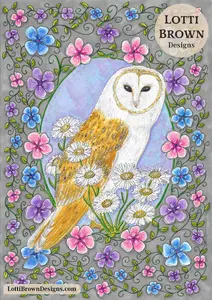 Explore barn owl folklore, symbolism and meaning, from ancient myths to British traditions. Discover the quiet wisdom and mystery of this ghostly bird.
 -
Bramble Meaning, Myth & Symbolism - Celtic Tree Calendar Art
Sep 02, 26 11:32 AM
 A look at bramble meaning, myth and symbolism as I share my bramble Celtic Tree Calendar art for the month of 'Vine'...
Shop My Current Artwork Collections

My art is available as sustainable art prints, notebooks, greetings cards, tote bags and clothing in my Teemill shop.
Find my stockists for all my earlier artworks here...

Lotti Brown is a self-taught nature artist and nature journaling educator whose hand-drawn work is inspired by wildlife, folklore, and close observation. With 18 years in creative fields and 10 years creating nature art, she brings deep practical experience to her work. Trained by the Wild Wonder Foundation, she shares nature journaling courses and guides online. Her artwork has been licensed internationally and exhibited at Goole Museum and Bridlington Spa in the East Riding of Yorkshire, UK.
Follow me:
Share this page: