
- Home
- Art
- British Birds Art
- House Martin Folkore & Art

House
Martin Folklore & Meaning
Sacred Bird of Home and Summer
By Lotti Brown
House martin folklore is filled with stories of home, belonging and summer's return. Explore myths, symbolism and traditions surrounding this cheerful little bird and its remarkable journeys.
With their cheerful chattering, the house martins swoop in, bringing spring and summer on their wings…
Walking in fields of barley near my home, summer evenings are filled with their happy trilling and I love to watch them swoop low along with the swallows as they chase insects to feed on.
Sometimes, as I sit in my garden, I hear them chatter high overhead and see them soaring high in the sky – house martins typically feed higher in the sky than swallows.
 House martin art by Lotti Brown
House martins hold such memories of childhood for me. I was lucky enough to live in a home in Wales that played host to a house martin nest, and sometimes two or three.
To feel them swooping alongside you, hearing the soft whisper of their wings, as you stepped into the house – their sweet chattering like a greeting and a ‘welcome home’. This felt like part of home and part of summer.
Their return each spring felt reassuring somehow – a promise that the seasons were turning as they should, and that summer had found its way back to us once again.
My current home isn’t lucky enough to host any house martins, but I’m still grateful to see them fly, around here, on their brave little wings – as agile in the air as a swallow but less showy…
House martins are not just swallows' dowdy little cousins – they’re impressive and beautiful birds in their own right and have a cherished history alongside us as our companions, friends, and neighbours.
House martin folklore is filled with stories of luck, home, protection and the return of summer, reflecting the affection people have long held for these cheerful little birds.
House Martin – What’s in a Name?
House martins are named from the common name Martin – thought to be the first bird so affectionately named as if human, and perhaps named after Saint Martin of Tours.
His day, November 11th, is Martinmas, and it’s possible that the house martin’s seasonal departure on their migration was around this time.
By the 16th century, the bird was known as the ‘rok martinette’ (rock martinet) and ‘chirche martnette’ (church martinet) – signifying that they once nested in rocks or cliffs but also in human buildings, such as churches.
Another common name based around martin was ‘martlet’.
They are a cousin to the swallow, both in the ‘hirundine’ family of birds – and many names acknowledged their similarities but identified this bird according to its usual nesting locations around our homes:
- Swallow
- Martin swallow
- Window swallow
- Eaves swallow (or Easin swallow)
Finally becoming known as the house martin in more recent times, recognised globally as the common house martin, western house martin, or northern house martin.
The house martin’s Latin name is Delichon urbicum. Delichon is actually a fun anagram of the Greek word chelidon (khelidon) meaning swallow - and ‘urbicum’ means from the town – so Delichon urbicum means ‘town swallow’.
In the Celtic world:
- the traditional Welsh name for the house martin is ‘Gwennol y Bondo’ – ‘the swallow of the eaves’ – signifying where the bird lives
- the traditional Gaelic name is ‘Gobhlan-taighe’ – ‘house fork’ – relating to the birds forked tail
- the traditional Irish name is ‘Gabhlan-binne’ – ‘gable fork’ – bird with forked tail who lives in the eaves.
House Martin Folklore – Our Friend and Neighbour
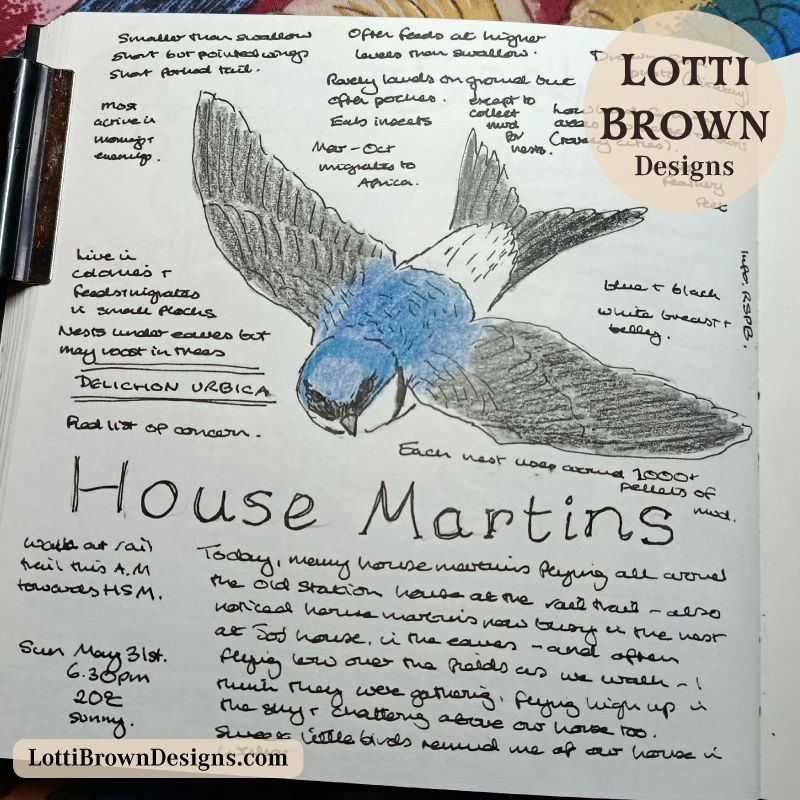 House martin, drawn in my nature journal
Simply from the name of the bird, we can see how house martins have lived alongside us for hundreds of years.
A home where house martins nested – building their remarkable mud homes beneath the eaves – was considered blessed…
This home could consider itself peaceful and happy, filled with luck and prosperity and benefiting from protection against fire and lightning.
Three house martins on your roof was said to be a sign of good fortune or good news.
Destroying a house martin’s nest was believed to bring misfortune to the home.
House Martin Symbolism and the Sacred Bird
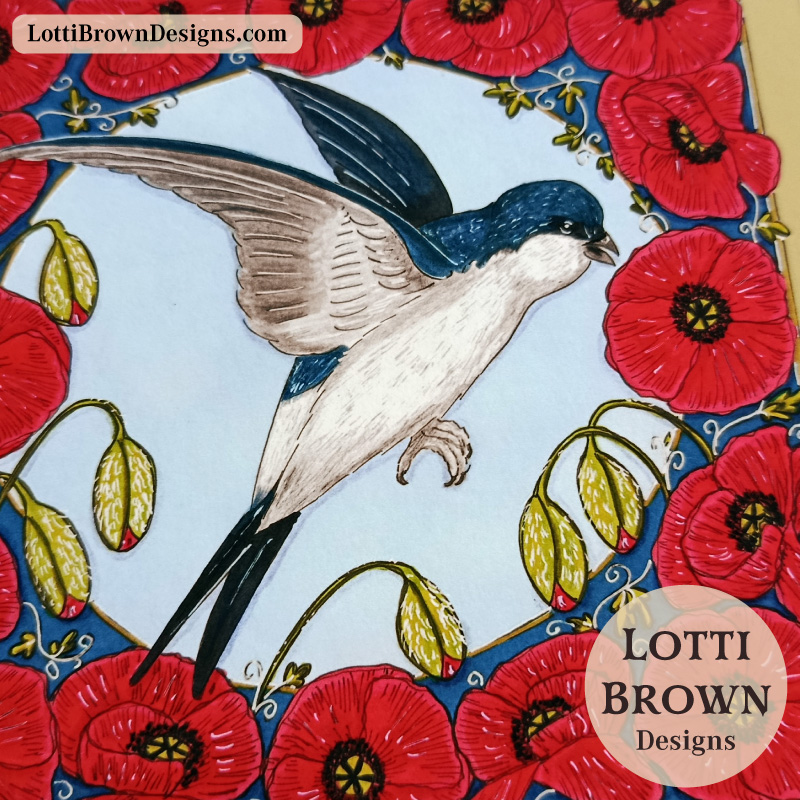 House martin art print - showing detail
The house martin itself was considered a blessed bird, one of God’s most beloved creatures and blessings were given where it made its home.
It’s white breast meant the house martin was holy and believed to be a creature of light.
Many similar folk rhymes show how sacred the house martin was believed to be:
“The martin and the swallow,
Are God Almighty’s bow and arrow.”
These two birds were also considered to be God’s scholars, holy birds, and companions in other versions of the rhyme.
And Shakespeare’s words in Macbeth echo such a sentiment:
“This guest of summer,
The temple-haunting martlet, does approve,
By his loved mansionry, that the heaven’s breath
Smells wooingly here. No jutty, frieze,
Buttress, nor coign of vantage, but this bird
Hath made his pendant bed and procreant cradle.
Where they most breed and haunt, I have observed,
The air is delicate.”
So revered was this little bird, that it’s said that when nesting house martins did not return to the eaves of the church of St Mary and All Saints in Bingham, Nottinghamshire, parishioners had a sculpture of a nesting house martin carved into the church porch in order to ensure their holy building remained blessed by the bird’s presence.
Noah and the House Martin
It may be due to this charming story of Noah and the house martin that the little bird is considered so sacred and welcomed to our homes and community buildings.
It’s said that in the ark, the house martin was especially liked as a clean, co-operative and friendly bird who brought comfort to the people of the ark through its cheerful chattering. When the ark found land and the people and animals left, the house martin found it had grown fond of humans and wanted to remain near them…
Noah was happy to grant the little house martin permission to ever after live alongside humanity and build his nest on human structures.
Even today, house martins live alongside us as neighbours sharing our homes – and, for anyone who has been lucky enough to have a nest on their home, considered as cherished guests and friends.
The House Martin’s Nest
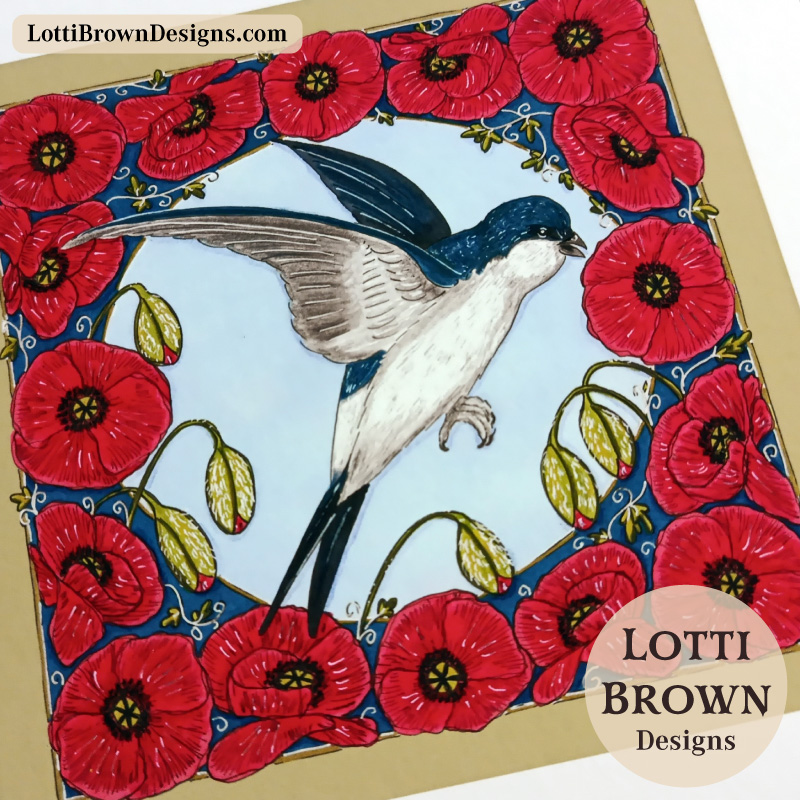 House martin and poppies art
The house martin’s nest is a remarkable feat of engineering – built from over 2,500 tiny globules of mud collected by the two parents’ beaks – and managing to cling between a vertical wall and roof overhang – holding their little family of chicks.
Many nests are used over several years – and most nests will last more than one year, with birds returning to their favoured site to rebuild and repair the nest when they return in Spring.
House martins land on the ground only to collect the mud they need for their nests – their feet are shaped for clinging vertically, so while they can land, they seldom take a single step on the ground.
Most other materials for their nests, such as feathers, straw and grasses are caught in the air. A nest may take around 2 weeks to build from scratch, but repairs to an old nest mean a nest may be ready within just 3 to 5 days.
It’s said that house sparrows are sometimes tempted to take over a house martin’s nest – folklore has it that a house martin may take revenge by ‘plastering-in’ the sparrows as they continue to build up the nest in mud...
In actual fact, sparrows can only move into a partially completed house martin’s nest – once the nest is completed, the tiny hole that suits the house martin is too small for the house sparrow – so they better move out fast!
House martins love their families – and one nest can soon become a whole colony, with one nest built on top of another – sometimes they build an annex nest for the youngsters of their first brood of the season, who will stay nearby to help with subsequent broods in later weeks.
House Martin Heraldry
In the language of heraldry, the house martin is known as the ‘martlet’ and shown on coats of arms as a bird without legs.
The myth of the house martin was that it was born without feet and could never land on earth – in fact, the house martin does have feet on short feathery legs, feathered to keep him warm as he climbs to high altitudes to feed, migrate, and even sleep.
He rarely lands on the ground, although he perches on wires and roosts in trees outside of breeding season - descending to earth just to gather mud for the nest.
It’s easy to see why this bird of the heavens was considered so holy it lived in the skies and rarely descended to earth.
The martlet symbol on a coat of arms was often used for a fourth son in an aristocratic family, who had no claim to the family estate. The martlet showed that the son had no ground to rest on and would have to make his own way in the world.
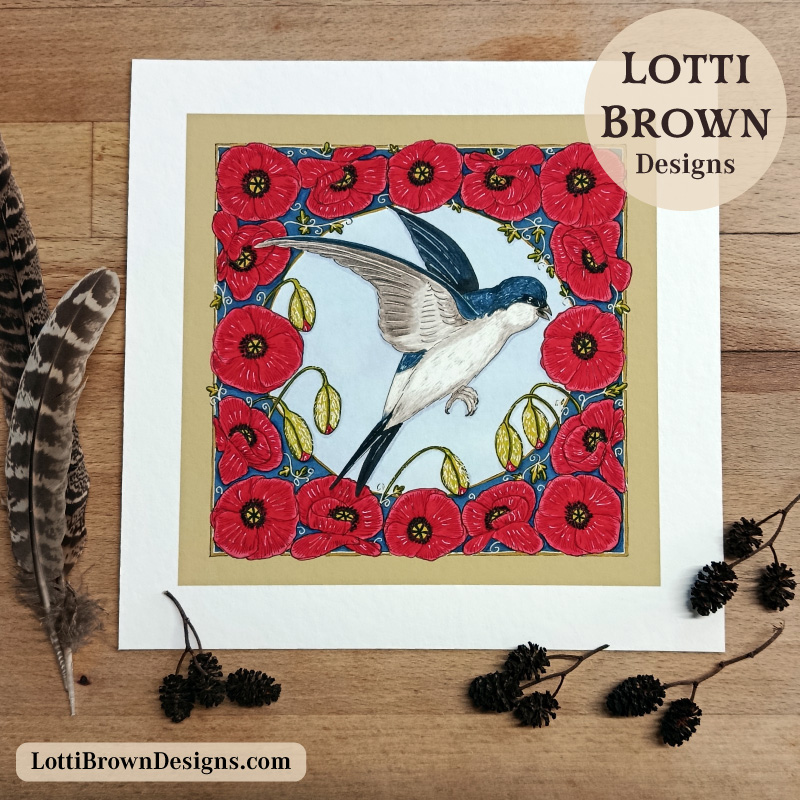 House martin illustration
View the house martin artwork collection in my Teemill store
House Martin Migration Folklore
The house martin arrives in Spring, along with the swallow, and in autumn often gathers on wires with the swallow as it awaits its migration departure.
Most house martins will have left Britain by September or October. It was once believed, along with the swallow, that house martins did not migrate but instead hibernated underwater in pools and rivers, as flocks were seen roosting in reedbeds.
We now know that house martins take a route through France and Spain to overwinter somewhere in the south and/or west of Africa, south of the Sahara.
It’s a modern mystery that we still don’t know exactly where house martins spend the winter. It’s known that house martins often fly at a high altitude so it’s thought that they may fly and roost high in the skies, possibly up to 1km altitude, even sleeping on the wing.
Another possibility is that they find their way to remote African rain forests where they feed on insects high above the tree canopy, away from human sight.
It’s amazing that with our modern technology, this little bird is able to disappear for half the year and we don’t know where it’s gone – a mystery worthy of myth…
Perhaps this sacred little bird has flown back to the heavens after all!
There is something comforting in knowing that even now, when so much of the natural world feels mapped and measured, the house martin still keeps some secrets of its own.
We will surely welcome him home as he returns from his epic voyage in Spring.
Soul Bird of Freedom
In Ancient Egypt, the house martin was one of the birds considered the ‘menet’ bird – a bird symbolising freedom and the human soul.
The menet was considered the daughter of Ra, the sun god - and was sacred to the goddess Isis who represented love and resurrection.
So the flight of the menet, leaving its nest at dawn and returning at dusk, flying constantly all the hours of daylight as it hunted insects, echoed the rhythms and cycles of the sun and was a symbol of the freedom of the human soul.
A beautiful and poetic myth that allows the human spirit to be filled with light and soar up to the heavens, just like the house martin that inspired the sacred ‘menet’ bird.
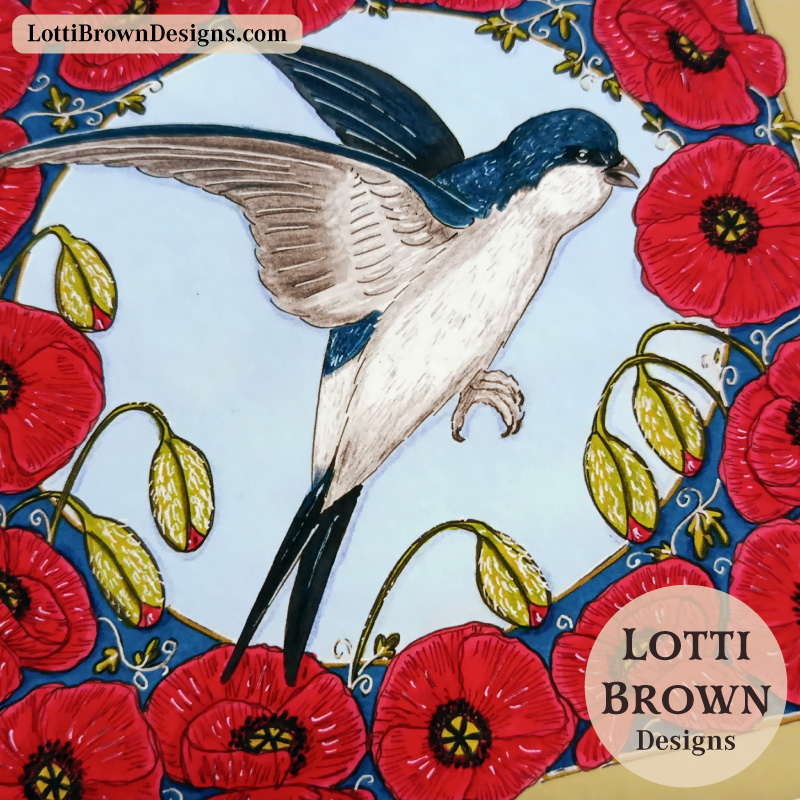 House martin and poppies art detail
Helping the House Martin
The house martin has been part of our human history, living alongside us, sharing our summers, and bringing joy as our neighbours.
House martins are now in decline, though…
The population has fallen around 40% over the last 30 years (1995-2024), and that includes a fall of around 30% in the last decade (2014-2024) and of around 16% in the last 5 years (2019- 2024). This is quite worrying and house martins have been added to the conservation red list of concern.
The reasons for the drop are not fully known but may include:
- Loss of habitat
- Decline in insects
- Changing weather patterns due to climate change
House martins are vulnerable to changes in weather – they need rain in late April and early May so that they have mud to build their nests.
They also need warm, dry weather so that there are insects to feed on.
Although adult house martins can withstand warm temperatures, and are often to be found sunbathing on south-facing roofs, nests of young are vulnerable to overheating in temperatures above 27C, especially in humid conditions.
Too much rain can be a problem, too, and can lead to nest collapse – but equally long spells of hot, dry weather can cause nest collapse, also. Nests built on modern PVC rather than traditional wood fittings are also more likely to collapse.
If we want future generations to enjoy the cheerful chatter of house martins overhead on summer evenings, just like we do, these little birds need our help...
To help house martins, we can:
- Fit pre-made house martin nesting boxes or structures of wood or terracotta – fix on north-facing walls - info & suppliers here (House Martin Coservation)
- Leave old nests in situ
- Make or maintain a pond in the garden so the birds have access to water and to attract insects
- Create muddy puddles for the birds when they return in Spring
- Plant pollinators in gardens to attract insects
- Consider donating to or getting involved in a bird charity or specific house martin organisation such as House Martin Conservation or Songbird Survival
I hope that house martins can be helped as they’re such beautiful and amazing little birds and have been cherished members of our communities for centuries.
House Martin Meaning
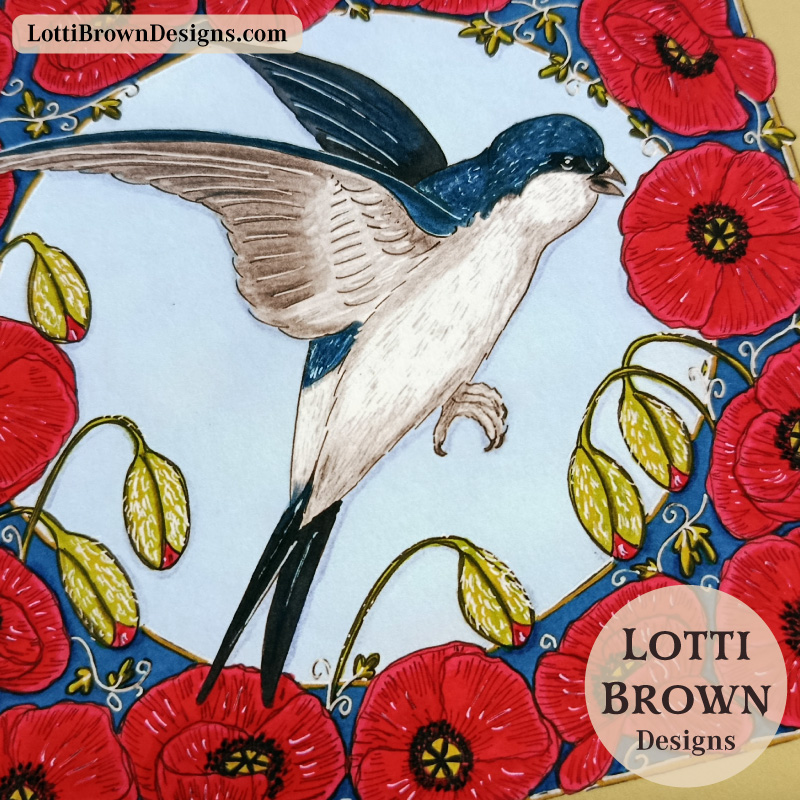 Hand-drawn house martin art illustration
House martin symbolism often centres around home, community, protection and the freedom of the soul.
The house martin is much more than just a little swallow – he’s a friend and neighbour, living alongside us as part of our history.
The house martin symbolises spring and summer – bringing the light of the season with his chatters of joy so that the sight and sound of this little bird’s arrive lifts our hearts.
He symbolises community and home – not just the walls and roof that shelter us, but the relationships, memories and familiar places that make us feel we belong.
He symbolises freedom and love, soaring high without a care, limitless and carefree.
He symbolises blessings and good fortune.
And he symbolises the hidden or unknown – those parts of our life that are allowed to remain private and unscrutinised – the freedom of our soul.
For me, the house martin will always be a bird of home. Of summer evenings filled with birdsong, of familiar voices returning after a long winter absence, and of the comfort that comes from sharing our lives with the natural world.
Perhaps that's why people welcomed them so warmly for centuries – not simply because they brought luck, but because they reminded us that we belong to a larger community of life.
Each spring, when the house martins return on their tiny wings from journeys we can scarcely imagine, they bring with them a little hope, a little joy…
House martin folklore reminds us that some of nature's oldest stories are still unfolding around us.
Drawing the House Martin
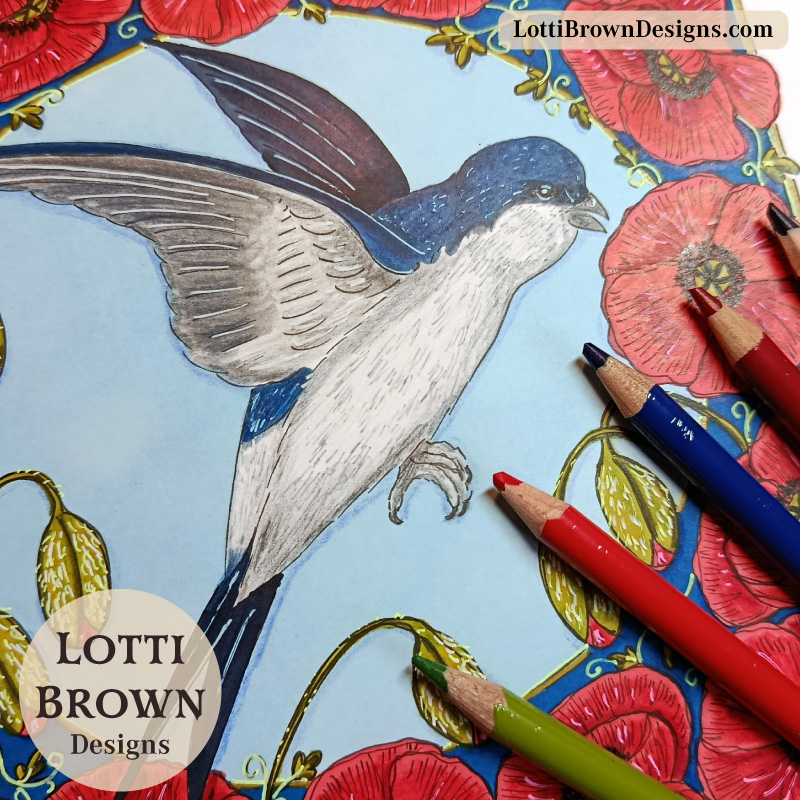 Drawing the house martin with pen and coloured pencils
I loved drawing my little house martin – as I layered on each colour and created his shimmering back of blue and wings of black, contrasting with his pristine white breast, I felt like I was drawing part of my own history…
Each summer of my five decades when the house martin’s chatter has accompanied part of my day – the childhood nights when I could hear the chatter of the baby birds in the nest as I lay in my own bed, just a few feet away…
When I saw the birds swooping at speed into the tiny nest hole or hanging there momentarily as they fed hungry mouths – and now, as I walk in the fields of barley and poppies, and the house martins loop around me or chatter in the skies, part of the soundtrack of my summer walks – always welcome and whose return is longed for each winter.
I think it’s amazing that they live so much of their lives on the wing – and that when they’re not nesting, they roost in trees, and we’ve never seen them…
It’s incredible that their winter lives are still such a mystery – and I kind of like that in the modern world, a little of the myth and mystery of the house martin still remains to bring a little quiet magic to our lives.
If you, too, have special memories of this cherished little bird who decided to make his home alongside us, then you might like my house martin artwork collection – see it in my Teemill store here…
House martin art by Lotti Brown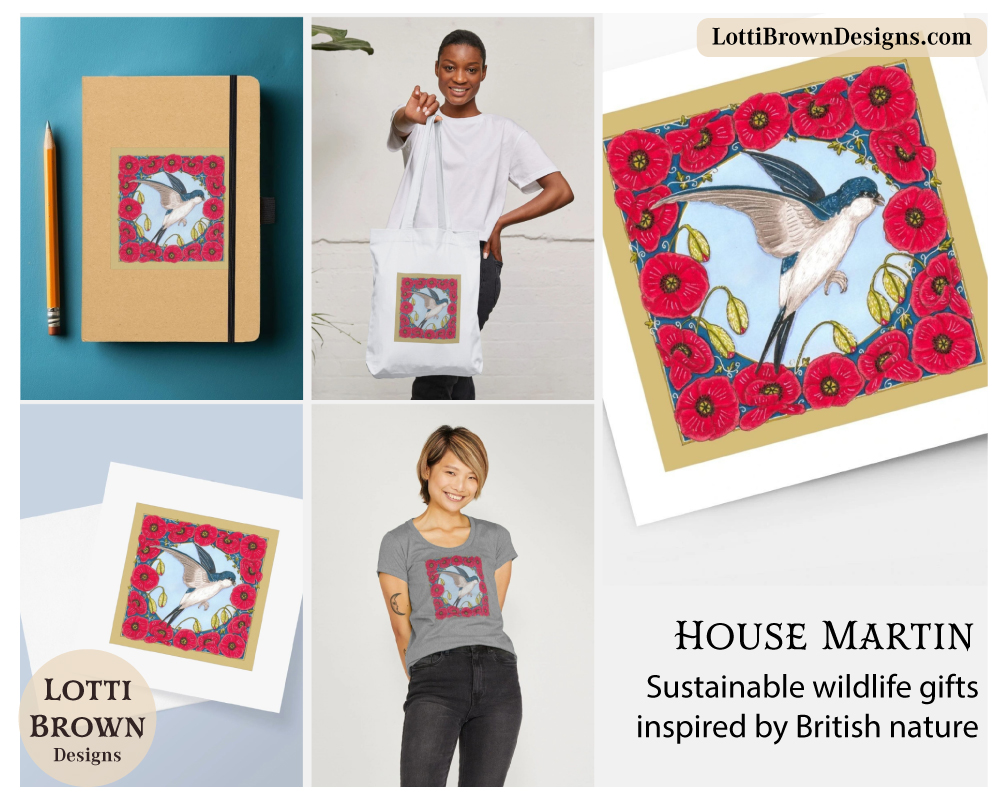
My house martin artwork is available as sustainable art prints, notebooks, greetings cards, tote bags and clothing in my Teemill shop.
You might also like to read about the folklore of:
Also:
You can also explore more British birds and corvids here...
If you like birds, you might enjoy reading about my year of birdsong, here...
Or browsing through my folklore hub here...
 Birds of summer skies
Or leaf through some of my nature journals with folklore here - or explore what I discovered in my first year of nature journaling here...
Visit my nature journaling hub here - to get tips and ideas for starting your own nature journal...
Have you ever thought about nature journaling..?
If you like nature, you might like to start your own nature journal!
Find out all about nature journaling here...
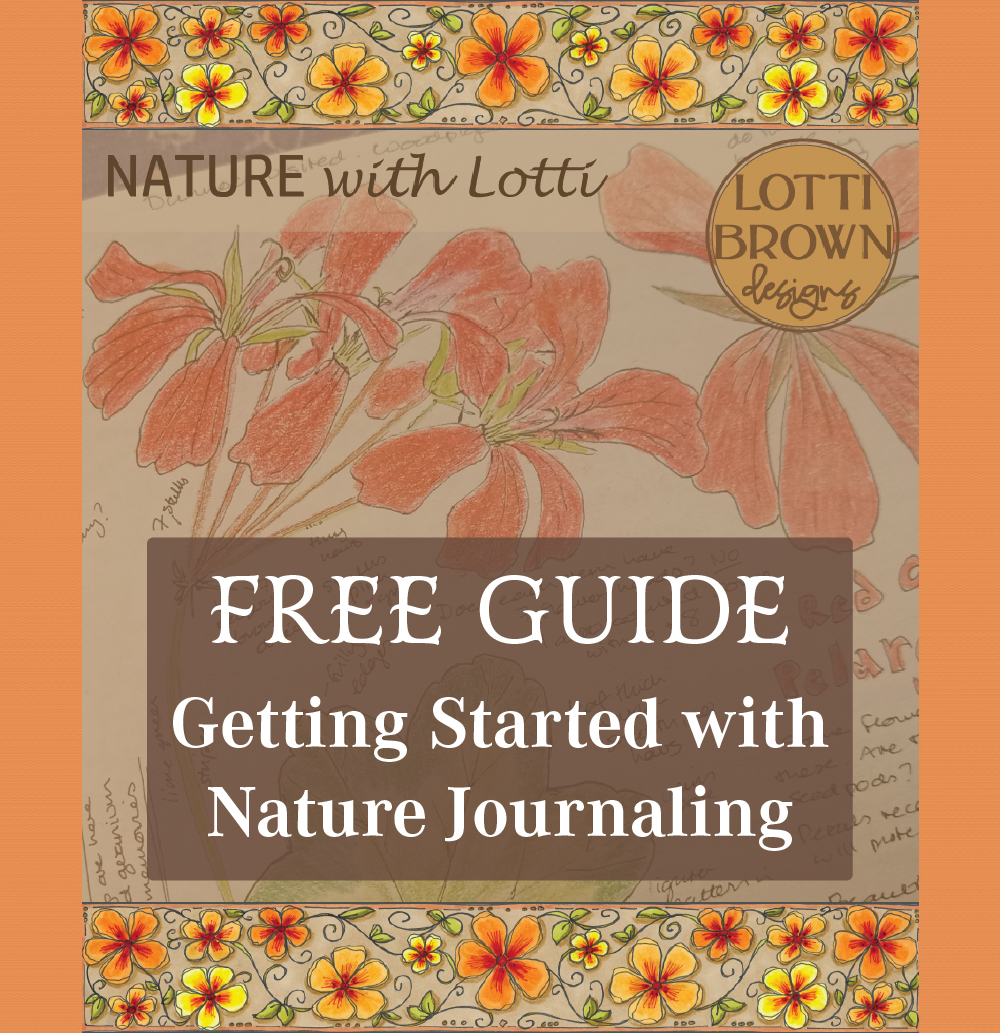
You can get started with my free guide here.
Or explore my gentle self-paced nature journaling course with nature journaling exercises to get you confident with nature journaling - take a look here...
Further Reading/Resources
- The Folk Lore and Provincial Names of British Birds - book by Charles Swainson
- A Dictionary of English and Folk-Names of British Birds - book by H. Kirke Swann
- British Birds: Names - Facts - Myths - book by Geoff Green
- RSPB Bird Tales: Traditional Stories, Folklore & Activities - book by Dawn Casey
- Favourite Garden Birds - book by Dairy Diary
- British Trust for Ornithology Bird Trends - https://data.bto.org/trends_explorer/?species=House+Martin - website accessed 2nd June 2026
- Songbird Survival - https://www.songbird-survival.org.uk/songbirds/house-martin - website accessed 2nd June 2026
- House Martin Conservation - https://housemartinconservation.com/ - website accessed 2nd June 2026

Shall we stay in touch..?
Each month, I share stories from my own nature journal, new art from my studio, and simple seasonal inspiration to help you feel more connected with the turning year - if you'd like to stay updated, please sign up with your email address below...
Recent Articles


-
Barn Owl Folklore & Meaning - Symbolism of the Barn Owl
Sep 15, 26 03:34 AM
 Explore barn owl folklore, symbolism and meaning, from ancient myths to British traditions. Discover the quiet wisdom and mystery of this ghostly bird.
 -
Bramble Meaning, Myth & Symbolism - Celtic Tree Calendar Art
Sep 02, 26 11:32 AM
 A look at bramble meaning, myth and symbolism as I share my bramble Celtic Tree Calendar art for the month of 'Vine'...
 -
Nature Journal Prompts
Aug 26, 26 04:05 AM
 Easy nature journal prompts to inspire and encourage you - one per week...
Shop My Current Artwork Collections

My art is available as sustainable art prints, notebooks, greetings cards, tote bags and clothing in my Teemill shop.
Find my stockists for all my earlier artworks here...

Lotti Brown is a self-taught nature artist and nature journaling educator whose hand-drawn work is inspired by wildlife, folklore, and close observation. With 18 years in creative fields and 10 years creating nature art, she brings deep practical experience to her work. Trained by the Wild Wonder Foundation, she shares nature journaling courses and guides online. Her artwork has been licensed internationally and exhibited at Goole Museum and Bridlington Spa in the East Riding of Yorkshire, UK.
Follow me:
Share this page: