
- Home
- Art
- Wildlife Art
- Fox Folklore & Art

Fox Folklore
Myths, Legends & Symbolism
By Lotti Brown
Discover fox folklore, myth and meaning with me...
As I explored the myths, meanings and symbolism of our familiar fox, I found stories stretching from ancient ritual sites to Celtic saints, clever folk-tale tricksters and even the flowers of our woods and hedgerows…
And foxes as wild messengers and mysterious creatures who slip between our world and somewhere just beyond it.
There is something particularly magical about seeing a fox in the wild. Perhaps it's their beautiful russet fur, their alert expression, or simply the feeling that we've been allowed a brief glimpse into a life normally lived just beyond our own.
Foxes have lived alongside people for thousands of years, slipping between the wild and human worlds - and perhaps it's no surprise that we've woven so many stories around this clever, adaptable and mysterious animal.
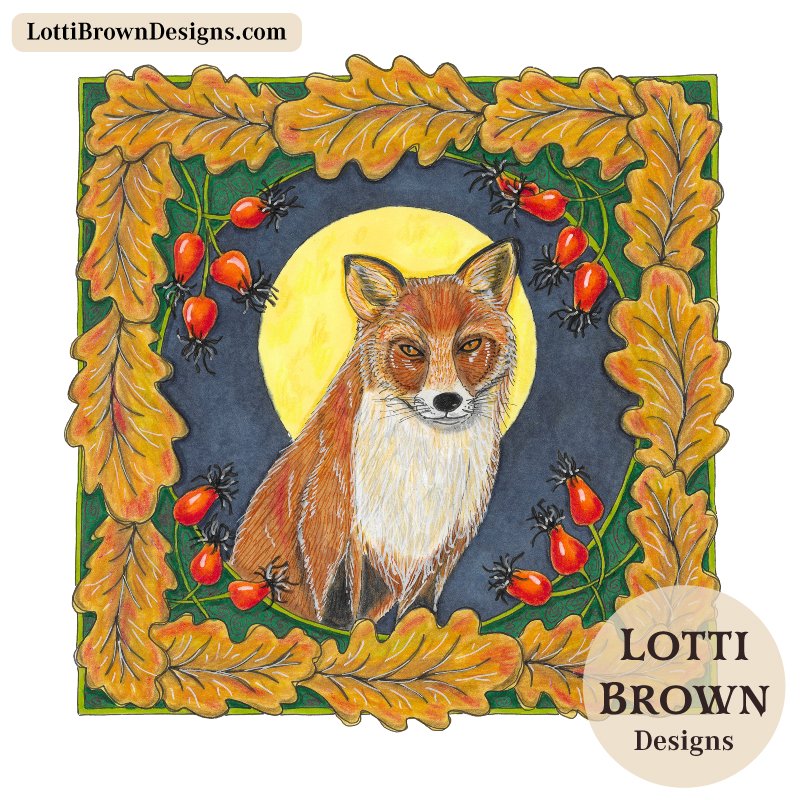 Hand-drawn fox artwork by Lotti Brown
We sometimes see a fox out on our walks – usually only very early in the morning or later in the evening. It’s always a thrill…
They’re always so sharp-eared that it’s so hard to come up on a fox unannounced. Normally, we just see them with one ear cocked back having already heard our approach – and then they trot off quickly, back to safety.
My absolute favourite experience with foxes was about 20 years ago, when we were walking in the fields, exploring the area around our new home…
Reaching the end of the track near the two big old oak trees, we peeked into the field around the corner and were rewarded by the sight of three or four young foxes just playing – jumping and running with each other…
Such a beautiful memory, and even thinking about it now, it seems more like something out of a fairy story than reality.
But it was a magical glimpse of how the natural world happens around us, out of sight, often out of mind, but real and ongoing just the same.
And with a little luck, good timing and a willingness to pay attention, every now and then we're allowed a glimpse into it.
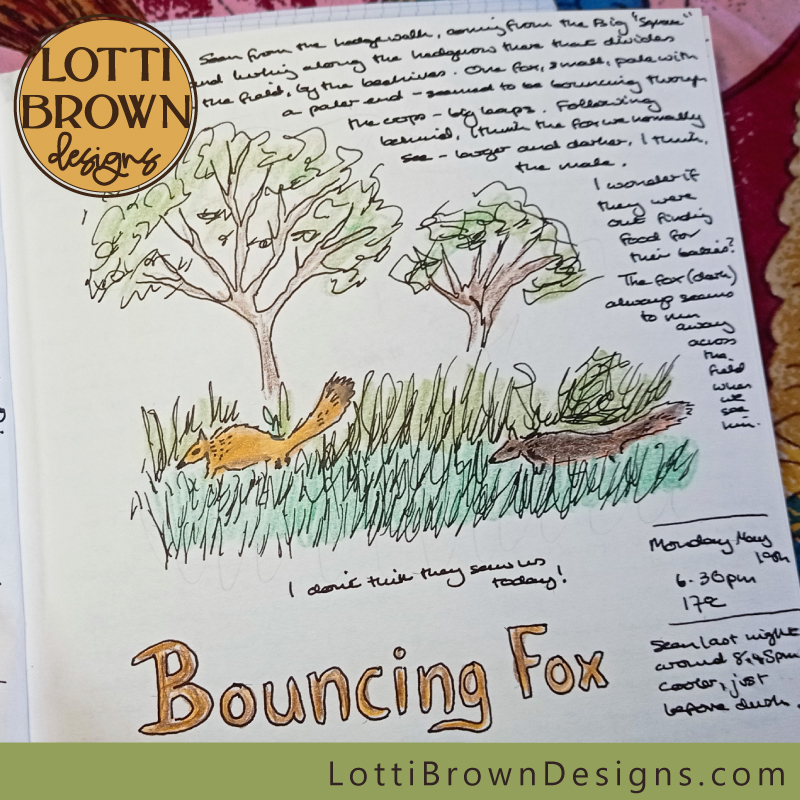 A fox seen bouncing through the crop field, followed by another, darker and larger - sketched in my nature journal
Ancient Fox Folklore & Our Earliest Relationships with Foxes
Foxes have been important to people throughout the ages…
Foxes feature in hunting scenes in the Camonica Valley Neolithic rock art in Italy - and Iron Age ritual burials in France and England contain foxes, showing that foxes have had some sort of sacred importance in our lives for thousands of years.
It is thought that foxes may have been sacrificed at Iron Age ritual sites at Winklebury (Hampshire) and various locations in France.
And the Iron Age ‘bog body' Lindow Man who it’s thought may have been a Druid, was found with a fox-fur armlet, so that we know that foxes were important in the sacred and practical life of our human society even 2,000 years ago.
We can't know exactly what the fox meant to those ancient people, but these discoveries tell us that our fascination with this animal is nothing new…
Long before foxes began trotting through our modern towns and gardens, people were already noticing them, depicting them and giving them a place within their stories and beliefs.
The Celtic chieftain of Gaul, Louernicus, was known as the ‘Son of the Fox’ – the name has also been discovered on third and fourth century items in the UK.
And the tenth century Scottish king, Ua Leochann, was called ‘An Sionnach’ (The Fox) for his diplomacy skills.
This shows how the fox has long been seen as a symbol of diplomacy – knowing when to appear and make his point, but also, equally, knowing when to recede back into the shadows and quietly disappear – highly-respected qualities for a diplomatic leader!
Perhaps this is a kinder way to understand the fox's famous cunning - not as dishonesty, but as awareness: watching carefully, reading a situation and knowing when to act.
Celtic Fox Folklore - Brigid and the Fox
In the Celtic tale, ‘Brigid and the Fox’, Brigid of Ireland is known to be able to talk with the animals. Brigid went to intercede with the King of Leinster who would take the life of the man who had accidentally killed his pet fox.
Brigid brought the king a little fox and made the fox do tricks to make the king happy. She offered the king the fox in exchange for the unfortunate prisoner’s life.
But the fox became unhappy living in the king’s castle without Brigid and he escaped back to the woods. The king’s men searched far and wide but it could not be found again.
The fox is always a wild creature – and can only be truly ‘tamed’ by Brigid.
I rather like that ending. Even in a story about a saint who can communicate with animals, the fox ultimately chooses the woods. There is something in the fox that belongs to itself.
Foxes are certainly seen as belonging to forests and the wild and in their self-sufficient nature, we see how the tales of their intelligence, adaptability and cunning have grown up around them…
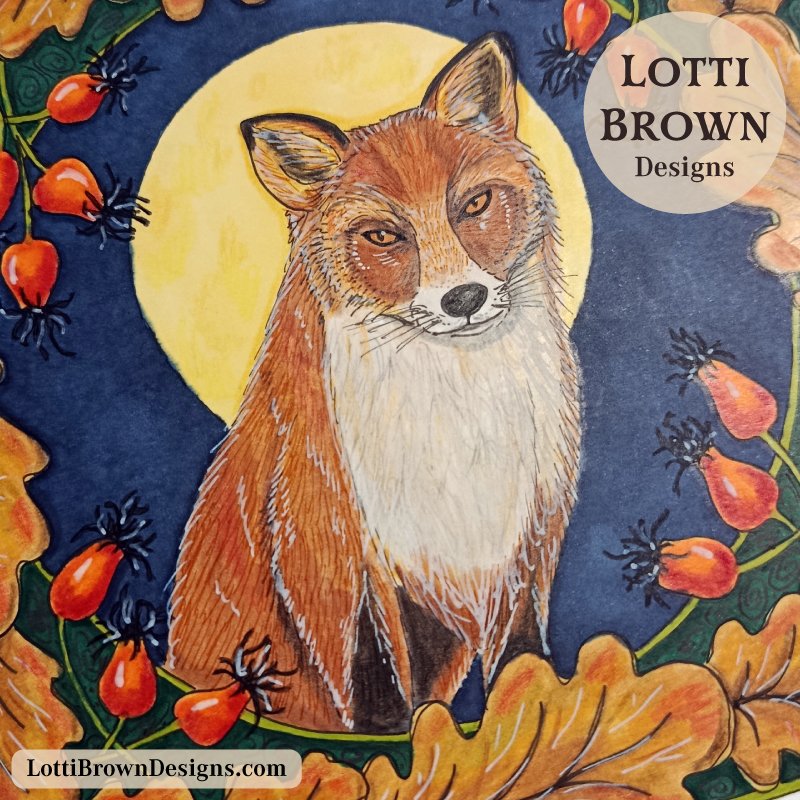 Fox drawing
The Clever Fox in Folklore
Many folk tales feature the fox playing tricks on other animals, such as running around a chicken until the chicken gets dizzy and falls down, or burying itself in the earth to surprise the crows who come to eat him!
Aesop’s Fables – ‘The Fox and the Crow’
In a tale from Aesop’s Fables, ‘The Fox and the Crow’, a crow is eating a piece of cheese on a branch. The fox calls out to the crow, flattering it and wondering whether the crow’s voice is as beautiful as the crow itself…
The crow opens its mouth to caw, the cheese falls out and the fox eats the cheese!
The table is seen as a tale of caution against listening too earnestly to flatterers – something we would all be wise to heed! In later versions of the tale, the fox is punished for this false flattery.
Brothers Grimm – ‘The Wolf and the Fox’
In a Germanic folk tale collected by the Brothers Grimm, ‘The Wolf and the Fox’, the fox and the wolf live together but the wolf makes the fox do all the work…
In the end, the fox and the wolf go to steal meat together in a farmer’s cellar. The fox keeps an eye on his escape route but the wolf just eats greedily.
When the farmer comes, the wolf has eaten too much to escape – but the fox is able to run away and live without the wolf – the fox’s wily intelligence saves the day!
Other European Fox Folktales
In Finnish folktales, the fox is seen as a trickster where intelligence outwits both strength and evil intent.
Whilst in Bulgarian and Russian folktales, the fox is known as Kuma Lisa, a she-fox trickster.
In Siberia, the fox is sometimes shown as a black fox – seen as a messenger from the world of death…
Whilst in Breton folktales, a white fox often represents the soul of the dearly departed.
So the fox moves strangely easily through our stories - comic trickster in one tale, wise survivor in another, and mysterious messenger between worlds in the next. Perhaps that slipperiness is part of the reason we've never quite managed to pin down what a fox means.
The trickster cunning of the fox is a common theme in folklore – but the word ‘cunning’ comes from the same root as the Old English word ‘ken’ meaning ‘to know’ – an air of wisdom, intelligence, or ‘knowingness’ about the fox which I think we can all agree we can see in the fox’s handsome face…
So the fox is a symbol of knowing, observing, adapting, surviving and always finding another way.
But folklore doesn't always allow the clever fox to win. A whole family of European tales pits the many-witted fox against an animal with only one reliable trick - often a cat, owl or hedgehog. When real danger arrives, it's sometimes the simpler strategy that succeeds.
In all these stories, the theme centres on the fox holding many tricks and wiles in his repertoire, with the other animals having very few or perhaps just one. But in a situation of real danger, it’s the fox that now comes off worse.
According to Aesop, the moral of the tale is:
“One sure trick is better than a hundred slippery ones”
Wise advice for the clever fox, indeed!
The Lucky Fox
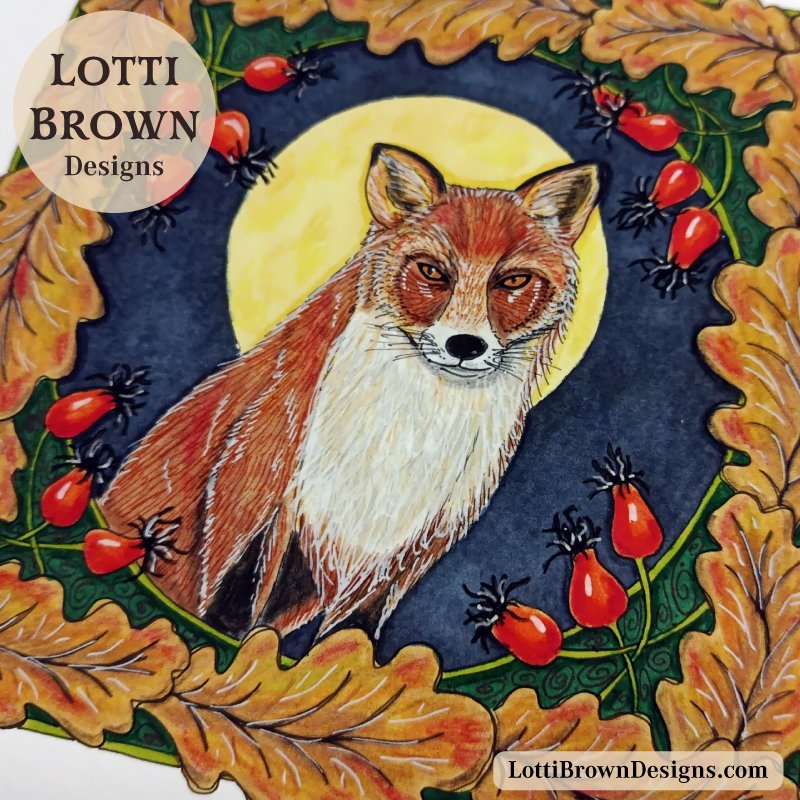 Fox art by Lotti Brown
The fox is thought to be lucky – it used to be viewed as a lucky charm to have a fox’s tail (not so much for the fox!).
And in Wales, seeing one fox was seen as lucky – but more than one would bring bad luck.
Some traditions say that a fox carried a magic pearl that would bring you luck if you found it.
Foxes were also sometimes seen as shape-shifting witches – often viewed as unlucky.
The Floral Fox
Bluebells and foxgloves are traditionally associated with foxes.
Folklore says that fox cubs would wear foxglove flowers to keep their little paws warm – did you ever hear anything so cute?
It is said that foxes were given bluebells by God after they complained that they were being hunted for their tails…
God created the little blue bells in the woodlands for the foxes, which would ring when hunters came near.
Bluebells were called ‘Fox Bells’ in many parts of the UK until relatively recently.
I love these gentler pieces of folklore. Instead of fearing the fox's wildness, they imagine the woodland itself protecting her.
Fox Meaning & Symbolism
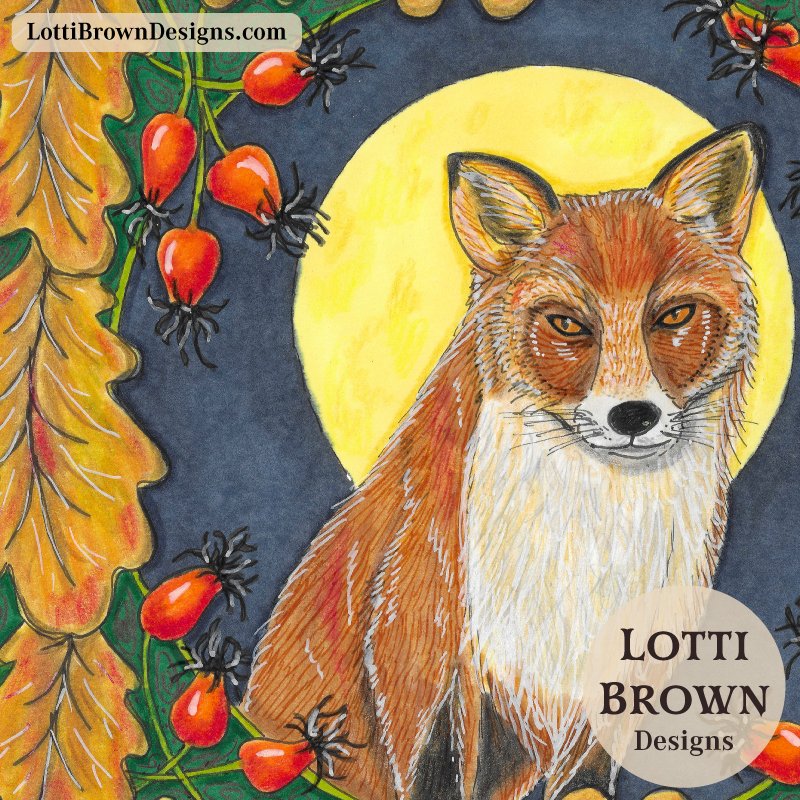 Hand-drawn fox artwork (showing detail)
Across centuries of fox folklore, the fox emerges as much more than simply 'cunning'. She is observant, adaptable, independent and extraordinarily good at surviving. She knows when to step forward and when to disappear, when to persist and when to find another way.
Perhaps that's one reason we continue to admire foxes today. They've adapted remarkably well to the world we've created, making homes not only in woods and fields but among our streets, gardens and railway lines. They live alongside us without ever quite belonging to us.
And perhaps there is something we recognise in that - the ability to remain ourselves while adapting to a changing world.
In Finnish, the northern lights are called ‘revontulet’ – ‘fox fires’ – or ‘The Light of the Fox’ said to be created by the sweep of the fox’s tail across the snowy landscape, flicking tiny snow crystals into the sky where they glowed with coloured lights – a beautiful image to leave us with… the lithe and graceful night-time fox, thriving in the forces of nature and the beauty of the wilderness, a true wild-child.
Drawing my Fox Artwork
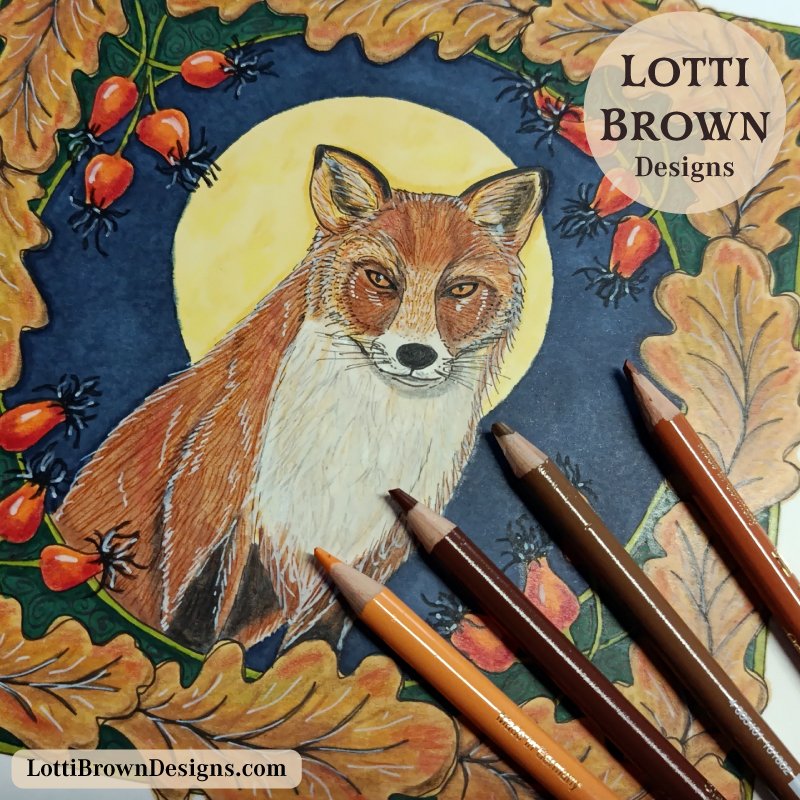 I drew my fox in pens and coloured pencils
I loved drawing my little fox surrounded by oak leaves and rosehips, it reminded me of early mornings walking along the hedgerows in autumn, the air cool and misty, the grass wet with dew softening our footsteps so that we can catch a glimpse of the swift red fox…
I thought about the gorgeous russet colours of the fox’s fur as I added layers of pen and coloured pencil to try and recreate the colours…
And added a cheeky glint in her eye as I remember those playful fox cubs we were so lucky to see all those years ago, feeling those magical moments of these wild creatures who stalk country fields and town avenues alike.
It’s important that we keep noticing these wild animals who continue to share our streets and pathways and live alongside us, quietly slipping through the edges of our lives, while beyond our sight they continue their own busy, complex lives - hunting, playing, raising young and finding ways to thrive alongside us.
If the wild nature, intelligence and playful nature of the fox resonates with you too, you might like to explore my fox artwork collection…
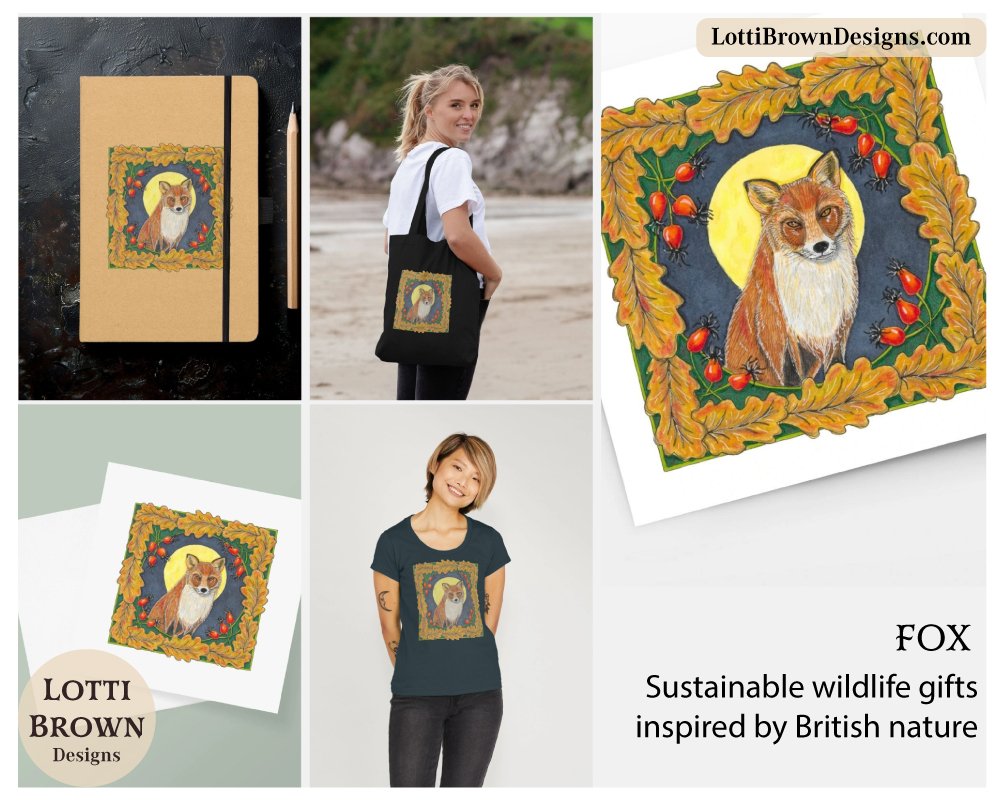 My fox artwork collection in my Teemill store
My fox artwork is available as sustainable art prints, notebooks, greetings cards, tote bags and clothing in my Teemill shop.
Still Living Alongside the Fox
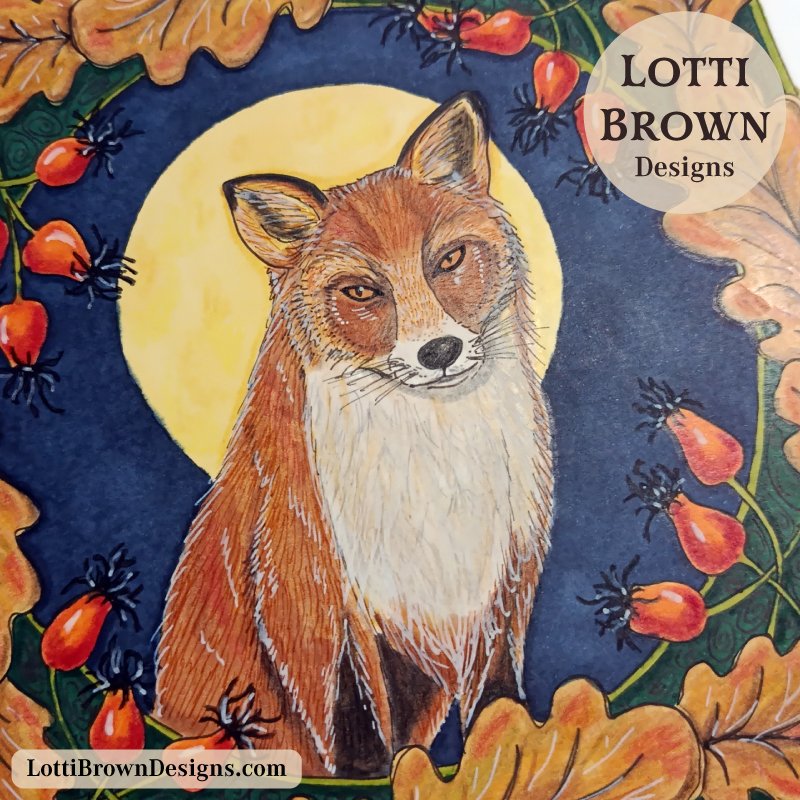 My fox drawing
Perhaps the fox has remained such a powerful figure in our stories because she has never really left us. The landscapes around her have changed, forests have disappeared and towns have grown, yet somehow the fox has adapted and continued to live alongside us.
We may no longer see a fox slipping through the dusk and imagine a shape-shifting witch or a messenger from another world, but the encounter can still make us stop. For a moment, we become aware of another life moving quietly alongside our own - watchful, intelligent and wonderfully wild.
And perhaps that's how we still live some of these ancient stories. Not necessarily by believing exactly what our ancestors believed, but by continuing to notice the fox, wonder about her, tell stories about her and feel that little thrill when a flash of russet fur disappears into the shadows.
And I think that's why fox folklore still feels meaningful today. The stories may be ancient, but the animal at their heart still lives quietly alongside us...
You might also like:
You might also like these earlier fox artworks...
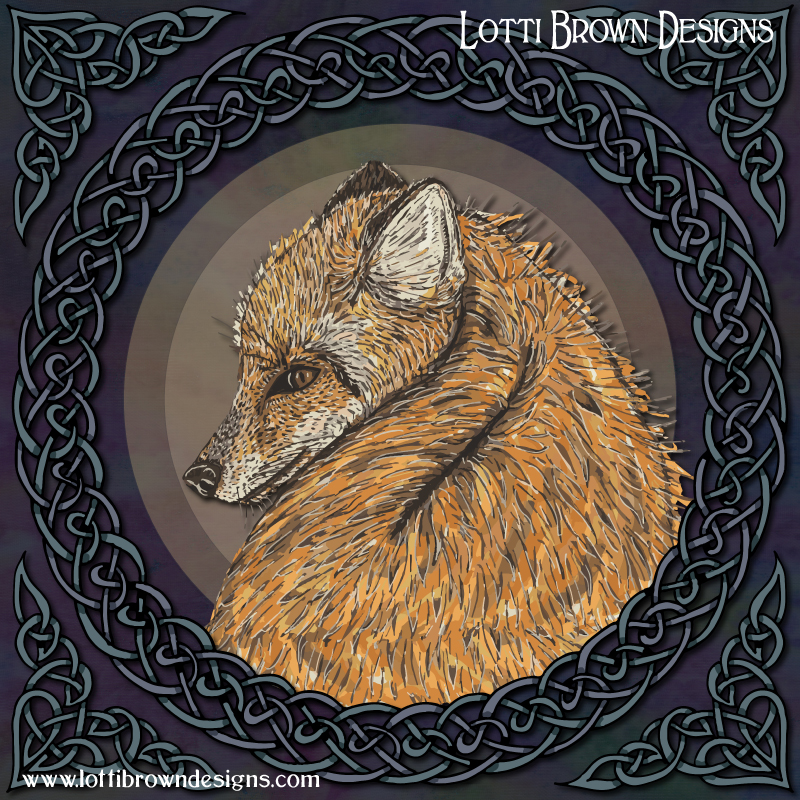
Explore my Celtic Fox prints & products in my Redbubble store here...
Discover more Celtic wildlife artworks here...
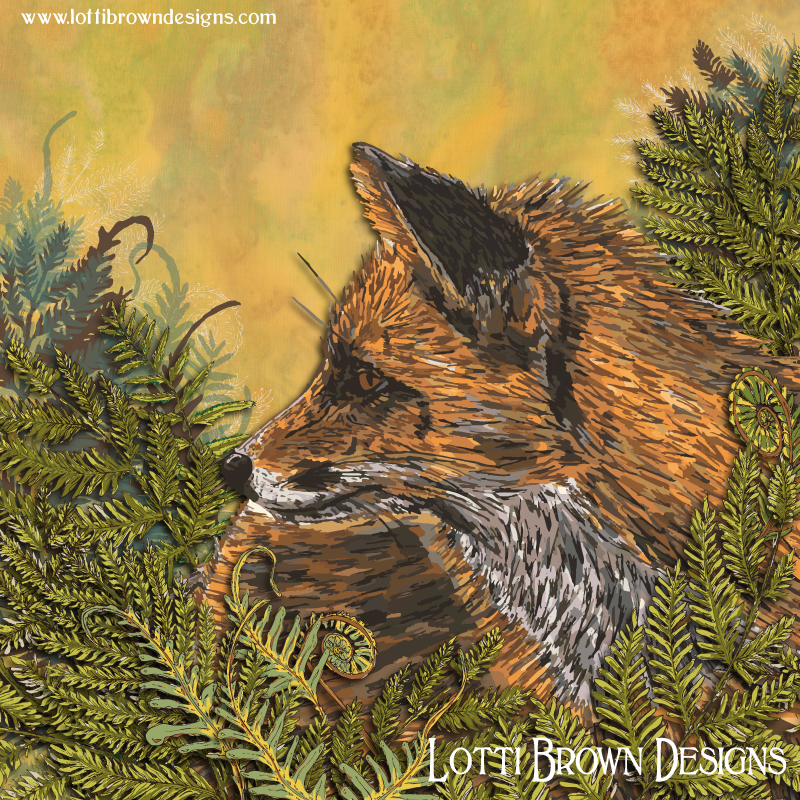
You can explore all my wildlife art from this page including earlier wildlife art here and Celtic wildlife art here - or discover all my nature-inpsired art here...
You might also enjoy exploring my Folklore of Nature hub here... - including folklore of the hare, here...
Or discover all about starting a nature journaling hobby here...
Have you ever thought about nature journaling..?
If you like nature, you might like to start your own nature journal!
Find out all about nature journaling here...
You can get started with my free guide here.
Or explore my gentle self-paced nature journaling course with nature journaling exercises to get you confident with nature journaling - take a look here...
Further Reading/Resources
- Beasts of Albion - book by Miranda Gray
- The Druid Animal Oracle - book by P & S Carr-Gomm
- Penguin Reference Book: Dictionary of Symbols
- Red Sky at Night - book by Jane Struthers
- Wikipedia: Foxes in Popular Culture

Shall we stay in touch..?
Each month, I share stories from my own nature journal, new art from my studio, and simple seasonal inspiration to help you feel more connected with the turning year - if you'd like to stay updated, please sign up with your email address below...
Recent Articles


-
Fox Folklore - Myths, Legends & Symbolism of the Fox
Oct 13, 26 04:18 AM
 Explore fox folklore, myths and symbolism, from clever trickster tales and Celtic legends to foxgloves, bluebells and the enduring magic of the wild fox.
 -
Magpie Folklore and Meaning - Symbolism & Superstitions - Magpie Art
Oct 06, 26 05:02 AM
 Discover magpie folklore, symbolism, and superstitions from around the world. Explore the meaning of this intelligent and mysterious bird.
 -
Nature Journal Prompts
Oct 05, 26 04:42 AM
 Easy nature journal prompts to inspire and encourage you - one per week...
Shop My Current Artwork Collections

My art is available as sustainable art prints, notebooks, greetings cards, tote bags and clothing in my Teemill shop.
Find my stockists for all my earlier artworks here...

Lotti Brown is a self-taught nature artist and nature journaling educator whose hand-drawn work is inspired by wildlife, folklore, and close observation. With 18 years in creative fields and 10 years creating nature art, she brings deep practical experience to her work. Trained by the Wild Wonder Foundation, she shares nature journaling courses and guides online. Her artwork has been licensed internationally and exhibited at Goole Museum and Bridlington Spa in the East Riding of Yorkshire, UK.
Follow me:
Share this page: