
- Home
- Art
- British Birds Art
- Skylark

Skylark Meaning & Folklore
Symbolism, Myths &
British Bird Lore
By Lotti Brown
Explore the folklore and symbolism of the skylark, whose joyful song has inspired myths, poetry and quiet moments of wonder for centuries - plus my own skylark artwork...
One of my absolute favourite things about living in the countryside in East Yorkshire, and walking in the fields every day, is hearing the skylarks sing. It's easy to understand why skylark folklore is filled with stories of joy, hope and heavenly song…
 Skylark and poppies art by Lotti Brown
There’s a quiet walk, out into huge open fields – I love it there, just the ground beneath my feet and the sky in my hair – and all around me as I walk is the singing of skylarks.
It feels as though the heavens themselves are singing – and for a few quiet moments, it almost seems as though the song is just for me. It gifts me a beautiful moment of connection with the natural world before I walk back to the village to get on with my day…
The skylarks are quite unremarkable-looking birds – they just look like punky sparrows. And it was quite a long time before I was able to connect the little punky birds that I often saw perched on a stalk of barley or long grass, with the music coming from the sky.
In fact, it took me quite a while to spot the birds who were doing the beautiful singing in the sky – when I saw my first skylark singing, I was in awe at how high the little bird was hovering, somehow throwing its voice down to the earth below…
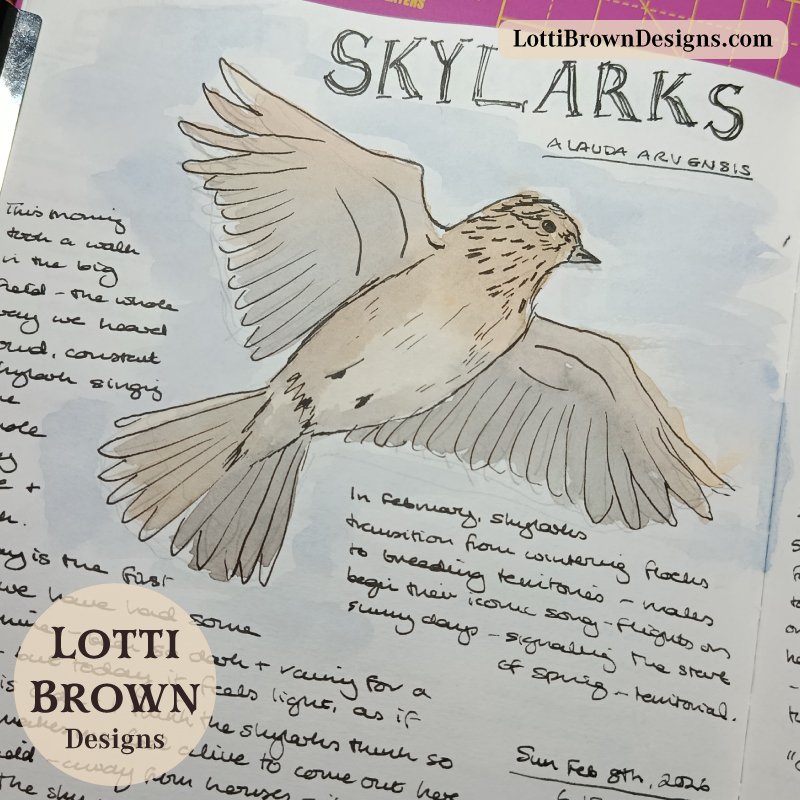 Skylarks in my nature journal (February singing!)
Skylarks have been singing for me, this year, all through winter – many days, even in cloud and winter rain, they have accompanied me on my walks – and in the long days of summer they seem to sing for long hours, dawn to dusk - and even beyond as they sing even in the dark, starting a couple of hours before sunrise, leading to the phrase ‘up with the lark’ for early risers.
I can’t admit to being up quite so early, but I do enjoy their musical accompaniment on my early morning walks – and that’s made it very special to create my skylark artwork and research the folklore, stories and myths of the skylark.
What’s in a Name?
The name sky lark comes from the name laverock, or sky laverock, which in turn derives from the Anglo-Saxon word ‘lawerce’ (or ‘laverce’/’laferce’) meaning either ‘little songster’ or ‘guile-worker’.
So the sky lark is beautifully described as a little songster of the skies.
The description of the skylark as ‘guile-worker’ comes from its habit of trying to disguise the position of its vulnerable ground nest by never taking off nor landing nearby. It has feet with a special elongated back toe and claw to allow it to run easily through the grasslands it makes its home in, so it can run easily from its nest to take to the sky so that potential predators never know where its nest is.
Luckily, the skylark’s nest is almost invisible in the ground, hidden under tussocks of grass – and the skylark can also draw predators away from its nest by feigning injury.
The Latin name for the skylark is Alauda arvensis. In one interpretation, Alauda comes from an amalgamation of two ancient Celtic words: ‘al’, meaning ‘high’ and ‘aud’ meaning ‘song’.
Arvensis means ‘of the fields’ – so in this case, the skylark’s name means ‘the high song of the fields’ – another perfect description.
Another interpretation sees Alauda coming from the Latin ‘laudare’ meaning ‘to praise’. This is because of the folklore that as the lark rises into the sky, she prays constantly to God, asking Him to allow her to soar to great heights, promising not to swear or take His name in vain. I look more at the ‘pious lark’ a bit later…
For now, here are the common and folk names of the skylark:
- Laverock
- Lavrock
- Learock
- Lerruck (you can see in this list how ‘laverock’ gradually became ‘lark’)
- Sky laverock
- Rising lark
- Field lark
- Lintwhite
- Lady hen (or Our Lady’s Hen)
- Sky flapper
- Melhuez
The Skylark’s Song
The skylark’s song is, of course, its most defining feature. Although both the male and female skylark sing, the male sings much more than the female, and if you see a skylark hovering high in the sky, warbling out the most beautiful tune, you have likely seen (and heard) a male skylark.
The skylark's song has inspired poetry, music and folklore for centuries...
The skylark’s song is famous not just as poems, but as a popular piece of classical music ‘The Lark Ascending’ by Ralph Vaughan-Williams – that pays homage to the little bird’s beautiful song.
The skylark starts to sing as soon as he takes off in his flight, climbs to a great height, sometimes more than 300 ft in the air, and sings his trilling melodies of more than 300 notes and 50 separate ‘songs’, hovering up high for anywhere up to an hour of song before he makes his descent.
It’s said that as the skylark rises into the air, his song is gushing and impatient, as if he has an urgent need to express himself in song – his song on descent is said to be ‘sadder and more subdued’ as he comes back down to earth.
Folklore recognised that if skylarks flew high and sang for longer periods, fine weather was on its way. In fact, the warmer the ground, the higher the skylark will fly to sing his song.
 The skylark sings in flight
The song of the skylark symbolises the joy of summer, yet folk sayings in Germany recognised that the skylark can also be heard singing in winter…
“The song of one lark does not bring summer…”
In fact, the skylark sings 11 months of the year. In midwinter, he will sing on sunny days, while singing begins in earnest in February as the skylarks’ courting begins, increasing through spring as the nest is built and the tiny eggs hatch – as if he sings there as an ever-present guardian, letting his family know that all is well through his song.
Skylarks may have up to 4 broods each year, so by August, as their feathers moult, the skylarks fall quiet and enjoy their well-deserved break.
By September, though, the male’s song needs to be sung, and he takes to the skies once more, singing lower in the sky, and shorter songs, during these autumn months.
Skylarks’ songs were once so praised that they were caught and kept caged songbirds – a cruel practice that backfired as the skylark’s song was not as sweet without his freedom high in the sky…
“I who would house a singing bird
Have caged a broken heart”
(From The Fowler, by Wilfred Gibson)
Skylarks were once cooked and eaten too – and eating lark or lark’s eggs was said to sweeten the voice.
If you’re curious what the skylark might be singing about in his long, beautiful songs, I may have the answer in this folklore rhyme exploring the meaning of the skylark’s song:
“Up in the lift go we,
Tehee, tehee, tehee, tehee!
There’s not a shoemaker on the earth
Can make a shoe to me, to me!
Why so, why so, why so?
Because my heel is as long as my toe.”
I love that this rhyme is exploring the skylark’s long toe that allows it to run through grass – and I can really imagine the skylark singing ‘tehee, tehee, tehee, tehee’ – however, when I hear the skylark sing, I feel he sings not of shoes, but of joy, freedom, the skies and the beauty of the world that he sees from his exalted position, almost like an astronaut looking back at Earth from space.
The Pious Skylark
The skylark’s beautiful song as he ascended into the skies was said to be a prayer to God.
In addition, the ‘pious lark’ was said to always say grace before and after meals, presumably by singing God’s praises.
The skylark was considered protected by the Virgin Mary, that’s why in Orkney, she’s known as Our Lady’s Hen.
Folklore tells us that larks existed before the Earth and would sing the praises of God seven times a day, as they flew high in the heavens – so the prayer of the lark’s song was said to be the first things that existed in the world.
From the skylark’s position so close to the heavens and his existence before the world, this is not a ‘down to earth’ bird, but truly seems one blessed by the heavens.
 Skylark art print
Explore my skylark artwork collection in my Teemill store here...
Bird of Daybreak
The skylark sings from even before dawn and has become synonymous with early risers: ‘up with the lark’…
The association is a long one – in the 14th century, Chaucer writes of the lark as ‘the bisy lark, messenger of day’ – the skylark, then, is the bringer of dawn, the sunlight, and the day.
It’s easy to associate this beautiful warbling song with the joy of a fresh new day.
The Lark & Her Young Ones – Aesop’s Fables
This lovely story of a skylark and her young nesting in the field is a meaningful tale that also recognises the precarious nature of the skylark’s vulnerable ground nest.
A skylark has a new family of young ones, recently fledged but safe in their nest, nestled hidden in the ground in a field of wheat.
One day, the youngsters hear the farmer tell his son that he thinks the field is ready to harvest and will call his friends to harvest the crop the next day.
The babies are scared that the wheat hiding their nest will be cut, and tell their mother – but mother skylark tells them not to worry and they are safe for now.
After a couple of days, the farmer comes back, but he and his son are alone. The farmer looks at the crops and says to his son, “The crops are ready to harvest. I will call my relatives to help harvest the crop tomorrow.”
The skylark babies are afraid again, but mother skylark tells them not to worry, and they will be safe tomorrow.
Sure enough, tomorrow comes and goes and the field is not harvested. The next day, the farmer comes again and looks at his field and tells his son, “The wheat must be cut tomorrow, or it will be too late. We will not wait for anyone else. We will come and do it ourselves tomorrow.”
The mother skylark looks down at her youngsters, and says to them, “Come, we will fly away today, as the farmer will surely come tomorrow and cut the wheat. Once a man determines to do his tasks himself, they will surely be done.”
And sure enough, the farmer and his son came to harvest the field the next day, but the skylark and her family were safely away.
The moral of the story is ‘self help is the best help’ – do not rely on others to do what you can do yourself. A lovely reminder that we are often stronger than we realise – and we should not delay starting our tasks through perceived dependence on others.
The Enchanted Song
 Skylark art print
This beautiful tale of The Monk and the Bird or The Story of the Little Bird is said to have originated as an Irish Celtic folk tale…
A monk decides to take a break from his duties and walk in the fields. He hears the beautiful song of a skylark and stops to listen, thinking it the most wondrous thing he’s ever heard.
After listening to the song, he returns to his monastery, but all is changed and he recognises none of the monks, and no-one there recognises him. After some time, the monks look in the records and realise that he is a monk that once walked out of the monastery one day and just disappeared… one hundred years ago.
Time had stood still while the monk had stopped and listened to the enchanted song of the skylark…
And I think that’s why I love to stop and listen to the skylark so much on my walk – not in the hope that I will return to a world of the future, ever changed...
But that in the moment of stopping and listening to the skylark, the world does stop – there’s simply me, with my feet on the ground, and the sweet music of the skylark filling my head and my heart for those moments outside of the everyday.
Skylark Meaning
The symbolism and meaning of the skylark have remained remarkably consistent through the centuries...
The skylark is a cherished bird that symbolises dawn and the sun, new starts and shining hope.
The skylark represents joy and freedom, a link between the heavens and the earth – a celebration of the beauty of the world.
The skylark reminds us that we are stronger than we know and can achieve much, if we just set our minds to it and take our fate into our own hands.
The skylark tells us to seek for these small opportunities to step out of time, out of our everyday lives, and connect with nature - a reminder to stop, listen, and find joy in the moment.
 Skylark
Skylark Conservation
Today, the skylark remains one of Britain's most cherished farmland birds...
The skylark population has fallen almost two-thirds in the UK (57%) since 1967 (to 2024), largely due to farming practices, especially concerning the timing of crop harvesting.
There is good news though, as since 2014, the population has increased 17% (to 2024), including an increase of 8% between 2019 and 2024.
There is advice to help farmers help skylarks here - but as a non-farmer, you can help skylarks by keeping dogs on leads or under close control in fields during the nesting season (February to August), especially if you hear skylarks singing overhead (as ground-nesting birds they are vulnerable).
Hopefully, with continued care, skylarks will continue to flourish and we can take our walks outside and find joy in their songs that truly seem to come from the heavens above.
Drawing my Skylark
 Drawing my skylark with pens and coloured pencils
I chose to draw my skylark in the moment it takes to the skies from the barley fields, as I’ve so often seen them near my home. I love the punky crest that helps to identify the skylark amongst the other small brown birds in the fields…
I’ve surrounded him in the poppies from the fields to bring him as much summer joy as his song brings to me on my daily walks.
I tried to concentrate on the feeling of being out of time, out of the everyday world – that feeling of enchantment that the skylark’s song seems to bring.
 Drawing my skylark
No matter how many times I hear the skylark song, it never fails to bring a spark of joy, deep in my heart – and a sense of connection with the skylark’s world, that world of freedom, endless skies and heavenly song from dawn to dusk.
If the song of the skylark, and the sense of freedom and joy, resonates with you too, this piece was created to reflect that.
View my skylark artwork collection in my Teemill store here...
Skylark & poppies - Lotti Brown Skylark artwork collection
My skylark artwork is available as sustainable art prints, notebooks, greetings cards, tote bags and clothing in my Teemill store.
Whenever I hear a skylark singing high above the fields, I find myself stopping almost without thinking. For a few moments, the everyday fades away and there's only the wide sky, the open fields beneath my feet, and that joyful song falling from somewhere almost beyond sight.
Perhaps that's why the skylark has inspired so many stories, poems and legends through the centuries. It reminds us to lift our eyes, to find joy in the ordinary, and to pause long enough for the natural world to work its quiet magic. In a busy world, the skylark still offers us that rarest of gifts – a moment outside of time.
 Birds of summer skies
You might enjoy more of my birds of summer skies:
Or more of my other British birds art & folklore here...
Read about my year of birdsong here...
You might also like to explore more folklore in my main folklore hub here...
Or explore all my art here...
Perhaps you'd like to notice nature more deeply and start your own nature journal? You can do that here...
Have you ever thought about nature journaling..?
If you like nature, you might like to start your own nature journal!
Find out all about nature journaling here...
You can get started with my free guide here.
Or explore my gentle self-paced nature journaling course with nature journaling exercises to get you confident with nature journaling - take a look here...
Further Reading/References
- The Folk Lore and Provincial Names of British Birds - book by Charles Swainson
- A Dictionary of English and Folk-Names of British Birds - book by H. Kirke Swann
- British Birds: Names, Facts, Myths - book by Geoff Green
- Favourite Countryside Birds - book by Dairy Diary
- British Trust for Ornithology - https://data.bto.org/trends_explorer/?species=Skylark - website accessed 26th June 2026
- The Monk & The Bird - https://www.heritage-history.com/index.php?c=read&author=scudder&book=legends&story=monk - website accessed 26th June 2026

Shall we stay in touch..?
Each month, I share stories from my own nature journal, new art from my studio, and simple seasonal inspiration to help you feel more connected with the turning year - if you'd like to stay updated, please sign up with your email address below...
Recent Articles


-
Magpie Folklore and Meaning - Symbolism & Superstitions - Magpie Art
Oct 06, 26 05:02 AM
 Discover magpie folklore, symbolism, and superstitions from around the world. Explore the meaning of this intelligent and mysterious bird.
 -
Nature Journal Prompts
Oct 05, 26 04:42 AM
 Easy nature journal prompts to inspire and encourage you - one per week...
 -
Meaning and Symbolism of Ivy in the Celtic Tree Calendar
Sep 29, 26 05:05 AM
 Explore the meaning and symbolism of ivy as part of the Celtic Tree Calendar...
Shop My Current Artwork Collections

My art is available as sustainable art prints, notebooks, greetings cards, tote bags and clothing in my Teemill shop.
Find my stockists for all my earlier artworks here...
Lotti Brown is a self-taught nature artist and nature journaling educator whose hand-drawn work is inspired by wildlife, folklore, and close observation. With 18 years in creative fields and 10 years creating nature art, she brings deep practical experience to her work. Trained by the Wild Wonder Foundation, she shares nature journaling courses and guides online. Her artwork has been licensed internationally and exhibited at Goole Museum and Bridlington Spa in the East Riding of Yorkshire, UK.
Follow me:
Share this page: