
- Home
- Art
- Corvid Collection
- Magpie Folklore & Art

Magpie Folklore
By Lotti Brown
Explore the folklore and symbolism of the magpie - a clever, mysterious bird surrounded by stories of luck, intelligence, and magic. Plus my hand-drawn magpie art.
Magpies are birds that seem to carry stories with them…
With their striking black-and-white plumage flashing blue and green in the sunlight, they feel both familiar and mysterious - birds we recognise instantly, yet never quite fully understand. For centuries people have watched magpies closely, weaving tales about their intelligence, their chatter, their loyalty, and their curious presence beside us in fields, villages, and gardens.
Magpie folklore refers to the many myths, superstitions, and symbolic meanings associated with the magpie across different cultures.
Magpie folklore is rich with tales of luck, intelligence and mystery. Some of those stories paint the magpie as mischievous or unlucky, while others celebrate it as a symbol of joy, partnership, and good news. Like the bird itself, its myths and folklore live somewhere between light and shadow...
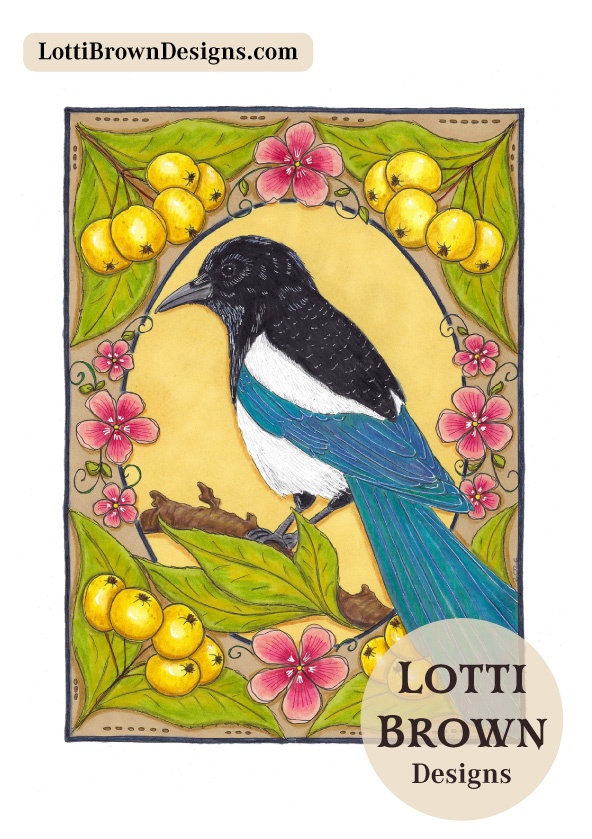 Magpie art by Lotti Brown
I love to see beautiful magpies when I’m on my walks out in the fields – their colours are amazing, with the dramatic contrast between black and white subtly shimmering with brilliant blue and green as their feathers catch the light. In sunshine they almost seem iridescent, as if carrying a little piece of the sky with them.
The pair of magpies I see on my walk always seem busy, chattering constantly about their daily comings and goings – and I love the way they fly so straight and true with long outstretched tail – immediately recogniseable and with a grace and confidence in their poise that I think is quite distinctive. I always wonder what they’re up to and what they’re saying to each other when I see them.
The magpie is a handsome and extremely intelligent bird – and one that I feel suffers a lot in popular perception from the myths, folklore and superstitions that surround this highly unusual bird...
Meet the Magpie – What’s in a Name?
The Eurasian Magpie, Pica pica, was originally known, from at least as early as the 13th century) as ‘pie’ – thought to mean ‘pointed’ referring either to its pointed beak or tail.
Now we know the term ‘pied’ as meaning black and white. But it’s thought that this came from the black and white plumage of the magpie and was then used to refer to other birds with similar ‘pied’ colouring. The Latin name Pica pica also comes from the word ‘pied’.
It was colloquially known as ‘Maggie Pie’ – it was quite common to give a proper name to a bird (for example Jenny Wren, Jack Daw, Robin Redbreast). Maggie is a diminutive of Margaret which was sometimes used to mean a woman – supposedly because the chattering of the Maggie Pie sounds like the conversation of women.
And actually, by the Middle Ages, gossiping women began to be called ‘pies’ after the magpie!
It shows how familiar people once were with these very noticeable birds who have lived for centuries alongside humans.
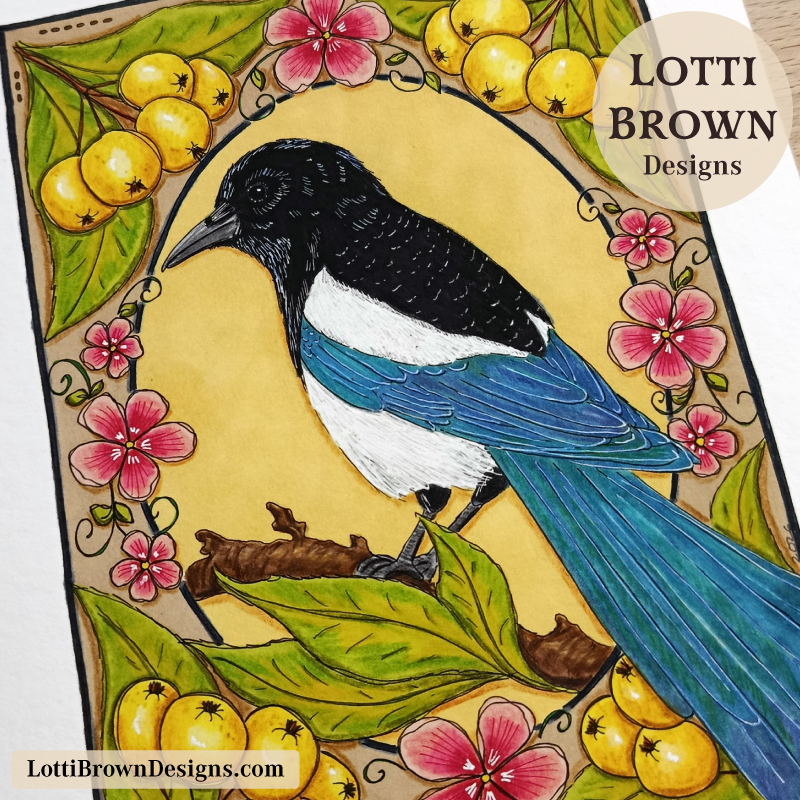 Meet the Magpie!
Other common names for the magpie:
- Pie, Piet
- Pianet – this is a Northern English name for the magpie from ‘pie – anet’ with ‘Anet’ being a shortened version of ‘Agnes’
- Pianate, Pyenate
- Mag, Madge, Margaret, Marget,
- Maggett
- Miggy
- Mock-a-pie
- Nanpie
- Tell pie
- Ninut
- Pye mag
- Pie nanny
- Hagister
- Haggess
- Chatterpie
- Cornish pheasant
Ancient Magpie Folklore
The Ancient Romans (correctly) believed that the magpie was a highly intelligent bird (more on that later) and kept them as pets to warn of approaching strangers with their chattering.
Even in later times, magpies continued to be kept with livestock to protect them with their noisy chattering. And because the magpie was such a perfect early warning system it became a folklore belief that the chattering of magpies would predict the arrival of a stranger.
While the Ancient Greeks associated the magpie with Bacchus, the god of wine… wine makes tongues loosen in idle chatter.
In Greek legend, the Pierides (note the use of the word ‘pie’), nine Thracian maidens, boastfully attempted to rival the famous 9 Muses but were defeated in a singing contest and the Muses turned them into magpies. In Ovid’s poem of the legend, in his ‘Metamorphoses’, he associates them with envy, presumption, snobbery and idle gossip.
Various Native American communities believed that the magpie was omniscient, was a messenger of the creator, a shamanic guardian, and associated with a fearless spirit.
Celtic Magpie Mythology
In Celtic myth, black birds were sometimes associated with the battlefield and with the mysteries of life and death, while white birds were often seen as symbols of purity or good fortune.
The magpie took an awkward position, encompassing both qualities in its black and white colouring. Perhaps because of this striking contrast, the magpie came to represent the balance of opposites - light and shadow, wisdom and mischief - a bird that seemed to live comfortably between worlds.
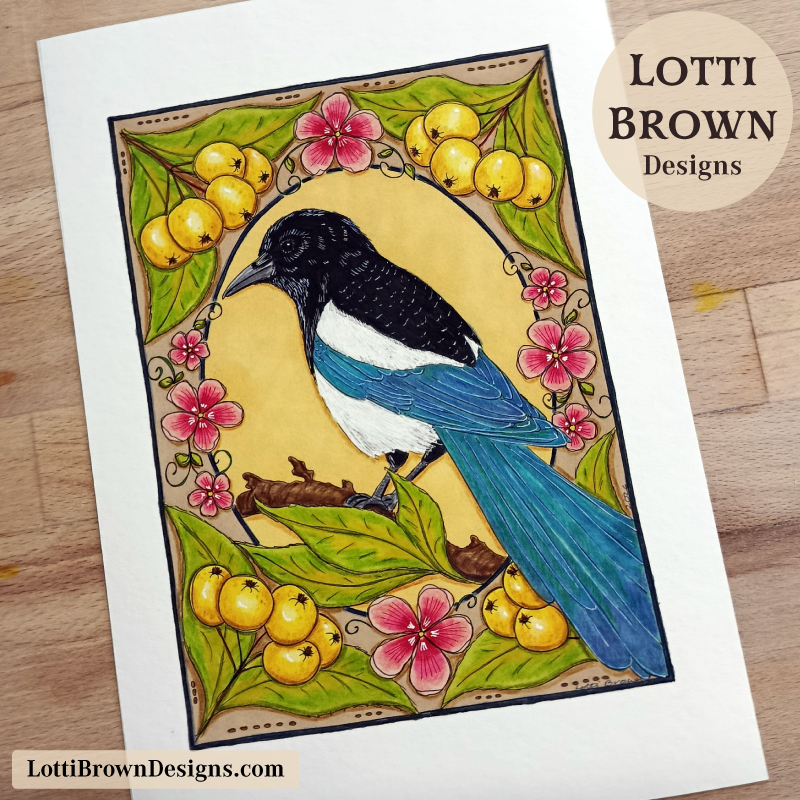 Magpie art print
Christian Magpie Mythology
In the Christian tradition, the magpie started to be further distrusted and disliked. It was believed that the magpie would not go inside Noah’s ark with the other birds and preferred to sit outside in the lashing rain “jabbering over the drowning world”. It was also said that the magpie did not sorrow at Jesus’ death and was not baptised.
These stories tell us more about human fears and beliefs than they do about the bird itself - whose intelligence and lively character likely made it seem mysterious and unpredictable to earlier generations.
The black and white colour of the bird led people to believe that the magpie was a cross between a raven and a dove and because of this it was not ‘baptised in the waters of the Deluge’.
The magpie held a little of the qualities of both the raven and the dove – again, the darkness of the bird of the battlefields and the purity and peace of the sacred dove.
It was thought that the magpie had the devil’s blood in its tongue – and if you cut the magpie’s tongue it would be capable of human speech. We now know that magpies can indeed mimic human speech, so it’s understandable how this skill might have led people to believe the bird had the devil in it.
Magpies and the Folklore of Luck
It was once said to be unlucky to see a single magpie – yet this idea was never universal, and many traditions tell a very different story. In many parts of the world the magpie is actually a bird of joy, good news, and good fortune.
It’s common to greet or ‘salute’ a single magpie when you see one - a superstition I and all my friends certainly followed as a child (…and even into adulthood!). Still today, it’s common for people to greet a magpie: ‘Good morning, Mr Magpie. How’s your wife today?’
In some cases, it was actually very lucky to see a magpie or have one cross your path, and you should greet a magpie with the rhyme:
“Magpie, magpie, chatter and flee,
Turn up thy tail, and good luck fall me.”
There are various versions of the famous magpie rhyme which suggests a plethora of riches are associated with seeing magpies – and it seems that the more you see, the luckier you become…
One of the most famous pieces of magpie folklore is the rhyme:
One for sorrow
Two for joy
Three for a girl
And four for a boy
Five for silver
Six for gold
And seven for a secret never to be told.
In addition, it was believed in some areas that to see a magpie on the roof of your house is very lucky and protects your home!
While some European superstitions viewed the magpie with suspicion, many cultures celebrate the bird as a bringer of happiness and good news…
- In China, a singing magpie was thought to bring luck and happiness.
- In Korea, magpies are lucky – they are thought to bring good news or to invite good people into your life.
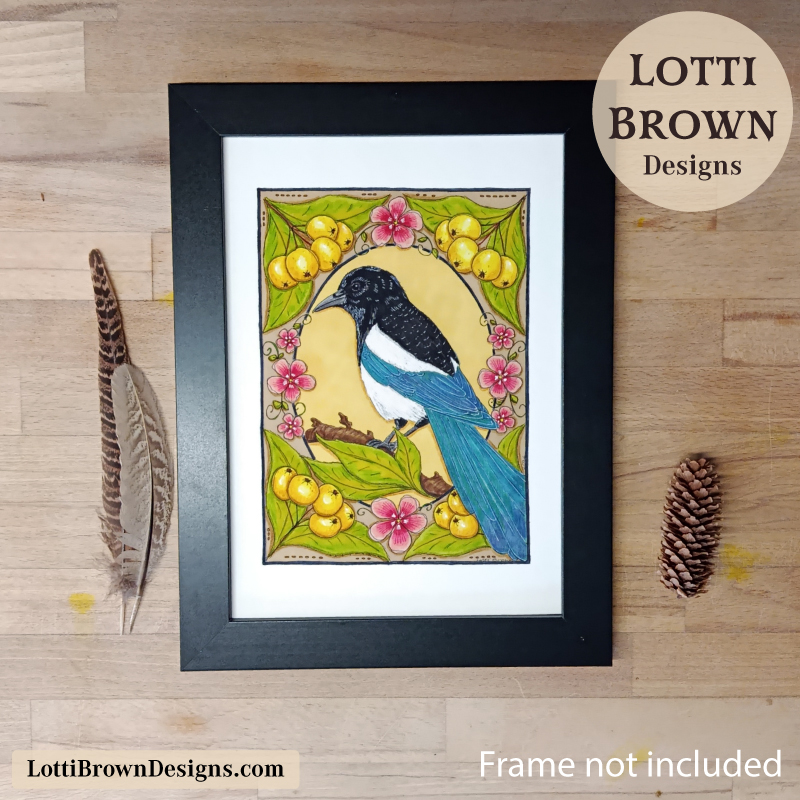 Magpie illustration
Magpies and Weather Lore
It’s said that a single magpie flying foretells stormy weather. Two magpies flying together means calm and mild weather.
And if magpies build their nests high, rainy weather is to come.
In Scandinavia, the magpie is also likened to Skadi, and ancient Norse winter goddess.
In Mongolia, it was said that magpies could control the weather!
Magpies and the Folklore of Love
In Chinese folklore, the birds were associated with a faithful marriage and were said to tell a husband if a wife was unfaithful.
Magpies are today believed to be monogamous birds and are commonly thought to mate for life.
The Chinese Qixi festival celebrates the annual coming together of the Cowherd and the Weaver Girl, when the magpies all gather at a celestial bridge where the lovers meet, so symbolising the coming together of man and woman.
A similar association is made in Scandinavian tradition, where the black and white colour of the magpie symbolises a balance of the masculine and feminine sexual energies.
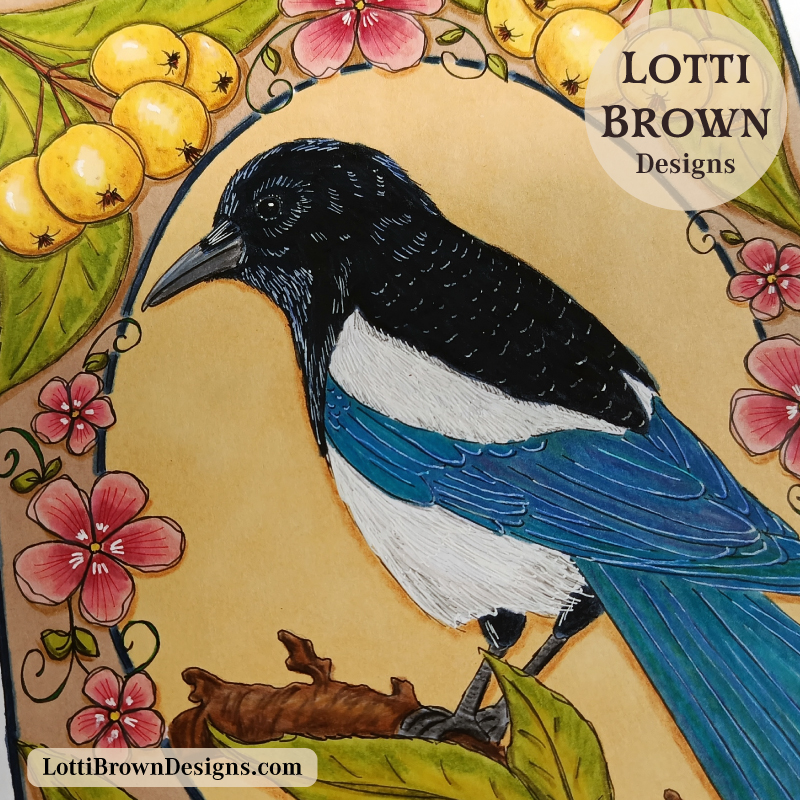 Magpie drawing (showing detail)
Magpies and Shiny Objects
In Western tradition, magpies do have a reputation for thieving and being attracted to shiny objects.
Modern studies have found no basis in fact for this assumption – and while it’s thought magpies may be curious about any unusual object, there’s no evidence that they’re particularly attracted to shiny objects over duller ones, nor that they take or ‘steal’ these away to their nests.
In fact, magpies may even be scared of shiny things and new things!
The Magpie’s Nest Folklore Tale
This is a mid-18th century tale about the magpie’s nest, written down from earlier oral folktales…
Once upon a time, the magpie was the only bird who couldn’t build a nest. The other birds felt sorry for her and decided to teach her – but for every piece of advice the birds gave her about nest-building, the magpie simply replied, “Ah, I know that already!”.
In the end, the birds felt they couldn’t show her anything more and left her to finish her nest herself – and that is why the magpie’s nest always looks unfinished and messy.
In fact, although it does look big and messy in the tall trees, the magpie’s nest has been carefully built, over up to 40 days and using up to 600 twigs in one nest. The nest is very large and dome-shaped – lined first with mud for structural integrity, and then with soft moss, feathers, grass and roots for a comfortable inner.
It’s perhaps through recognition of the magpie’s true nest-building skills that later versions of the folklore tale have the magpie as the nest-building teacher, teaching the other birds how to build their nests, but in this instance the other birds are the ones not listening properly – and thus their nests end up without all the excellent features of the magpie’s nest.
The Intelligent Magpie
Modern science has only confirmed what many ancient cultures suspected - that the magpie is an extraordinarily intelligent bird…
It’s known now that the magpie is an extremely clever bird – thought to be amongst the most intelligent non-humans and certainly amongst the most intelligent birds (alongside other corvid species).
Magpies are able to recognise themselves in mirrors. This is very rare amongst the animal kingdom. In experiments conducted on multiple species of animal and bird, only four ape species, bottle-nose dolphins, Asian elephants, and the Eurasian magpie (Pica pica) show this self-awareness (at the time of writing).
Scientists put a non-irritating coloured mark on the neck of magpies. When put in a cage with mirrors, and after seeing their own reflections, the magpies tried to scratch at their necks, seemingly to remove the marks. They had recognised themselves and also knew that there was something different to their anticipated appearance.
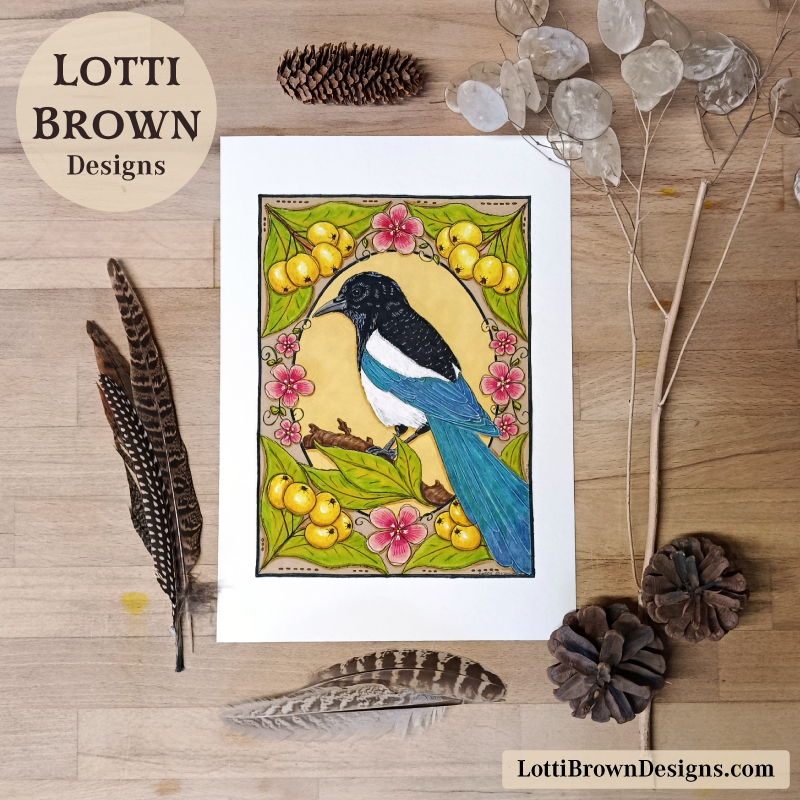 Magpie art print
It’s also been shown that the highly intelligent magpie also shares a similar type of emotional experience and social community to humans.
Dr Mark Bekoff, of the University of Colorado, has noted a case of magpies appearing to grieve for a fallen friend, gathering ritually around the body to keep vigil, calling out in sorrow, touching the corpse, and even laying ‘wreaths’ of grass alongside the body in an amazing ‘magpie funeral’. Further similar instances have since been recorded.
Magpies are also known to be able to count, imitate human voices, use tools, and gather socially for strategic group hunting or other reasons. We recognise this gathering of magpies in one of our collective nouns for a group of magpies – a parliament of magpies. A ‘mischief’ of magpies is also commonly used – cheeky chappies!
I love to see groups of magpies gathering in the fields near our village – they gather in the trees calling out loudly – it always seems a mysterious gathering to me, but it’s likely that it’s for deciding matters of territory and choosing mates that they gather in community like this.
I think it is their social intelligence and their excellent communication skills that makes them such an interesting and very impressive bird.
Magpie Symbolism and Meaning
MagpieThese are fascinating and intelligent birds, as well as being strikingly beautiful - certainly worthy of admiration and respect. Across cultures, magpie symbolism often reflects intelligence, communication, and curiosity.
- Magpies are wit and intelligence.
- They are communication and society, protection and community.
- They are loving and faithful, mating for life.
- They also have a strong sense of self or self-awareness – which makes the magpie independent and confident.
They are a balance of black and white, good and evil, masculine and feminine, shadow and good fortune – the essential duality of life.
Perhaps that is why the magpie continues to captivate us - a bird both ordinary and extraordinary, full of intelligence, beauty, and quiet mystery.
Drawing my Magpie
After learning about the many stories surrounding the magpie - some wary, some admiring - I found myself drawn most strongly to the bird’s intelligence, beauty, and sense of partnership.
I drew my magpie together with beautiful golden crab apples. I thought that the little apples look like golden baubles, which links with the magpies’ reputed fondness for shiny objects.
I also know that magpies enjoy eating apples in autumn. The crab apple is our native apple and is associated, like the magpie, with protection - as well as love and fertility, which fits with the magpie being known for mating for life and symbolising love, loyalty and the coming together of man and woman.
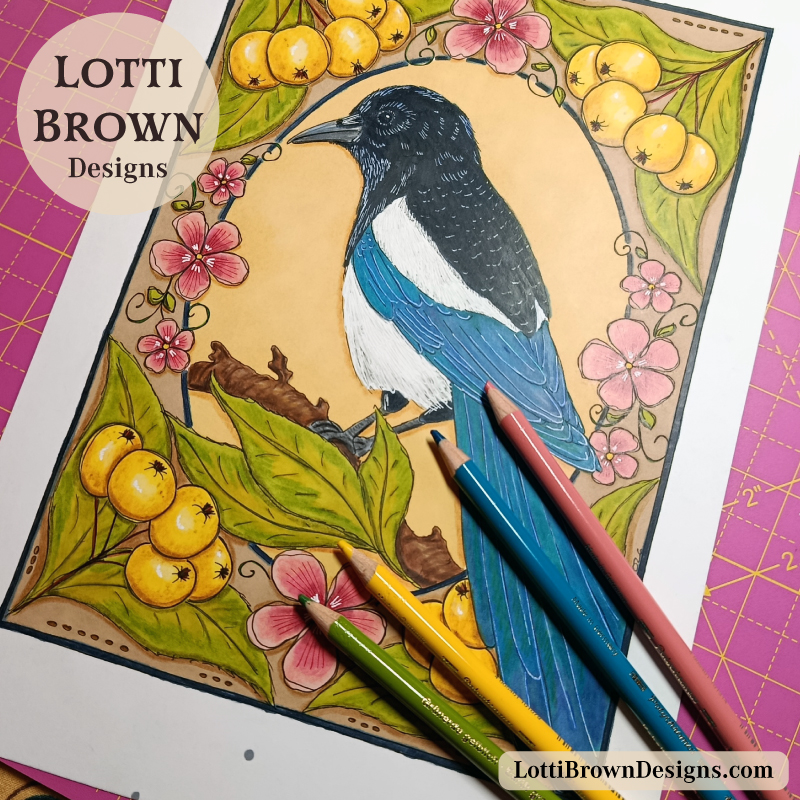 Magpie drawing with pens and coloured pencils
I loved adding all the different blue, green, teal and even purples into the magpie’s beautiful feathers – I tried to make her shimmer with quiet magic, reflecting the hidden colours that appear when the light catches her feathers.
I thought about how magpies have long been so important to us, and so closely associated with our lives – they’re instantly recogniseable and seem to perhaps recognise us as well, as they chatter to us when they see us. I like to think they greet us, much as we greet them.
The magpie is so intelligent and has a strong sense of partnership and community – but also a strong sense of self and confident independence.
My Magpie Art Print
Inspired by the magpie’s iridescent feathers and clever spirit - a bird that has shared our landscapes, stories, and superstitions for centuries...
Magpie and Crab Apple – original wildlife illustration by Lotti BrownMagpie (Duality, Curiosity, Brightness)
If the magpie has caught your attention - that contrast of black and white, that curious energy - this piece was created to reflect that balance.
It grew from those striking visual moments, where movement and pattern come together so clearly.
Take a closer look at the magpie artwork collection in my Teemill store here...
A piece like this brings a sense of contrast and lively presence into a space.
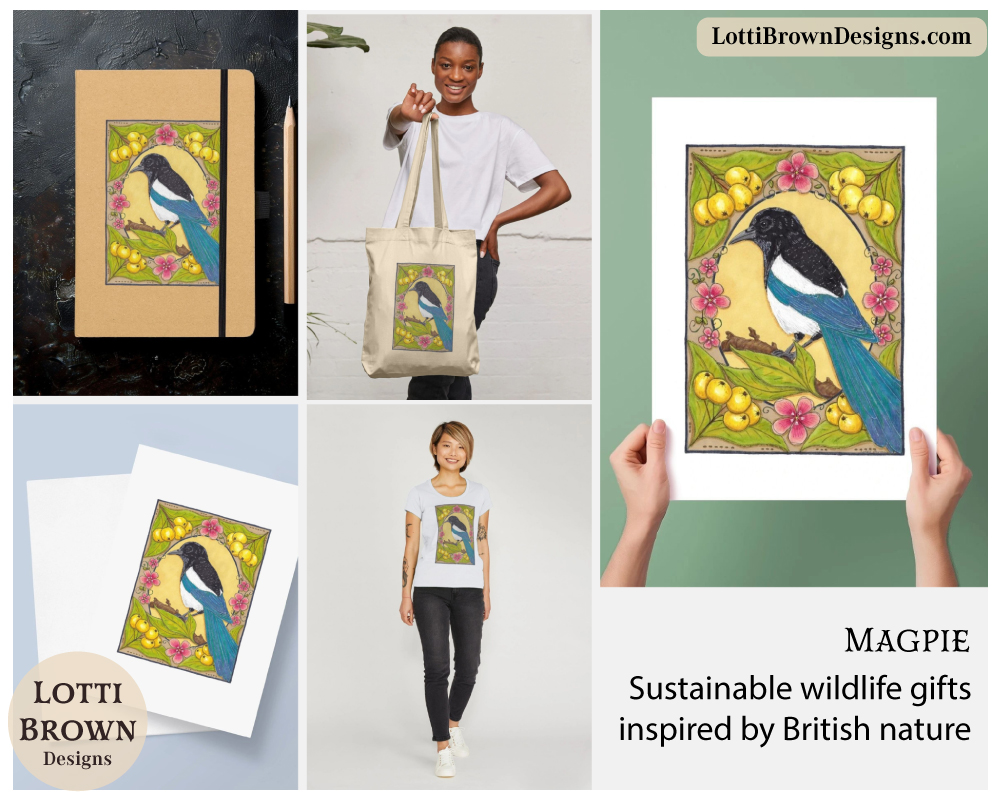
My magpie artwork is available as sustainable art prints, notebooks, greetings cards, tote bags and clothing in my Teemill shop.
Magpies have lived alongside us for centuries - clever, curious birds that have inspired a rich tradition of magpie folklore and symbolism, and stories of mystery, intelligence, luck, love, and mischief. Whether chattering in the hedgerows or flashing across the fields with their long, elegant tails, they remain one of the most recognisable and fascinating birds in our landscape.
If you enjoy exploring the folklore and symbolism of the natural world, you may also like my other nature folklore articles and wildlife artworks, where I share the stories, traditions, and quiet magic surrounding many of the animals and plants that live alongside us.
You may also enjoy exploring the folklore of the raven, blackbird, and other birds of myth - including the other corvids...
You can also discover my earlier artworks, including my Celtic tree calendar artworks and Celtic nature art.
If you enjoy nature, why not start your own nature journal?
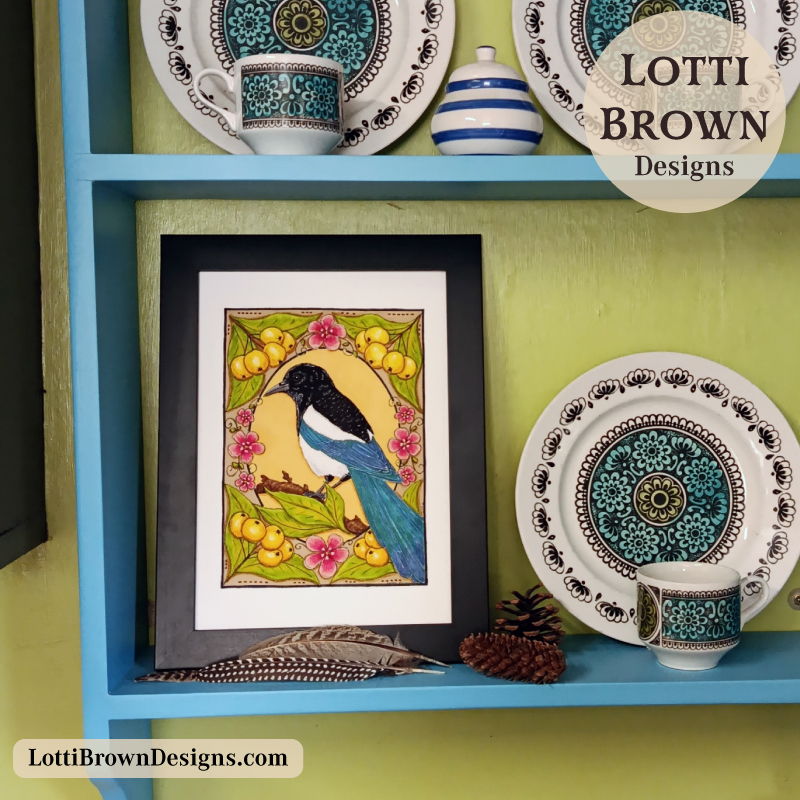 Magpie art on display in my home
Further Reading/Rescources
- Discovering the Folklore of Birds and Beasts - book by Venetia Newall
- The Folk Lore and Provincial Names of British Birds - book by Charles Swainson
- A Dictionary of English and Folk-Names of British Birds - book by H. Kirke Swann
- British Birds: Names - Facts - Myths - book by Geoff Green
- Favourite Garden Birds – 'Dairy Diary' book
- A Treasury of British Folklore – book by Dee Dee Chainey
- Red Sky at Night – book by Jane Struthers
- Penguin Dictionary of Symbols
- Seven Birds and Their Mysterious Folklore - https://www.bbc.co.uk/programmes/articles/3HQl1RD2B9ny9PX8bYRBL9W/seven-birds-and-their-mysterious-folklore - website accessed 5th March 2026
- Six Fascinating Facts about the Misunderstood Magpie - https://focusingonwildlife.com/news/6-fascinating-facts-about-the-misunderstood-magpie/ - website accessed 5th March 2026
- Why are Magpies so Often Hated? - http://news.bbc.co.uk/1/hi/magazine/7316384.stm - website accessed 5th March 2026
- The Emotional Life of Animals by Marc Bekoff - https://www.dailygood.org/story/2418/the-emotional-life-of-animals-marc-bekoff/ - website accessed 5th March 2026
- Magpies & Superstition - https://www.birdspot.co.uk/culture/magpies-and-superstition - website accessed 5th March 2026
- Halliwell's Popular Rhymes & Nursery Tales - https://www.gutenberg.org/files/35707/35707-h/35707-h.htm - website accessed 4th March 2026

Shall we stay in touch..?
Each month, I share stories from my own nature journal, new art from my studio, and simple seasonal inspiration to help you feel more connected with the turning year - if you'd like to stay updated, please sign up with your email address below...
Recent Articles


-
Magpie Folklore and Meaning - Symbolism & Superstitions - Magpie Art
Oct 06, 26 05:02 AM
 Discover magpie folklore, symbolism, and superstitions from around the world. Explore the meaning of this intelligent and mysterious bird.
 -
Nature Journal Prompts
Oct 05, 26 04:42 AM
 Easy nature journal prompts to inspire and encourage you - one per week...
 -
Meaning and Symbolism of Ivy in the Celtic Tree Calendar
Sep 29, 26 05:05 AM
 Explore the meaning and symbolism of ivy as part of the Celtic Tree Calendar...
Shop My Current Artwork Collections

My art is available as sustainable art prints, notebooks, greetings cards, tote bags and clothing in my Teemill shop.
Find my stockists for all my earlier artworks here...
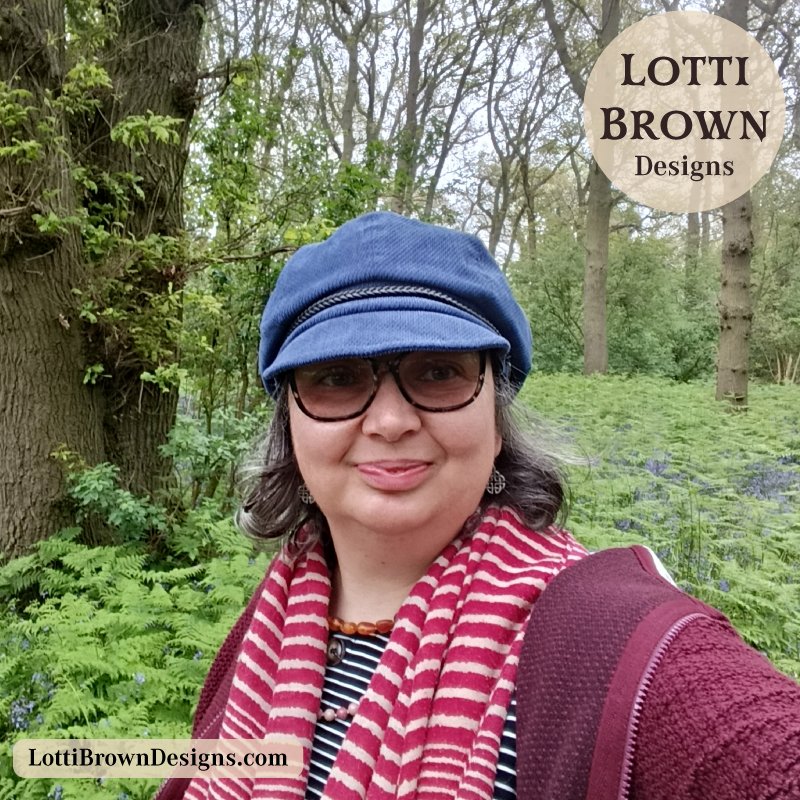
Lotti Brown is a self-taught nature artist and nature journaling educator whose hand-drawn work is inspired by wildlife, folklore, and close observation. With 18 years in creative fields and 10 years creating nature art, she brings deep practical experience to her work. Trained by the Wild Wonder Foundation, she shares nature journaling courses and guides online. Her artwork has been licensed internationally and exhibited at Goole Museum and Bridlington Spa in the East Riding of Yorkshire, UK.
Follow me:
Share this page: