
- Home
- Art
- Corvid Collection
- Rook Art & Folklore

Rook
Folklore, Meaning &
Hand-Drawn British Bird Art
By Lotti Brown
Discover rook folklore and the meaning of the rook in Britain - a bird of winter, community, weather wisdom, and ancient connection to land and trees - plus my hand-drawn rook illustration...
 Rook art by Lotti Brown
During the long months of winter, the rook keeps me company for those liminal moments of dawn and dusk. Our little house lies right under the flight path of a huge flock of rooks, who process sedately in cawing groups for 10 minutes or more as the flock leaves their roosts a little after sunrise to commute to the fields…
During the days, if I’m walking out in the fields, I see them in their flocks, busy about the ground, pecking and cawing – lifting off in a noisy eruption if disturbed.
And their homewards commute after sunset, cawing more as they stream away from the fields back to their roosts, hundreds or maybe thousands of birds passing back through the fields, past the village and onwards – this has long been my signal to hurry home from my walk before darkness falls.
The rooks have an excellent instinct for the moment they should leave, so that the whole group can reach the roosts before it’s too dark.
The rook has long held a place in British folklore, so let’s meet the rooks…
Meet the Rooks
The Latin for Rook is Corvus frugilegus.
Corvus is for the corvid family – corvus thought to relate to an iron bar similar to a crowbar – and frugilegus meaning ‘fruit picker’ – they do enjoy berries and other fruit.
The Rook is named from the Anglo-Saxon ‘hroc’ with suggested meanings of ‘croaker’ or ‘smoke-black’.
An alternative interpretation for the name is derived from ‘rau cus’ from its call.
 My rook drawing (showing detail)
Rooks, Crows & Names in Folklore
Once both rooks and crows were known as ‘crows’ - before I knew my rooks were rooks, I always used to call them ‘the crows’ – with common folklore names originating from their calls: ‘cra’ or ‘craw’.
This country saying is a good way of actually distinguishing rooks from crows without having to be close enough to see their distinguishing features, which isn’t always easy…
“A crow in a crowd is a rook,
A rook on its own is a crow.”
From the huge flocks of birds passing out and back along the same route at dawn and dusk each day during the winter months, we can know that my birds are rooks.
Crows tend to hang about individually or in small family groups of up to around 4. If there’s a flock of ‘crows’ they’re likely to actually be rooks.
Scarecrows would actually have been made to scare the rooks and not the crows, as it would’ve been the rooks gathering in big flocks in the fields. Often it is not actually the seed that the rooks are eating, but the grubs and leather jackets that they love, and which could cause harm to the crops.
Rooks seek safety in winter in community and the large winter flocks are actually made up from the birds of several rookeries…
Rookeries, Roosts & Ancestral Memory
A rookery is the ancestral home of the rooks – passed on through generations. Rookeries may have been in use in the same location over hundreds of years.
The rookery is the group of tall trees where the rooks have their nests. Each year, they return to the same location to nest. Rookeries are powerful symbols in rook folklore, representing continuity, protection and ancestral memory…
Rookeries are seen as very lucky, if you have one on your lands or in your village. Rooks were protected from harm or disturbance as it was thought that if the birds left a rookery it would foretell disaster for the family who owned the land.
If there was a death in the family, especially of the head of the family, it was believed that the rooks should be told – and the promise not to harm the birds should be renewed by the new head of the family.
Rookeries are for nesting – but they may or may not be where the winter roost is. In winter, the rooks from several rookeries will all roost together for safety, in tall trees, often in woodland.
Both rookeries and roosts can be very large. The largest recorded rookery in the UK is over 6,000 birds whilst the largest roost has around 65,000 birds!
The roost may be the ancient site of a rookery no longer used for nesting, but retained as a site of safety in the birds’ ancestral memories.
Sometimes, the rooks will gather at their own rookery at sunset, before travelling onwards together to the communal roost.
Rooks will fly for miles to reach their roost from their daytime grazing areas in open fields. Their flight path is very distinctive as they travel in a direct and straight line between their roost and their daytime area.
This is where the saying ‘as the crow flies’ comes from – the straight line flown by the rook to its roost site – remember that both rooks and crows used to be called ‘crows’.
The Rook through the Seasons
In midwinter, the rooks’ roosts are very large but they start to nest early, and for that they return to the rookeries.
This country saying notes the seasonal habits of the rook:
“And again goes the rook,
Nest at Brigit, egg at Shrove, chick at Easter.”
So by St Brigit’s Day (1st February) we will most likely see the rooks return to their rookeries where they refresh their old nests with new twigs, sometimes stolen from their neighbours’ nests!
By March, the rooks will roost again in their rookery and by Easter, when the April showers bring out the worms and bugs that the rook loves to eat, the rook chicks will start hatching.
Dry summers can be hard for the rooks, parching the earth until it’s hard and dry and making it difficult for the rooks who use their long beaks to search the soil for things to eat. Rooks tend to spend less time in the rookery now as they go abroad to search for food, while during the colder months they seek community in the large roosts.
 Rook art print
The Intelligent and Playful Rook
Rooks are highly intelligent birds and are also very playful.
Rooks will play with sticks, stones and will also play tug of war.
They also play in their flight, spiralling high as they enjoy the thermals and tumbling dramatically.
The rooks’ flight has even been used in folklore to predict the weather…
Rook Folklore & Weather Lore
Folklore tells us that the rook is able to foretell changes in the weather and it was once common for country folk to use the movements of these common birds to direct their daily chores.
Here are some that you might want to take note of – and see how accurate the rooks are at weather forecasting! Note that these sometimes contradict each other, so it’s likely that these were observed and accurate only in specific geographic locations.
If rooks sit in rows on walls and fences, rain is coming.
If rooks suddenly drop down in their flight, a storm is coming.
-------------
When rooks fly low, ice will come.
When rooks fly high, it will be warm.
-------------
“When rooks fly sporting high in air,
It shows that windy storms are near.”
-------------
“If rooks fly to the mountains in dry weather, rain is near.”
-------------
If rooks are at home in the middle of the day, it will rain,
If they go far aboard it will be fine.
-------------
If rooks perch on the living branches of a tree, the day will be fine,
If they perch on the dead branches of a tree, it will rain.
-------------
“If rooks feed in the streets of a village, it shows that a storm is near at hand.”
-------------
If the rooks feed busily and hurry over the ground in one direction in a compact body, a storm will follow.
-------------
When returning to the roost, if the rooks fly high, the next day will be fair, and if they fly low, it will rain.
-------------
This rich tradition of rook weather lore shows how closely people once watched these birds and felt them to be part of their daily lives…
 Rook illustration by Lotti Brown
The Holy Rook in British Folklore
The rook was traditionally seen as a religious bird in British folklore, in part because their rookeries were often in the tall trees of churchyards.
It was said that rooks sat quietly in trees to keep the sabbath, and particularly kept Ascension Day holy and would not work on their nests.
The rhyme ‘Who Killed Cock Robin?’ speaks of the religious credentials of the rook:
“Who’ll be the parson?
I, said the Rook,
With my little book,
I’ll be the parson.”
Another folklore tale tells us that the rook was once a white bird, but turned black for sorrow, while mourning the crucifixion.
Folklore Tales of Rooks and Trees
A British folklore tale of rooks and pear trees…
Once upon a time, there were five beautiful pear trees along an old country road, they bore delicious pears that were the best ever tasted…
The story goes that these pear trees had once grown in a luscious meadow, close to a rookery – and the rooks very much enjoyed earing the pears.
One day, the landowner decides he is fed up of the rooks eating the pears, and he gets his gun and starts shooting at the rooks eating his pears.
The rooks are startled by the gunshots and as a flock rise up into the air. But they keep tight hold of the pear trees and lift them up as they fly away, roots and all.
Eventually, the trees become heavy and the rooks drop the trees into a hedge by a country road. The trees take root and continue to bear their delicious fruit, and the rooks are free to continue to eat the pears – while the ungenerous landowner who refused to share with the rooks now has none!
 Rook art print
Rook Symbolism & Meaning
The rooks are dramatic birds – the black colour and huge flocks with their evocative cawing seem full of portent, yet rooks were often seen as a bird of protection and good fortune.
The rook is closely linked with the weather – a bird of rain and storms – yet also a bird of dry, still days and soaring flight.
In British folklore, the rook is a bird of winter – a bird that tells us to seek community in our darkest days.
The rook is a bird of wit and intelligence – very clever – and yet playful and light, taking pleasure in playtime and their abilities on the wing as they tumble through the air and ride the thermals for pure joy.
The rook tells us to seek a clear direction, and to follow it, with their direct flight paths.
The rook is a bird that connects us with ancient wisdom – following ancestral knowledge in their habits – and connecting us with the natural world through the weather lore of the rook.
Drawing my Rook
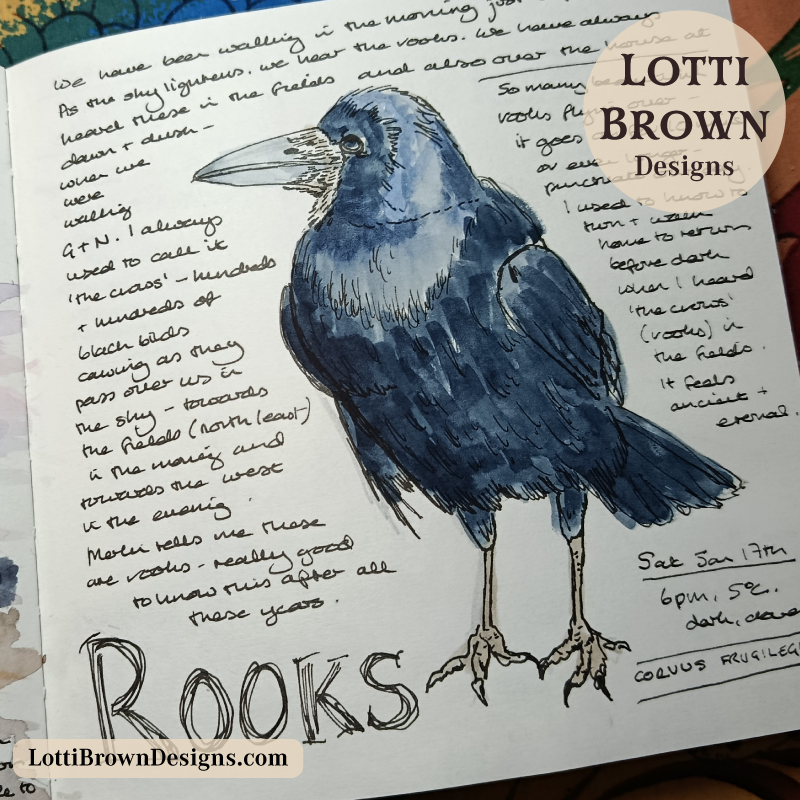 My rook nature journal page inspired my rook illustration
I was inspired to draw my rook after drawing a rook in my nature journal in January, hearing the rooks overhead at dawn and dusk, and seeing them feeding in the fields behind my house.
Rooks have always felt like part of this place, part of the rhythm of the seasons as they pass over each day and I loved them for that – but when I started reading more about the folklore of the rook, I started to really adore this bird and appreciated more of how intelligent and interesting rooks are.
 I layered up pens and coloured pencils to create my rook drawing
I added acorns and oak leaves to my rook drawing, as I read that acorns were the rooks favourite food. I wonder if they hide them like jays?
The acorn, growing into a tree, also symbolises the tall trees that form the rooks rookeries and roosts and are such a big part of their lives.
I loved drawing the rook, adding blue tones under the blacks in his feathers to try and show the depth of colour in there as I layered up the pens and coloured pencils.
My Rook Art Print
Rook art print - by Lotti BrownCreating this artwork, I tried to feel the ancient belonging of the rook to the land and the trees – so much so that they feel like a part of the land, the trees, the skies, even the rain and storms – not just a bird to see, but even the sound that fills the air around us – the soft cawing that feels like a communication between the birds and the land and skies.
Rook (Community, Intelligence, Rookery Life)
If the rook has stayed with you - that sense of movement and sound within a rookery - this piece was created to reflect that shared presence.
It grew from watching their social nature, the constant coming and going, and the feeling of life gathered together in one place.
Take a closer look at the rook artwork collection in my Teemill store
It’s a piece that brings a sense of connection and quiet activity into a space.
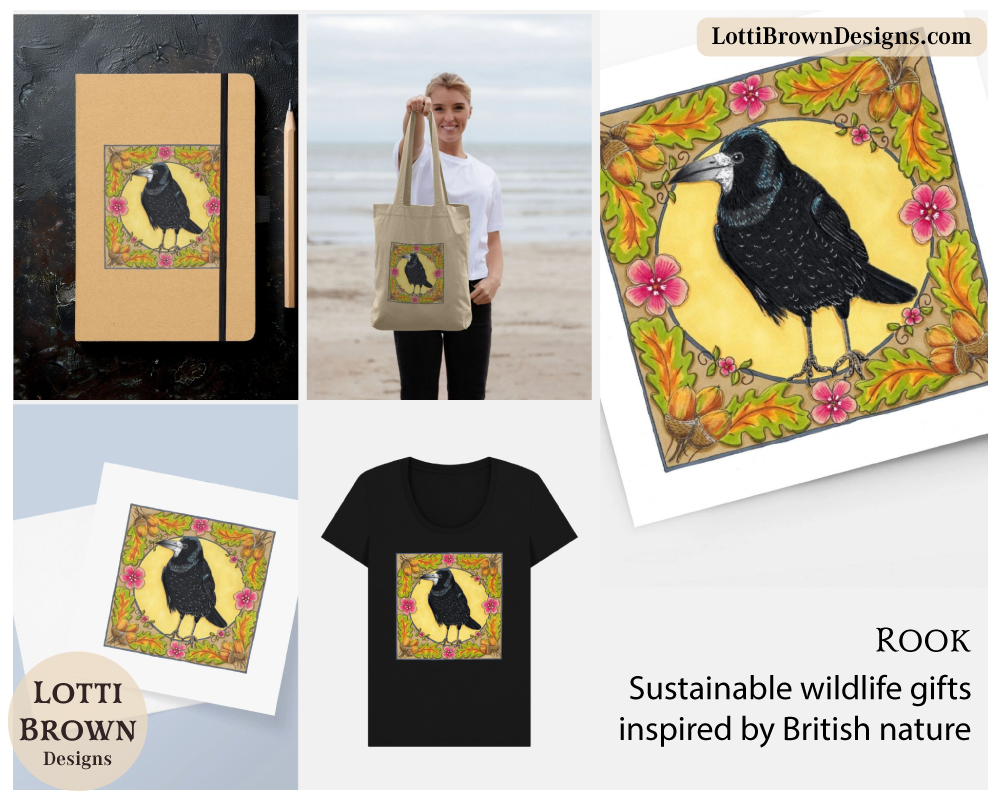
If you’d like to bring the rook’s ancient belonging to your home, too, my rook artwork is available as sustainable art prints, notebooks, greetings cards, tote bags and clothing in my Teemill store…
You might also like some of the other birds in my corvid collection – discover more corvid folklore and artwork here…
Also:
You can also explore more British bird folklore and artworks here (recent) – and earlier bird art and Celtic bird and nature art here…
If you enjoy learning about the folklore of the natural world, you can explore more nature-inspired folklore here…
If you’re interested in starting nature journaling, or just peeking into my own nature journals, you can discover more about nature journaling here…
 Rook art displayed in my home
Further Reading/Resources
- Discovering the Folklore of Birds and Beasts - book by Venetia Newall
- The Folk Lore and Provincial Names of British Birds - book by Charles Swainson
- A Dictionary of English and Folk-Names of British Birds - book by H. Kirke Swann
- British Birds: Names - Facts - Myths - book by Geoff Green
- RSPB Bird Tales: Traditional Stories, Folklore & Activities - book by Dawn Casey

Shall we stay in touch..?
Each month, I share stories from my own nature journal, new art from my studio, and simple seasonal inspiration to help you feel more connected with the turning year - if you'd like to stay updated, please sign up with your email address below...
Recent Articles


-
Barn Owl Folklore & Meaning - Symbolism of the Barn Owl
Sep 15, 26 03:34 AM
 Explore barn owl folklore, symbolism and meaning, from ancient myths to British traditions. Discover the quiet wisdom and mystery of this ghostly bird.
 -
Bramble Meaning, Myth & Symbolism - Celtic Tree Calendar Art
Sep 02, 26 11:32 AM
 A look at bramble meaning, myth and symbolism as I share my bramble Celtic Tree Calendar art for the month of 'Vine'...
 -
Nature Journal Prompts
Aug 26, 26 04:05 AM
 Easy nature journal prompts to inspire and encourage you - one per week...
Shop My Current Artwork Collections

My art is available as sustainable art prints, notebooks, greetings cards, tote bags and clothing in my Teemill shop.
Find my stockists for all my earlier artworks here...
Lotti Brown is a self-taught nature artist and nature journaling educator whose hand-drawn work is inspired by wildlife, folklore, and close observation. With 18 years in creative fields and 10 years creating nature art, she brings deep practical experience to her work. Trained by the Wild Wonder Foundation, she shares nature journaling courses and guides online. Her artwork has been licensed internationally and exhibited at Goole Museum and Bridlington Spa in the East Riding of Yorkshire, UK.
Follow me:
Share this page: