
- Home
- Wildlife Art
- Deer Folklore

Deer Folklore
Ancient Myths, Meaning & British
Legends
By Lotti Brown
Explore the myths, legends and symbolism of deer in Britain, from Celtic stories and white harts to the quiet magic of encountering a wild roe deer.
The deer is one of our ancient magical creatures of Britain – considered as sacred, and linked to the Otherworld for thousands of years…
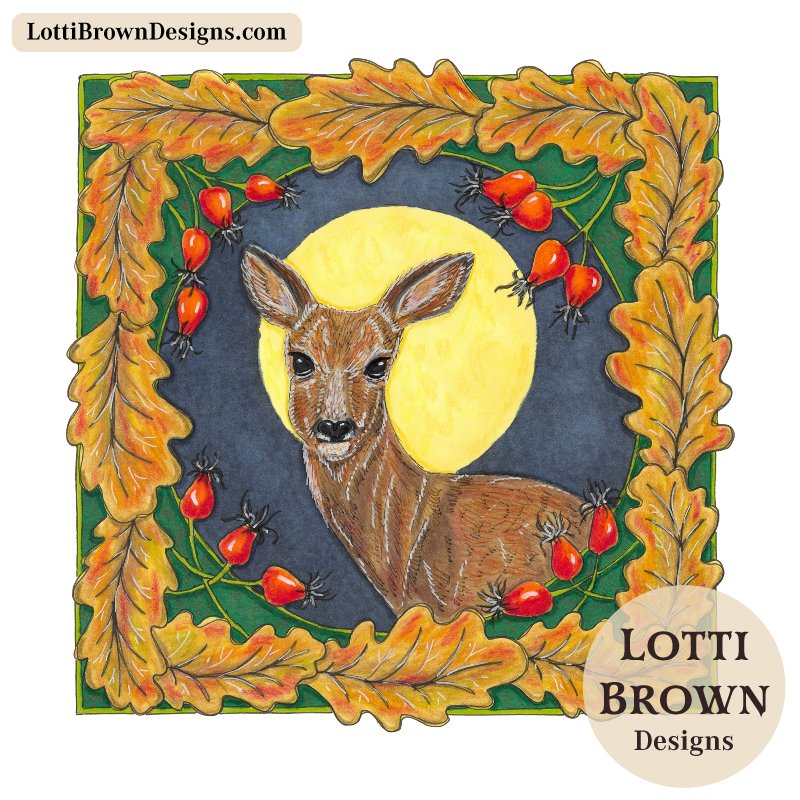 Hand-drawn deer art by Lotti Brown
Deer folklore is some of the oldest surviving folklore in Britain. Even today, deer still feel somehow different. They continue to appear in folklore, stories and legends, reminding us of humanity's long and enduring connection with the natural world.
Every moment of connection with a deer is unique – the deer is a truly wild animal that makes its home in our fields and forests and does not see hedges as boundaries.
I remember a quiet meeting with a deer, one morning many years ago, walking in the woods with my dog – along a quiet grassy track, a deer stood framed by the trees and met my eyes for a long moment before disappearing almost as quickly as she had seemed to appear.
Many encounters with deer are fleeting - little more than a glimpse - but sometimes we're lucky enough to meet them eye to eye. Moments like these feel like true encounters, where, for just a second, we recognise one another as fellow beings sharing the same landscape.
More recently, the deer seem to come closer still to the village – we see the deer stood in a lane, in a field – and they stand silent and watchful as we pass...
Perhaps they feel no danger now, or recognise us from several encounters, as they no longer flee.
One summer morning, we had a very close encounter with a pair of beautiful roe deer who burst out of the tall maize growing in the field near to where we were walking, in a flurry of rustling and beating hooves.
 A memorable encounter with two roe deer, recorded in my nature journal
Each of the pair stopped, seemingly surprised by our presence so close – although perhaps less surprised than we were ourselves – I felt like I could’ve almost reached out and touched their velvet russet coats as their big eyes sought ours, perhaps for confirmation that we were safe humans.
That moment of connection – eyes meeting – then the deer took off again – the doe heading into the barley field and the buck off up the track, bellowing loud and repeatedly to the doe as he ran.
This encounter is something I’ll remember always – that brief moment of closeness and connection with two wild deer who paused in their gallop to seek our eyes.
I think we still see them since then, quiet and watchful as we walk by them in fields and hedgerows – and I think about them with wonder – how such large wild creatures can still live in our world, part of our world but apart from us, living in the wild edges of our existence, where sometimes, just sometimes, we’re lucky enough to cross paths and acknowledge each other as fellow souls.
 The deer seems comfortable with us near, standing and watching us as we pass
Perhaps that's why deer have always inspired stories. They live alongside us, yet remain wonderfully untamed, reminding us that true wildness still exists just beyond the edges of everyday life.
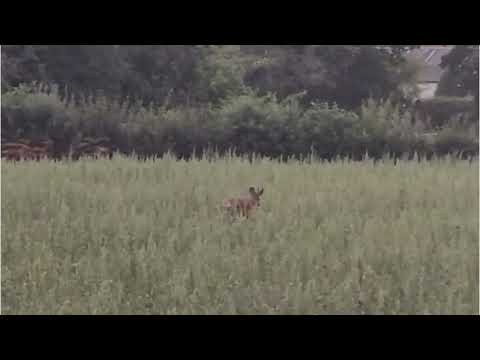
A deer we saw wandering in the field - he didn't spot us at all this time - so we stopped to video him rather than approach closer!
I’m going to explore some of our history with deer, the myths and legends we’ve woven around them, and how we relate to them and take meaning from them.
Across Britain and Europe, deer folklore appears in countless myths and legends. Although the stories vary, they often share the same themes of wisdom, guardianship, the Otherworld and humanity's relationship with nature.
The Roman Deer
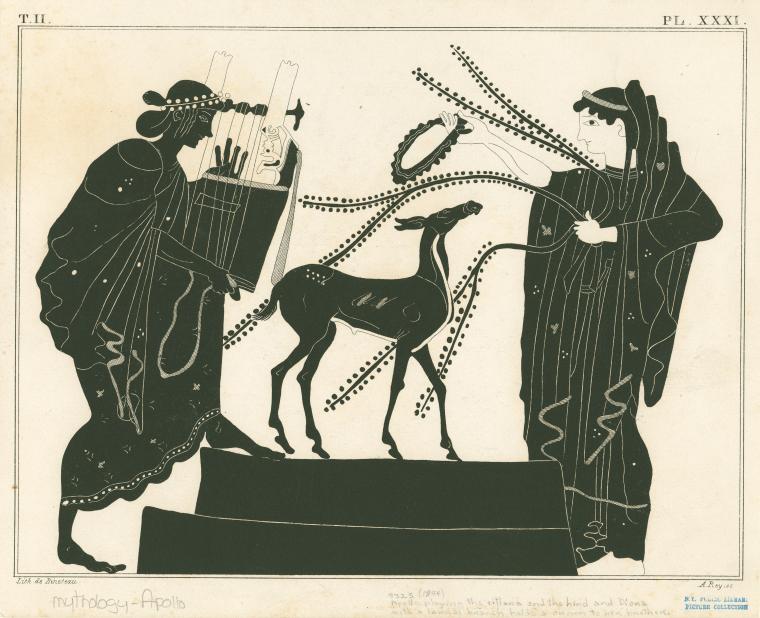
In the Greek and Roman mythological world, the goddess Diana/Artemis had four deer to pull her chariot, led by golden reins.
Herakles/Hercules searched for the fifth deer for a year and followed it to the land of the 'Hyperboreans', the primeval 'sages'. He captures the deer alive and carries it back to Mycenae.
The deer he takes is described as ‘brazen-footed’ – meaning with hooves of bronze. The deer was considered fleet of foot and can run tirelessly with hooves never wearing out – due to the hooves of bronze, perhaps? Bronze was considered a sacred metal in these times, so this associated the deer with being a sacred animal…
The creature was discovered in the land of the sages – thus equating Hercules’ quest for the deer with a quest for wisdom or knowledge.
It's striking that these ancient cultures linked deer with wisdom rather than simply speed or beauty - appearing as creatures that lead people towards knowledge rather than away from it.
This links also to the Celtic tales where the stag is a creature of wisdom and depicted as one of the five oldest animals in the world…
One of the Oldest Animals
The Arthurian tale of Culhwch and Olwen tells of the quest of King Arthur and his men who seek the whereabouts of Mabon, the Celtic ‘Divine Youth’ or ‘Son of Light’ who has been imprisoned in the underworld.
To gain the knowledge they need, the band of men seek the oldest animal in the world...
They find the Blackbird of Gilgwri, who directs them to an older animal, the Stag of Rhedynfr on Fenbrake Hill.
Although old and wise, the stag is not the oldest. He directs them to the Owl of Cawlwyd, who sends them to the Eagle of Gwenaby, who is able to point them towards the Salmon of Knowledge, who is the oldest and wisest animal in the world and can take them to the divine Mabon.
 My deer drawing
St Patrick and the Deer
In a striking demonstration of the magical strength of the deer symbol and the deer’s relationship to the symbolism of Christ, we see the 5th century Christian saint Patrick turn himself and his men into deer to escape a trap laid by the pagan king Loegaire mac Neill.
He achieves this through an enchantment from Irish mythology known as the ‘feth fiada’ which is usually used to invoke a magical mist for concealment.
St Patrick’s enchantment is a prayer called the ‘Deer’s Cry’ (Faeth Fiada) also known as ‘St Patrick’s Breastplate’. The incantation (‘fith-fath’) was used in the Highland glens even into the early 20th century.
Even Christianity, rather than replacing the symbolism of the deer, seems to have embraced it. The deer remained a creature of protection, guidance and spiritual significance.
Celtic Legends of the White Deer
In Arthurian legends, hunting the white stag (or white hart) was a ritual event that Arthur and his men would often participate in. The head of the stag was to be presented to ‘the fairest maiden in the land’.
One of the best-known themes in deer folklore is the appearance of the white stag. A white deer or stag was a frequent symbol in Celtic myth and legend – the appearance of a white stag would indicate a moment of portent in the story and often signified the commencement of a series of challenges for the hero.
The white colour of the animal would have been recognised by the story’s audience as a symbol of the magical Otherworld – so a white stag or hind was a magical beast who signified an opening into the Otherworld or message from the Otherworld.
Perhaps that's why the white deer still captures our imagination today. Even if we don't believe in an Otherworld, catching sight of a rare white deer still feels like witnessing something extraordinary.
The Tale of Finn McCool
In 3rd century Celtic Irish tales of the Fenian Cycle, the story of Fionn mac Cumhaill ('Finn McCool') has many links with deer…
Fionn was named ‘Deimne’ by his mother Muirnw, daughter of a druid. The name means ‘sureness’ or ‘certainty’ but is also the word for a young male deer.
Grown into a young man, one day Fionn is out hunting with his two Otherworldly hounds, Bran and Sgeolan. The dogs corner a deer, but recognise that it was no ordinary deer but a human in animal form, like themselves, and do not kill it.
The deer transforms into a beautiful woman from the fairy folk of the Otherworld of Tir na n’Og (the Land of Everlasting Youth). She has been transformed into a deer by the ‘Black Druid’ or ‘Dark Man’ Fear Diorich, as she refused to marry him. Her name is Sadhbh (Sava).
Once in Fionn’s land, she is able to live as a woman. Fionn and Sadhbh marry and she becomes pregnant. But the 'Black Druid' tricks Sadhbh and takes her away and turns her back into a deer.
Fionn searches for his wife, but to no avail…
After some years, Fionn is again out hunting with his two Otherworldly hounds, and they find a small boy, alone. They learn the boy has been living in a cave with a deer. One day, the deer was taken by a man, and the boy had been rendered immobile from that moment until saved by Fionn and his hounds.
Fionn recognises that the little boy is his and Sadhbh’s son. He calls him ‘Oisin’ (Ossian or Osheen) – meaning ‘little deer’.
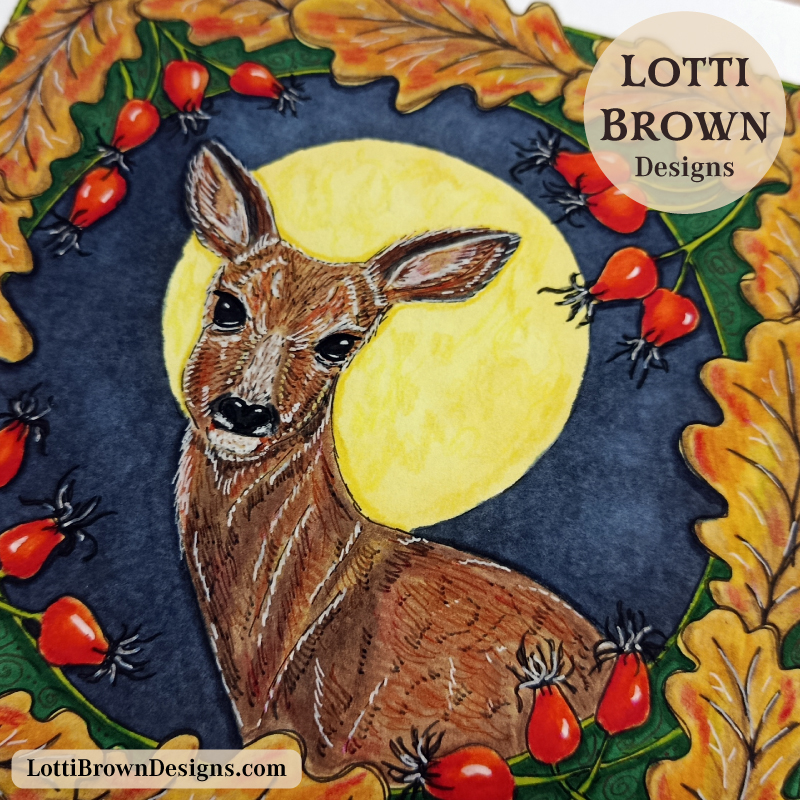 Deer
The Tale of Lugaid Laigde and the Loathsome Hag
Irish legends tell the tale of Lugaid Laigde, son of King Daire. Lugaid Laigde was one of five brothers, all named Lugaid (Lugaidh). A druid tells King Daire that whichever of his sons catches a beautiful running fawn with a golden sheen, he will become king.
The brothers all chase the deer and run into a mist. Lugaid Laigde catches and kills the deer. A ‘great snow’ falls, and the brothers seek shelter in the home of a ‘hag’, ‘loathsome to look upon’.
She asks each of the brothers to lie with her, but only Lugaid Laigde will. The ‘hag’ turns into a beautiful woman, who reveals herself as the ‘Sovereignty of Ireland’ which Lugaid Laigde will obtain.
This is part of a Celtic tradition linking a beautiful maiden to the sovereignty of the land. The king may rule, but he gains his authority through the permission of this lady, seen as a guardian or goddess of the land - and importantly, linked to the symbol of the deer which signifies the wildness of the land, guardianship of the land, and its sovereignty.
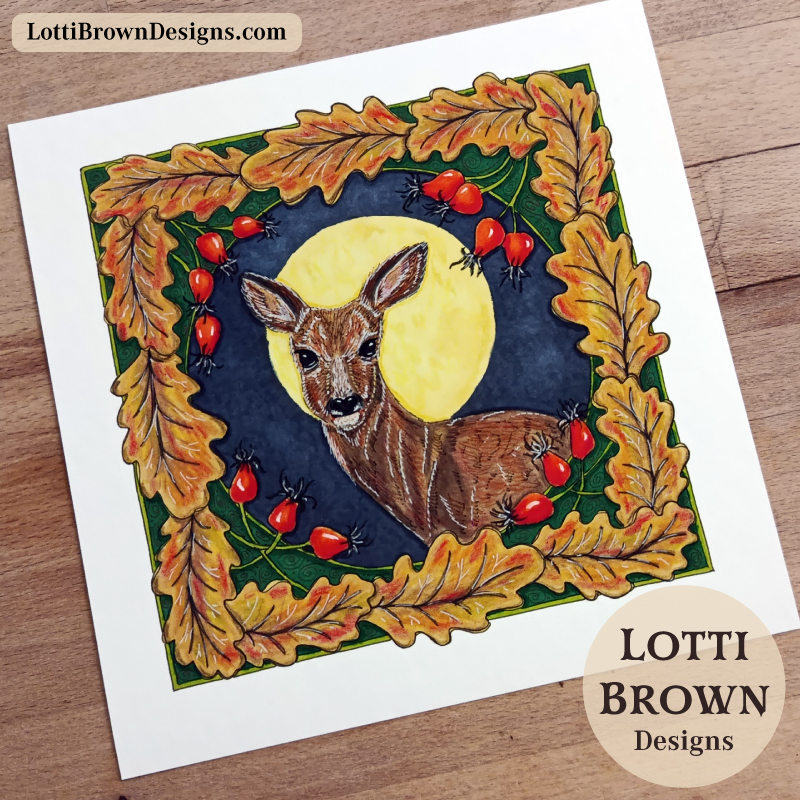 My deer art as a giclee print
Doe a Deer, a Female Deer
Whilst the male deer, the stag or hart, is often a symbol of strength, power and kingship, the female deer, the doe or hind, is the symbol of femininity or the land.
Just like the hag-maiden in the story of Lugaid Laigde, the female hind can be a symbol of the land or earth, particularly with reference to the symbolic marriage between heaven and earth.
In classical Greek-Roman mythology, the hind is sacred to the goddess of love and marriage – Hera or Juno - bringing a further aspect into this symbolism of marriage or partnership between male and female, the king and the land he governs, and the realms of heaven and earth (the land).
Deer as ‘Fairy Cattle’
Medieval Irish texts tell of Flidais, often seen as the goddess of cattle and deer, who possessed the ‘fairy power’ of milking ‘double cattle’ (cows and does).
In Scotland, the does or hinds were known as ‘fairy cattle’ and it was said that they were milked by the fairies.
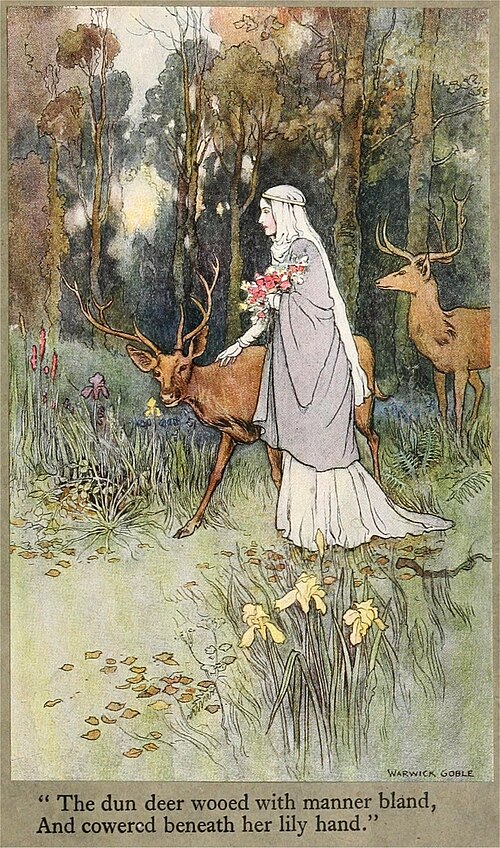 Illustration from 'The Book of Fairy Poetry' by Warwick Goble (via Wikimedia Commons)
The 'Cailleach' Guardian of the Deer
The fairy cattle, or hinds, are frequently protected by a ‘Cailleach’ or ‘Carlin’ (also a name for a standing stone) – an old-woman enchantress or fairy woman, or ‘hag-goddess’. Various islands or mountainous areas would have their own ‘Cailleach’ who cared for the deer herds in the area.
Folk fairy songs collected by Alexander Carmichael in the late 19th century refer to ‘The Carlin of Beinn Bhreac’ – ‘the tall carlin of the mountain spring’.
In the song, the Carlin or Beinn Bhreac calls:
“I would not let my herd of deer
Go seek the grey shells upon the strand.
….
They had rather the cresses green
That grow on the mead of the glorious springs.”
It’s clear that the Cailleach or Carlin is a fairy woman, and she is a guardian woman of the mountain, part of the land itself, responsible for the deer, the wild creatures of the mountain.
In Ireland, the Cailleach Bheura (The Old Woman of Beara) is described in a medieval Irish poem ‘An Chailleach Bheara’ - ‘The Lament of the Hag of Beara’. She is also sometimes known as the ‘White Nun of Beara’. She lives on peninsular on the coast of County Cork – today in the form of a rock. She herds her deer by the shore and is able to take the form of a deer herself and is considered a winter goddess.
I love the idea that even the wildest creatures were imagined to have a guardian. It reflects an older way of seeing nature - not as something to conquer, but something to care for.
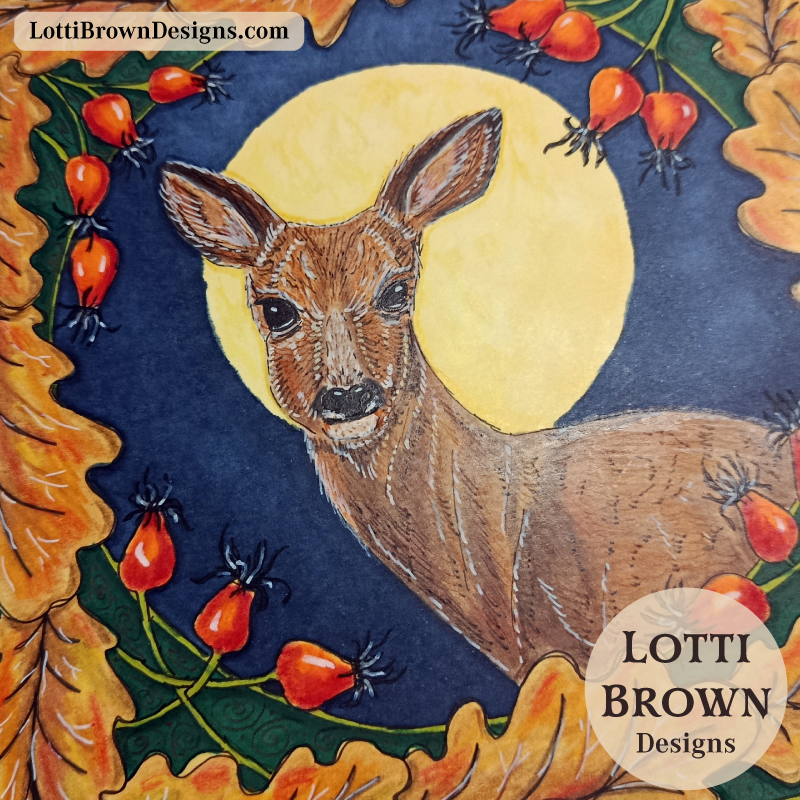
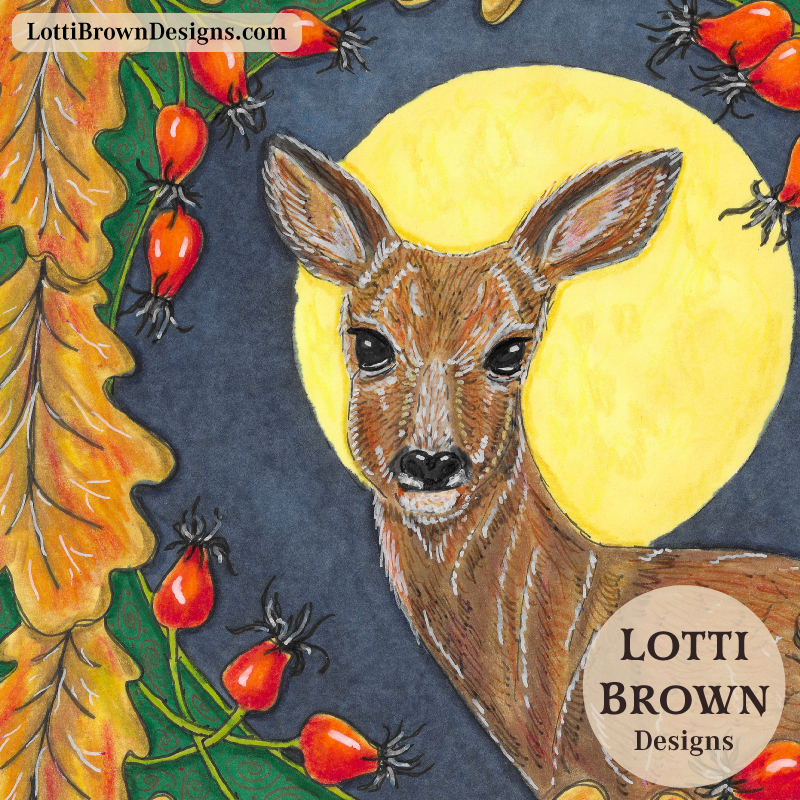 Deer artwork (showing detail)
The Enchanted Deer
In the Celtic tradition, the female deer, or hind, can often be a fairy woman who has been turned into a deer – and is considered a magical creature…
A Highlands folklore tale tells of a hunter, about to shoot a hind. Suddenly, a beautiful woman appears, to stop him – “I am the leader of my herd. I am under ‘fith fath’ (an enchantment). You must promise only to shot at stags, not hinds.” The hunter promises, and the beautiful woman disappears.
In a similar tale at Loch Ericht in Scotland, a hunter spotted a white hind. Unfortunately, on this occasion, the hunter allowed his dog to chase the fairy deer, and it led the dog into the loch, never to be seen again.
In a happier tale, a white hind was seen in the forest by the Lord of Kilmersdon, Somerset. His community were in a terrible situation of pestilence and death, but on seeing this magical white hind, he was filled with hope and was inspired to improve the lot of his community.
Even today, in Britain, the sighting of a wild white deer – a female hind or particularly the white hart or stag – is a newsworthy event that echoes with these magical and mythical tales.
Deer Meaning
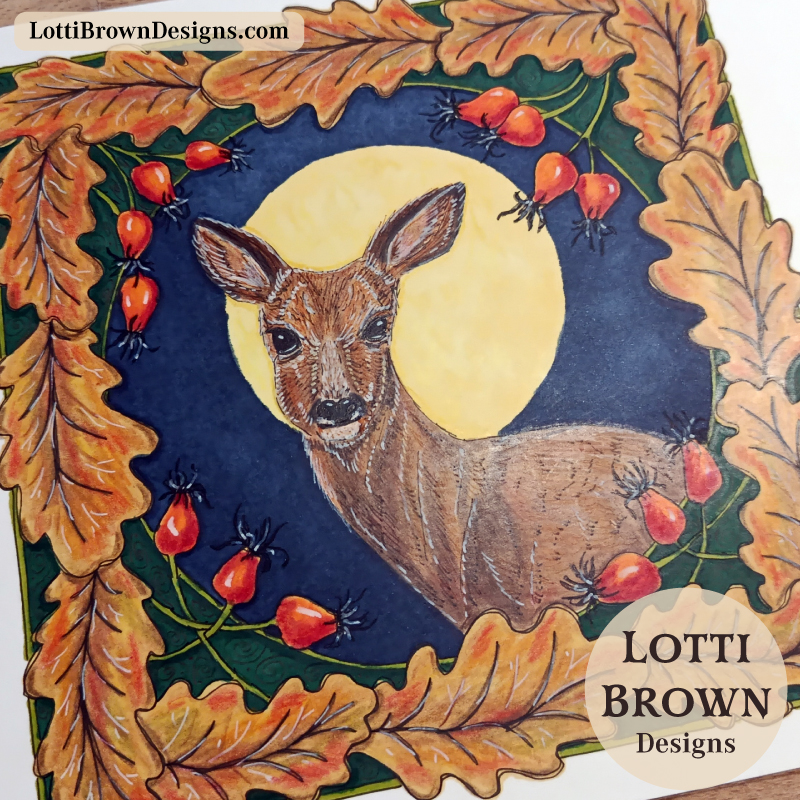 My deer drawing
Across all this deer folklore and stories, the deer seems to carry remarkably similar meanings. Whether appearing in Greek myth, Celtic legend or Christian tradition, the deer is rarely just an animal. It becomes a guide, a messenger, a guardian or a symbol of the wild landscape itself.
The stag often represents strength, courage and wisdom, while the hind embodies gentleness, protection and the living spirit of the land. Together they remind us that nature has always been seen as something worthy of respect rather than possession.
Perhaps that's why encountering a wild deer still feels so special today. Even if we no longer believe they step between this world and the Otherworld, many of us still pause when we see one...
For a brief moment, everyday life falls away and we're reminded that truly wild creatures still share our landscape.
Drawing my Deer Artwork
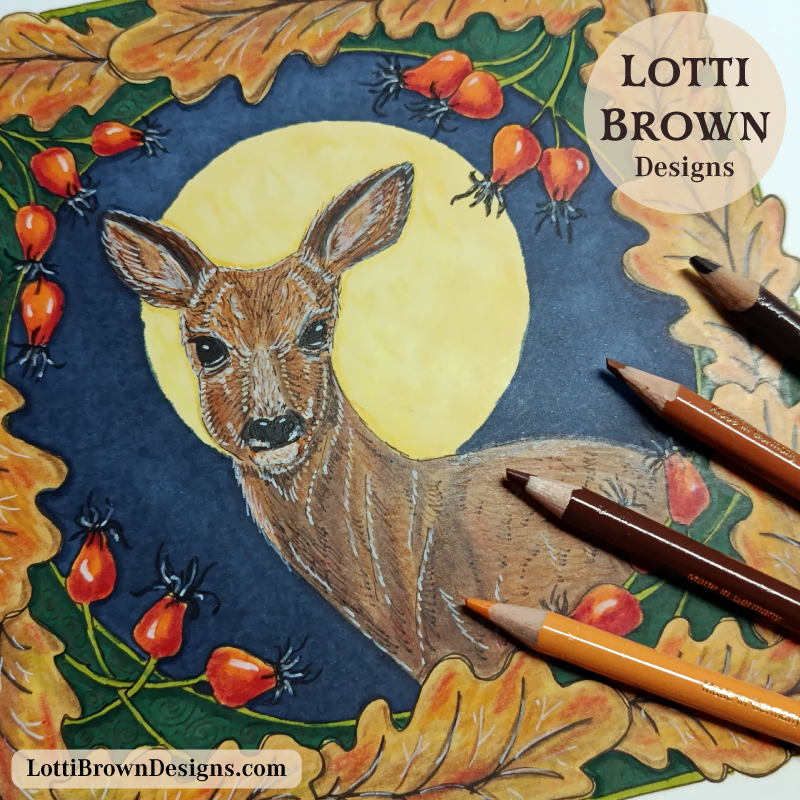 I drew my deer with pens and coloured pencils
After spending so much time immersed in deer folklore, I found myself thinking about my own encounters with deer – the times that I’d met the eyes of this truly wild creature and recognised a fellow soul.
I tried to recreate the velvety brown fur of the deer and the depth of her big eyes.
The deer feels gentle, yet immensely strong - graceful rather than fragile, alert rather than fearful. Looking into her eyes while I drew, I kept thinking about those quiet encounters in the woods and fields, and how they have stayed with me for years afterwards.
A symbol of the feminine and the history and stories of the land, she is the messenger between her world and ours – and so she ventures from the wild into the edges of our human world and meets our eyes so that we can understand her story.
If the story of the deer resonates with you too, you can explore my deer artwork collection in my Teemill store…
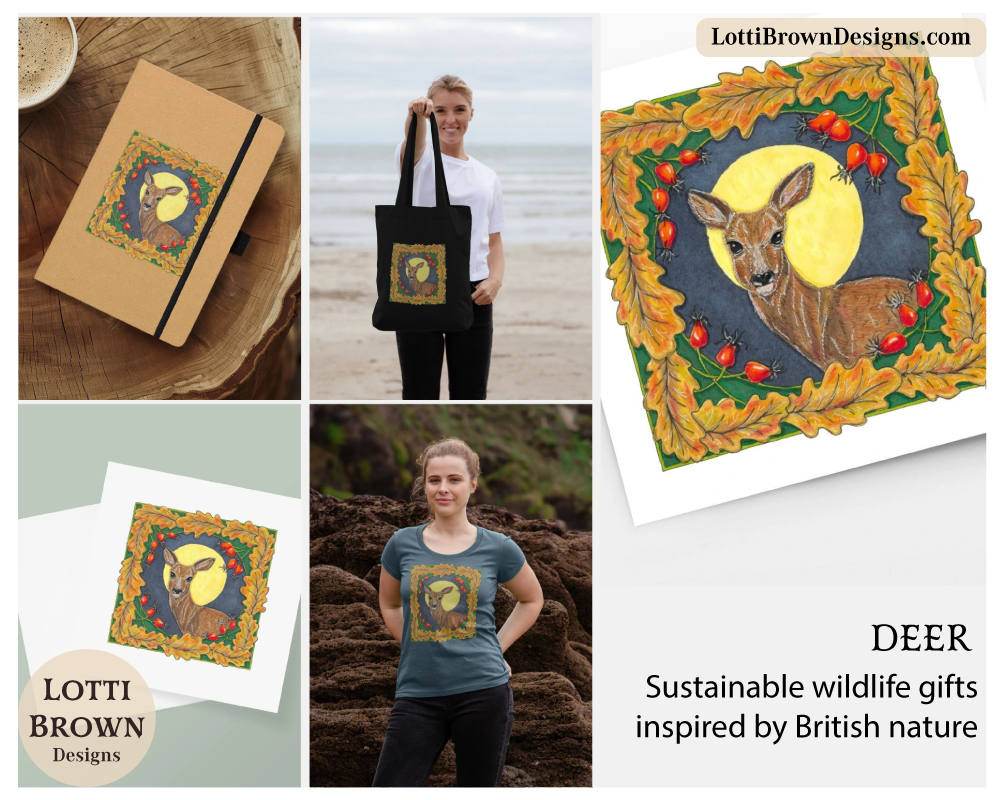
My deer artwork is available as sustainable art prints, notebooks, greetings cards, tote bags and clothing in my Teemill shop.
A Quiet Reminder of the Wild
A quiet connection with naturePerhaps that's why deer continue to hold such a special place in our imagination. Long after many of the old stories have faded, they still have the power to stop us in our tracks.
Most encounters with deer last only a few seconds. A movement between the trees. A silhouette standing quietly in a field. A pair of dark eyes watching us before melting silently back into the woodland.
Yet those brief meetings often stay with us for years.
Whether we think of the deer as a messenger from the Otherworld, a guardian of the forest, or simply one of Britain's most beautiful wild animals, it reminds us that there are still places where nature belongs to itself.
Perhaps that's why I love seeing deer so much.
Not because they're rare, but because every encounter feels like a quiet invitation to slow down, look a little more closely, and remember that we're sharing this landscape with lives every bit as rich and mysterious as our own.
I think that's perhaps that's why deer folklore still resonates today. These ancient stories remind us that the quiet wonder of meeting a wild deer hasn't disappeared - we are simply experiencing it in our own way.
Earlier Deer Artworks
I created these two deer artworks in 2019, using a mixture of my own drawings and digital technology...


You might also enjoy exploring more folklore of nature here - and seeing more of my British wildlife and bird art here...
Explore all my art here...
You might also like to discover the myths and folklore of the forest with my Celtic Tree Calendar trees section here...
Or think about exploring nature journaling - start here...
Have you ever thought about nature journaling..?
If you like nature, you might like to start your own nature journal!
Find out all about nature journaling here...
You can get started with my free guide here.
Or explore my gentle self-paced nature journaling course with nature journaling exercises to get you confident with nature journaling - take a look here...
References/Further Reading
- Dictionary of Celtic Myth and Legend – book by M.J. Green
- Animals in Celtic Life & Myth - book by M. Green
- The Druid Animal Oracle – book by P. & S. Carr-Gomm
- Beasts of Albion – book by M. Gray
- A Treasurey of British Folklore – book by D. Chainey
- Carmina Gadelica – book by A. Carmichael
- Penguin Dictionary of Symbols
- https://thewildgeese.irish/profiles/blogs/the-legend-fionn-mac-cunhaill - accessed 28th July 2026
- https://www.jstor.org/stable/291559 - accessed 28th July 2026
- https://www.folklorethursday.com/folktales/the-white-hart-of-hope/ - accessed 28th July 2026
- https://www.irishcentral.com/travel/best-of-ireland/cailleach-irish-goddess-winter-trail-ireland - accessed 28th July 2026

Shall we stay in touch..?
Each month, I share stories from my own nature journal, new art from my studio, and simple seasonal inspiration to help you feel more connected with the turning year - if you'd like to stay updated, please sign up with your email address below...
Recent Articles


-
Deer Folklore: Myths, Legends & Symbolism in Britain
Nov 11, 26 05:07 AM
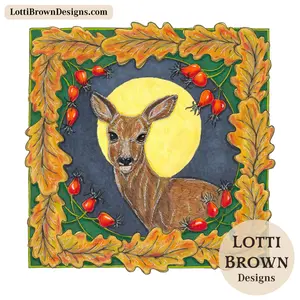 Discover the folklore of deer in Britain, from Celtic myths to the symbolism of the hind. Explore the stories, meanings & quiet wonder of a magical wild animal.
-
Nature Journal Prompts
Nov 02, 26 04:48 AM
 Easy nature journal prompts to inspire and encourage you - one per week...
-
Symbolism and Meaning of Fern/Reed for the Celtic Tree Calendar
Oct 28, 26 08:23 AM
 Explore the symbolism, myth and meaning of the fern (reed) as part of the Celtic Tree Calendar...
Shop My Current Artwork Collections

My art is available as sustainable art prints, notebooks, greetings cards, tote bags and clothing in my Teemill shop.
Find my stockists for all my earlier artworks here...
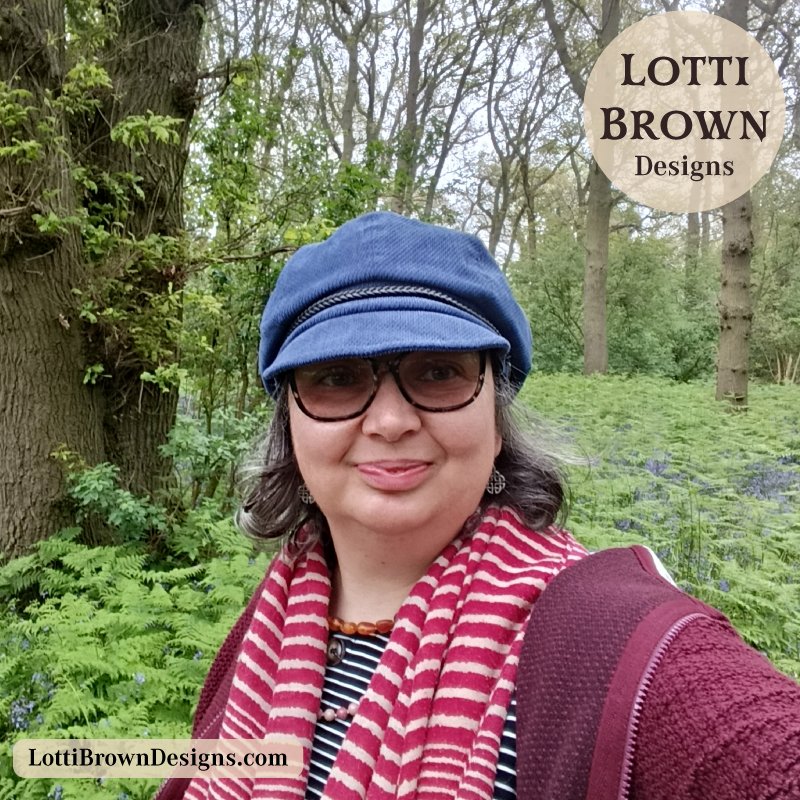
Lotti Brown is a self-taught nature artist and nature journaling educator whose hand-drawn work is inspired by wildlife, folklore, and close observation. With 18 years in creative fields and 10 years creating nature art, she brings deep practical experience to her work. Trained by the Wild Wonder Foundation, she shares nature journaling courses and guides online. Her artwork has been licensed internationally and exhibited at Goole Museum and Bridlington Spa in the East Riding of Yorkshire, UK.
Follow me:
Share this page: