
- Home
- Art
- Corvid Collection
- Jackdaw Art & Folklore

Jackdaw Folklore, Meaning
& Hand-Drawn British Bird Art
By Lotti Brown
Explore jackdaw folklore, meaning and symbolism - a bird of loyalty, community and intelligence - alongside my hand-drawn British bird art.
Jackdaws are birds of belonging. Their voices carry across rooftops, chimneys, church towers and old stone walls, stitching human places together with something wild, watchful, and deeply familiar. For many of us, the sound of jackdaws isn’t just birdsong - it’s a sense of home…
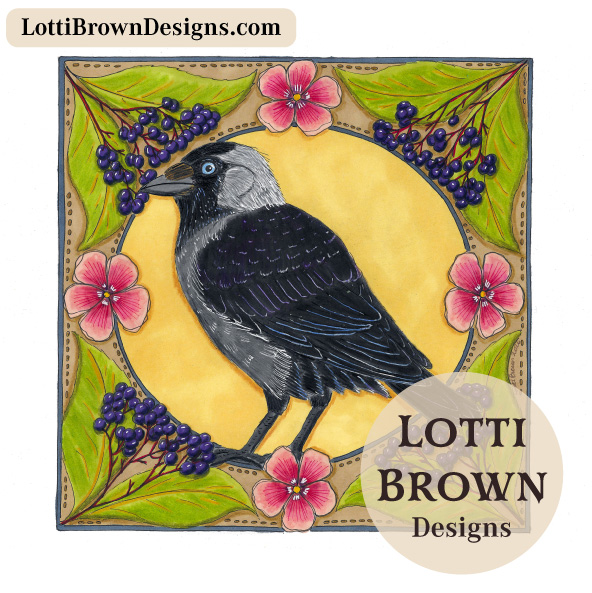 Jackdaw art by Lotti Brown
As the soft ‘chack, chack’ of the jackdaws fill the still skies, there’s something comforting about the sound to me – it means home.
The chattering of jackdaws filled my childhood days as a colony of jackdaws nested in the church behind my home and in the abandoned old school and chapel that were our other next-door neighbours. Jackdaws were always in the garden and on the rooftops surrounding us, calling out their greetings to all…
And today, where I live, hundreds of miles from my childhood home in Wales, jackdaws accompany me still, nesting on neighbouring roofs – so I still hear that soft ‘chack, chack’ that means that these beautiful black birds are still living alongside us, accompanying us, creating their homes amongst ours.
Their calls have become part of the shape of my days, marking time as faithfully as any clock.
Jackdaws are part of our human history, and indeed have lived alongside us for hundreds of years, in our chimneys, churches, and derelict buildings. They are part of our culture – a bird rich in folklore, symbolism and meaning - which shows just how important these often-overlooked corvids once were to us…
Meet the Jackdaw
The jackdaw is one of Britain’s most familiar corvids, long woven into our folklore and daily lives...
 Meet the Jackdaw!
Jackdaw Names and Origins
The jackdaw is named for its calls: ‘jack’ and ‘daw’.
Daw has sometimes been known as a generic name for a corvid. Jack is thought to also relate to the nickname ‘Jack’ (as a diminutive of John’) meaning small, boy, or knave. So the jackdaw here, is the small crow.
Other common and folk names for the jackdaw:
- Jack (most common)
- Jakie
- Jac-y-do (Wales)
- Daw
- Caddaw, Cadder, Caddy, Carder
- Cawdaw,
- Ka, Kae
- Ka Wattie
The Latin for Jackdaw is Corvus monedula – monedula from monetula/moneta meaning money – as it was believed the jackdaw had a reputation for thievery.
The Roman poet Ovid writes:
“…a bird, which even now loves gold,
Monedula, the black of foot, in plumage black arrayed.”
All of these names hint at how closely jackdaws have been observed - watched, listened to, and lived alongside - for centuries...
The Happy Jackdaw
The jackdaw is a popular bird with people, seen as clever, cheeky, and bold…
The 19th century Bishop of Norwich, Edward Stanley, described the jackdaw in his book ‘A Familiar History of Birds’:
“…wherever found, he is the same active, bustling, cheerful, noisy fellow…
….
He seems to know neither care nor sorrow – ever satisfied – always happy! Who ever saw or heard of a moping, melancholy jackdaw?”
It’s easy to recognise this cheerful, bustling character if you’ve ever spent time watching jackdaws go about their day.
Jackdaws were such popular birds they were often kept as pets, sometimes tied on a string, as if a dog on a lead. As such intelligent birds, they were quite easy to tame and could also be taught to whistle a tune or say a few words and were said to be very loyal to their owners, as well as being very amusing as companions.
The Church Bird
In Wales, jackdaws were said to be sacred as they were so often to be found nesting in church towers.
 Jackdaw art print
View my jackdaw artwork collection in my Teemill store here...
The Jackdaw as a Community Bird
Jackdaws nest most often in human buildings, including chimneys and churches, although they will also nest in cliffs or rocky crags when not close to buildings.
They are sociable birds and like to nest in colonies where they care for each other, feeding injured relatives and sharing food with their community - even, and especially, their favourite foods such as acorns, elderberries, wheat and barley.
Their communal nature was recognised thousands of years ago, with the Ancient Greek philosopher Aristotle noting, “like tends to like: a jackdaw to a jackdaw” meaning ‘birds of a feather, flock together’.
In fact, it’s so rare to see a single jackdaw, that in folklore, seeing a lone jackdaw was once viewed as unlucky.
The community of jackdaws can be noisy though – and the collective noun for a group of jackdaws can be a ‘clattering’ or a ‘train’ – both relating to that ‘chack, chack’ call that so often accompanies their presence.
At midsummer, I've sometimes seen a huge flock of chattering, 'clattering' jackdaws together – rising from tall trees as one, swooping and gliding before alighting again. I wonder if these are young jackdaws, all socialising and learning about the world together as a group. I like to think of it as 'jackdaw school'.
For jackdaws, life is not meant to be lived alone - and perhaps that’s one of the reasons we find them so easy to love.
 Journaling 'Jackdaw school' in my nature journal
The Happy Couple – the Jackdaw as a Lifelong Partner
Jackdaws mate for life and also stay with their chosen partner all year round, even outside the breeding season. Even when jackdaws join the flock, the pair stay with each other and will often sit together, preening, maintaining their close bond.
Because of this, for a bride to see a jackdaw on her wedding day was said to foretell a happy marriage…
And a jackdaw on the roof was said to predict a new arrival.
Jackdaw Intelligence and Cleverness
In folklore and observation alike, the jackdaw is seen as one of the most intelligent of British birds – they can use tools, recognise human faces and expressions, understand eye contact, and they play with the small objects they find in their daily lives, exploring, learning and understanding the world around them.
 The clever jackdaw
Jackdaw Foklore and Weather Lore
It’s said that the sight of jackdaws could foretell rain. Like many familiar countryside birds, jackdaws were once read as living barometers of the world around us.
In Wells, Somerset, it was said that, “whenever a jackdaw has been seen standing on one of the vanes of the cathedral tower, the citizens have often been heard to say, ‘We shall have rain soon,’ …it has always followed within 24 hours.” The same was said to have occurred at nearby Croscombe and at Romsey.
In Norwich also:
“When three daws are seen on St. Peter’s vane together,
Then we’re sure to have bad weather.”
Jackdaw Folklore Tales
The Bird in Borrowed Feathers
Aesop’s tale of ‘The Bird in Borrowed Feathers’ shares a story about the jackdaw…
The god Jupiter intended to appoint a king of the birds, who would be chosen as the most beautiful of all the birds. The jackdaw wanted to be king, but felt ugly compared to all the colourful and gorgeous birds he saw, with his black and grey feathers.
He collected feathers from all the other birds, and stuck them into his own plumage – with such an array of beautiful and colourful feathers, Jupiter could not help but select Jackdaw as the new king of the birds…
But the other birds were angry and pecked at Jackdaw’s feathers until they all fell away, leaving Jackdaw feeling naked with his only his original own black and grey feathers, again.
The moral of the tale is, “hope not to succeed in borrowed plumes.”
Strangely, although the jackdaw is not the most colourful or exotic looking bird, he is truly beautiful in his own way, with his smart grey and black suit looking very striking and dapper…
And a whole world of intelligence, love and care in that brilliant blue eye, which is worth a sonnet in itself.
I think the message we can gently take from this story is to judge not by appearance but by character – and the bold, cheeky, clever, funny, caring jackdaw is as human-like a bird as they come…
Lots of personality, cleverness, and emotional intelligence make it understandable that this is a bird we’ve historically chosen to be our companions, and perhaps it is a complement that they’ve chosen, too, to live so closely with us…
 Jackdaw art print
Jackdaw Meaning and Symbolism
In folklore, the jackdaw is a bird of love, loyalty and devotion – mating for life and pairing up with a deep, sincere bond that stretches across seasons and years in close companionship and caring.
The jackdaw is a bird of community – enjoying the sociable clatter of community living, but caring and sharing, making sure all in their community are equally surviving and thriving.
The jackdaw is a bird of intelligence – of play, learning, and wit – but also emotional intelligence, which is just as important as cleverness.
The jackdaw is a bird of companionship – both of each other and of us – a bond between species, between nature and humanity that seeks to understand and nurture.
In many ways, the jackdaw reflects back to us the best of what it means to live well together.
Jackdaw drawing (showing detail)Drawing my Jackdaw
Seeing jackdaws marching about on rooftops or in the fields near my home always makes me smile – we often see them in the fields on our morning walk, and can even see them on neighbouring rooftops, their calls echoing softly even inside our house…
So I thought about their cheeky demeanour that always lights me up inside – and how their ‘chack, chack’ still feels like home to me, no matter where I live.
I hope that my jackdaw has lots of personality – a happy little chap with a twinkle in his eye and plenty of important jackdaw business to attend to.
I gave him elderberries to eat, as I read that elderberries are one of the jackdaws favourite foods, so I thought they would certainly make him happy and keep him and his family well fed.
I noticed how the blacks of the jackdaw are toned with different shades of greys, browns and dark blues and purples, so I tried to bring those colours into the blacks of his feathers, too.
As I learned more about jackdaw folklore and symbolism, I began to see this bird in an entirely new way…
Jackdaws remind us that intelligence and tenderness can live side by side - that community matters, that loyalty is worth tending, and that home is something we build together over time.
Their presence feels ancient and reassuring, a reminder that even in a fast-changing world, some rhythms remain.
 My jackdaw illustration - created carefully with pens and coloured pencils
My Jackdaw Art Print
If the ‘chack, chack’ of jackdaws feels like home to you, too, or reminds you of a special place, I’d love it if my jackdaw art print found a safe home with you...
Jackdaw art by Lotti BrownJackdaw (Community, Intelligence, Subtle Presence)
If the jackdaw has resonated with you - that subtle presence, that sense of awareness and connection - this piece was created to reflect that character.
It grew from observing their social nature and quiet intelligence within a group.
Take a closer look at the jackdaw artwork collection in my Teemill store
It’s a piece that brings a sense of quiet connection and awareness into a space.

My jackdaw artwork is available as sustainable art prints, notebooks, greetings cards, tote bags and clothing in my Teemill shop.
Explore more corvid art and folklore here - including raven, rook, crow and magpie.
Discover more bird folklore and art here…
Explore my earlier bird artworks here – you might also like some of my Celtic nature artworks here…
Browse more folklore of nature in my Folklore Hub here...
If you love nature, like me, you might also like nature journaling. Click here to start exploring my nature journals or find out about starting your own nature journal habit here…
 Jackdaw art displayed in my country kitchen
Resources/Further Reading
- The Folk Lore and Provincial Names of British Birds - book by Charles Swainson
- A Dictionary of English and Folk-Names of British Birds - book by H. Kirke Swann
- British Birds: Names - Facts - Myths - book by Geoff Green
- RSPB Bird Tales - book by Dawn Casey
- A History of Birds - book by Simon Wills
- Favourite Garden Birds - book by Dairy Diary

Shall we stay in touch..?
Each month, I share stories from my own nature journal, new art from my studio, and simple seasonal inspiration to help you feel more connected with the turning year - if you'd like to stay updated, please sign up with your email address below...
Recent Articles


-
Barn Owl Folklore & Meaning - Symbolism of the Barn Owl
Sep 15, 26 03:34 AM
 Explore barn owl folklore, symbolism and meaning, from ancient myths to British traditions. Discover the quiet wisdom and mystery of this ghostly bird.
 -
Bramble Meaning, Myth & Symbolism - Celtic Tree Calendar Art
Sep 02, 26 11:32 AM
 A look at bramble meaning, myth and symbolism as I share my bramble Celtic Tree Calendar art for the month of 'Vine'...
 -
Nature Journal Prompts
Aug 26, 26 04:05 AM
 Easy nature journal prompts to inspire and encourage you - one per week...
Shop My Current Artwork Collections

My art is available as sustainable art prints, notebooks, greetings cards, tote bags and clothing in my Teemill shop.
Find my stockists for all my earlier artworks here...
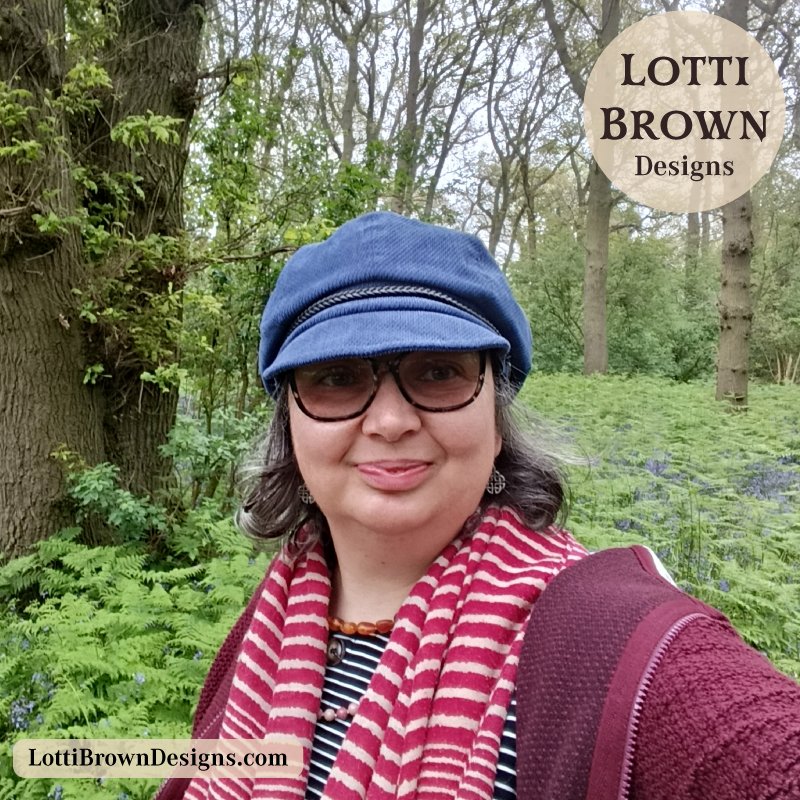
Lotti Brown is a self-taught nature artist and nature journaling educator whose hand-drawn work is inspired by wildlife, folklore, and close observation. With 18 years in creative fields and 10 years creating nature art, she brings deep practical experience to her work. Trained by the Wild Wonder Foundation, she shares nature journaling courses and guides online. Her artwork has been licensed internationally and exhibited at Goole Museum and Bridlington Spa in the East Riding of Yorkshire, UK.
Follow me:
Share this page: