
- Home
- Art
- Corvid Collection
- Raven

Raven Folklore & Meaning in Celtic, Norse and British Myth
By Lotti Brown
Discover raven folklore and symbolism in Celtic, British and Norse myth, from Odin’s ravens to the Tower of London and the bird’s spiritual and symbolic meaning – plus my raven art print…
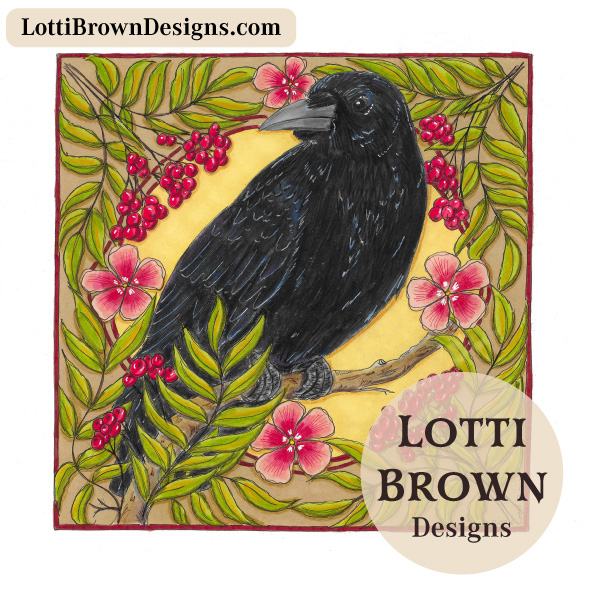 Raven art by Lotti Brown
Ravens are only rare visitors to the part of East Yorkshire where I live, recognisable from their corvid cousins by their deep haunting croak and massive size.
When one does appear, it feels like something ancient has crossed the sky - not just a bird, but a presence.
In more mountainous areas, such as Scotland, where I love to holiday, we’ve more often seen them, sweeping majestically from hilltops with their deep black feathers seeming to shimmer as they glide – their calls echoing evocatively.
There is something about a raven that feels older than the landscape itself - as though it belongs not only to the hills, but to the stories beneath them.
The raven is a significant bird in British folklore – as loved as it is respected, with a distinct aura of darkness…
Raven Meaning – What’s in a Name?
The word raven comes from the Old-English ‘hraefn’ (connected to the Old Norse ‘hrafn’) and has been known as the English name for a raven from around the year 699AD. The word is thought to come from the sound of the raven’s cry.
The Latin for Raven is Corvus corax – ‘Corvus’ is the Latin for a bird in the crow family, and ‘corax’ is the Greek word for ‘raven’.
In earlier times, it was common for the raven, in common with other corvids in the crow family, to be called ‘crow’.
Other common and folk names for the raven are:
- Corbie
- Corbie Craw
- Croupy Craw
- Ralph
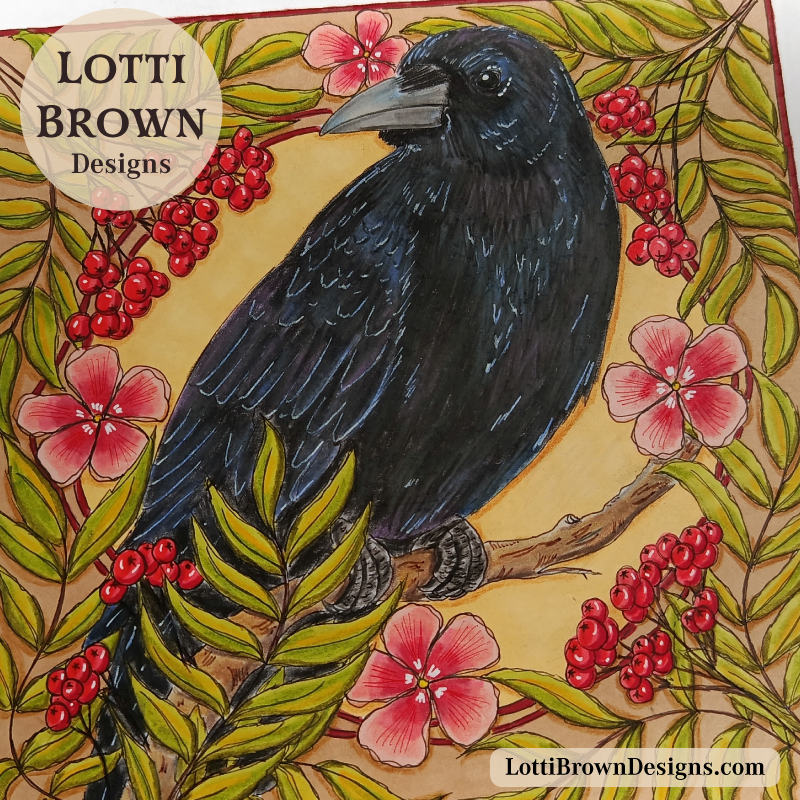
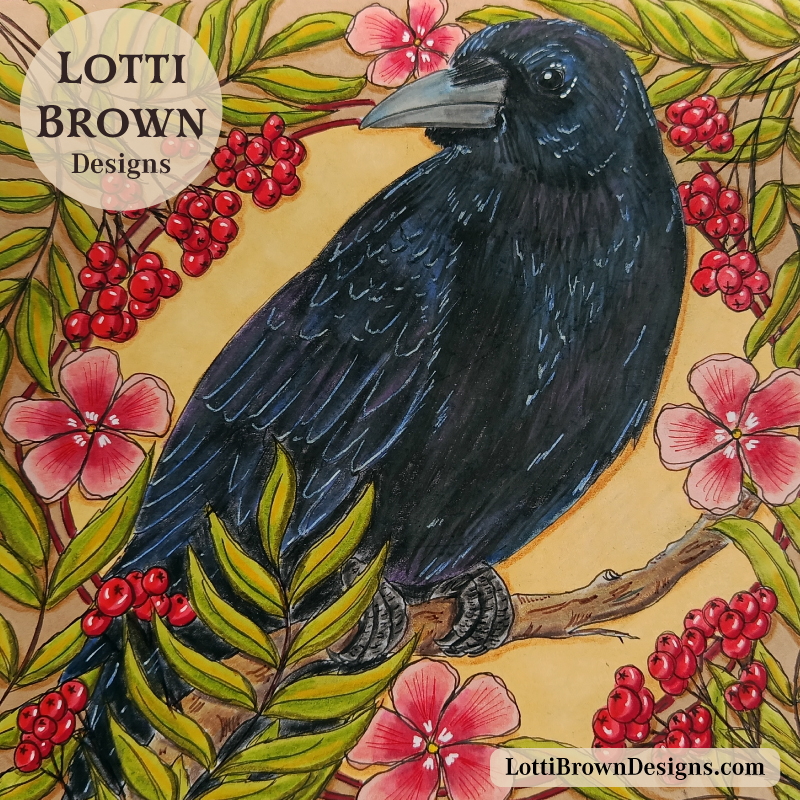 Raven with flowers and rowan berries
Raven in Norse Mythology
The Nordic god Odin (also known as the Anglo-Saxon god Woden), was given the title of ‘Raven-God’ – Hrafnaguð.
Odin had two ravens, Hugin (Thought or Mind) and Munin (Memory), who flew all over the world as Odin’s eyes and ears, reporting back to him. In Norse raven mythology, these two birds are central symbols of wisdom and spiritual insight. Thought and Memory are thought to relate to Odin’s intellectual and spiritual aspects.
I’ve always loved that Thought and Memory travel with the raven - as though this bird carries not only myth, but the inner landscape of the human mind.
Odin is also known as the ‘All-Father’ and is the god of war, wisdom, magic, poetry, and inspiration. The Norse greatly respected the raven as the bird of Odin and it was common for the symbol of a raven to decorate battle standards.
Through their association with Odin, ravens are linked with wisdom, intelligence, and spirituality.
There is something reassuring in the idea that Thought and Memory still fly overhead - even if we no longer call them by name.
Raven – Bird of the Celtic Godesses
In Celtic raven mythology, the bird is closely associated with powerful goddesses, the Otherworld, and prophecy.
The raven is associated with the Celtic fertility and horse goddess Epona and other Celtic mother goddess figures including Nantosuelta, a goddess of fertility, nature, the earth and fire.
The raven connects these goddesses with the Celtic Otherworld, providing a connection with spirituality and the afterlife.
In the Welsh tales of the Mabinogion, the Celtic goddess Rhiannon, known as the ‘Great Queen’ is associated with the earlier Celtic goddess Epona and is a goddess of fertility, horses, and the moon.
Rhiannon has three black birds, usually depicted as ravens, or sometimes blackbirds - called the ‘Birds of Rhiannon’ who are said to enchant the living and wake the dead with their song.
The raven is also the bird of the Irish battle goddesses, the trio of the Morrigan, Badb, and Nemain/Macha – they were known as ‘Battle Ravens’ or ‘Battle Crows’ and it’s said that they could foretell the outcome of battles, and even influence victory or defeat by appearing on one favoured side.
It’s easy to see how a bird that appears after battle could become a symbol of fate itself.
The Celtic ‘Cailleach’, the Scottish and Irish ‘Queen of Winter’ - a giantess crone who presided over the winter land and symbolised old age, appeared in the form of a raven - watching over her lands as a protector, and using the raven form to bring the cold of winter to her kingdom.
The raven seems never far from powerful women in myth - queens, crones, protectors - as if it stands at the threshold between worlds, watching.
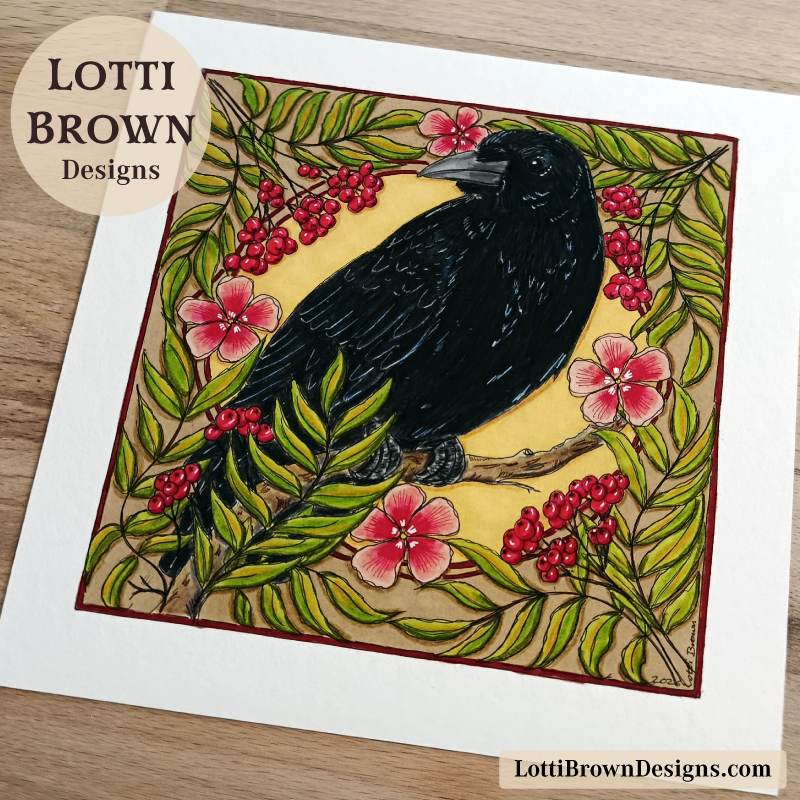 Raven and rowan berries art print
Raven – Bird of British Kings
The raven is the bird of the mythological Celtic giant god-king Bran the Blessed, whose name ‘Bran’ means ‘raven’. When Bran died, he requested that his head be taken to White Mount (now known as Tower Hill) in London to protect the kingdom from invasion. His head was taken there and continued to speak prophecies – the Celtic believed that the head housed the soul.
Bran continued to protect Britain until his descendant, the legendary King Arthur removed the head, taking on the role of protector. In Wales and Cornwall, it’s said that King Arthur still lives on in the form of a raven and revisits his favourite places in this form.
But the power of the ravens still remained at the Tower and was passed to living ravens who to this very day live at the Tower of London and are said to protect the kingdom of Britain. The legend of the Tower of London ravens remains one of the most enduring pieces of British raven folklore. If the ravens ever leave, it’s said that Britain will fall – and the ravens’ wings are clipped to ensure that they stay.
During World War II, the noise of the bombing frightened away the ravens, and Winston Churchill immediately reinstated the ravens at the Tower to continue to protect the country.
Even now, something in me feels strangely reassured knowing they are still there. Perhaps we keep the ravens there not only for tradition, but because we still want something watching over us.
Ravens in Celtic Mythology
Another Celtic myth, the story of the Dream of Rhonabwy, again links King Arthur to the raven – as he battles the knight Owain and his army of ravens in a dreamworld as the two men play chess.
Morgan le Fay (or Morgana le Fay) was said to be a powerful enchantress and the sister of King Arthur – she was able to take the form of a raven – and bears King Arthur’s body to the mystical Isle of Avalon.
The battle goddess the Morrigan alights on the shoulder of the Irish hero Cuchulain in the form of a raven, at the very moment of his death.
Again and again in myth, the raven stands at thresholds - between life and death, battle and peace, winter and light.
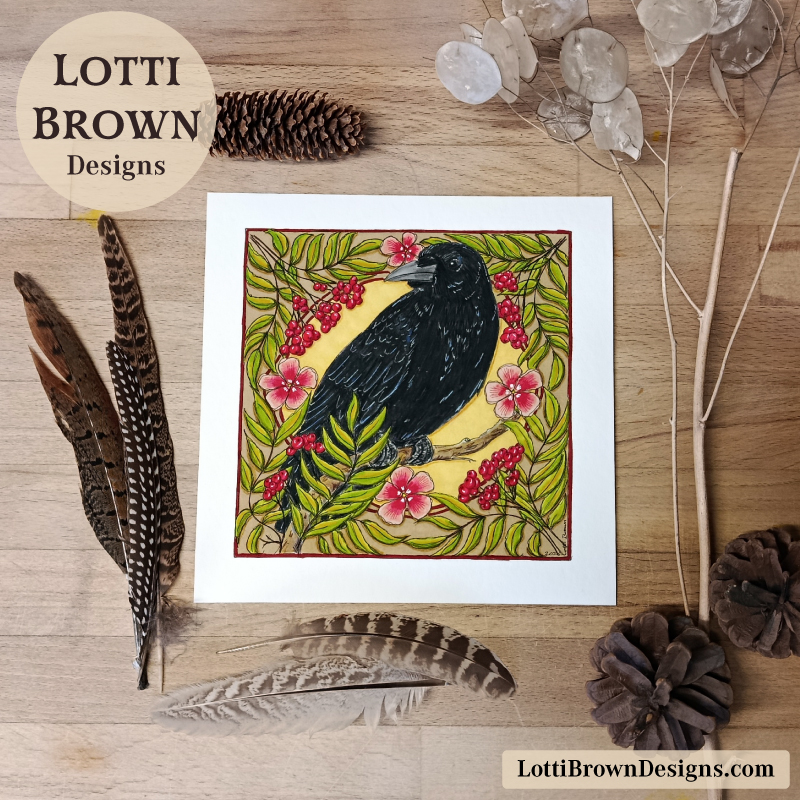 Raven & rowan art print
Raven – Bird of Light and Joy
Often, ravens are seen as dark or ominous birds, but once they were seen as birds of light. It feels almost radical now to remember this - that the raven was not always shadow, but sunlight too.
In the Ancient Roman empire, followers of the very popular sun god Mithras were known as ravens or ‘servants of the sun’.
I love that once, the raven was a servant of the sun. It reminds us that darkness and light are not enemies - only different expressions of power.
The Celtic god of light and sun, Lugh/Lludd, is also associated with ravens – he is said to have been attended by two ravens who would warn him of impending danger.
And the Old English epic poem Beowulf features a raven as ‘blithe-hearted’ (joyful) as it announces the return of light and the sun.
Raven – Bird of Healing
Ancient Romano-Celtic healing sanctuaries feature images of the raven and link the raven with healing gods and gods of protection.
In later folklore, it was said that kindness to a raven could restore the sight of a blind person.
Raven – Bird of Prophecy
In the Celtic world, raven ghosts flew in the forests by night and ravens were seen as sacred birds, with the gift of prophecy in their voice. Druids would keep tame ravens to divine the future from their calls.
It was believed that ravens could warn of impending attack or danger and the battle-raven goddesses such as the Morrigan could foretell the outcome of battles.
In the Ancient Celtic world, ravens were seen as messengers between this world and the Otherworld and were often buried with outstretched wings in ritual offerings.
In 1694, it’s said that a raven in Hertfordshire was heard to cry a prophecy three times.
With her evocative voice, so unusual and resonant, it's easy to see how the raven's call was seen to be otherworldly and able to tell of the future...
Raven as Guide
It’s said that Noah sent the raven out from the ark to see whether the flood waters had abated.
Similarly, Vikings at sea would travel with ravens, which they would send out from their ships in search of land, and follow their flight to find land.
One folklore custom was that a maiden following the direction of a raven’s flight at Candlemas could discover her future marital home.
 Raven
RavenRavens and Witchcraft
The Raven was seen as a witch’s familiar – and witches were also thought to have the ability to shape-shift into ravens.
Raven in British Folklore
The raven was believed to be a long-lived bird, who was said to live 27 times the age of a man – this great age gave the raven great wisdom and powers.
A ‘ravenstone’ was a magical stone that brought life to ravens – and if you were fortunate enough to get hold of one it was said to confer the gift of invisibility.
The raven was said to be a magical protector of treasure, hiding her treasures wisely - but revealing the hiding place of any wrong-doers.
Raven Symbolism and Spiritual Meaning
Raven - bird of wisdom, protection, healing, light and darkAfter so many stories, what remains is not just myth - but feeling…
The raven is a bird of wisdom - carrying knowledge across worlds.
A bird of prophecy - her voice echoing between what is and what might be.
A bird of protection - standing sentinel over kingdoms and thresholds alike.
She is a bird of healing – bringing kindness and restoration to the worthy.
And a bird of both light and darkness – the darkness of war and winter and the light and joy of sunlight. The raven does not belong entirely to darkness, nor entirely to light. She moves between them - and perhaps that is why she unsettles and comforts us in equal measure.
The raven is a sacred and magical bird – able to link the worlds of human and gods, intellect and spirituality, light and dark - a messenger for the sacred truth.
Perhaps that is why the raven endures so strongly in our stories - because she refuses to belong entirely to shadow or to light.
She is most comfortable at the edges - where certainty gives way to mystery...
Drawing my Raven – Inspired by Raven Folklore
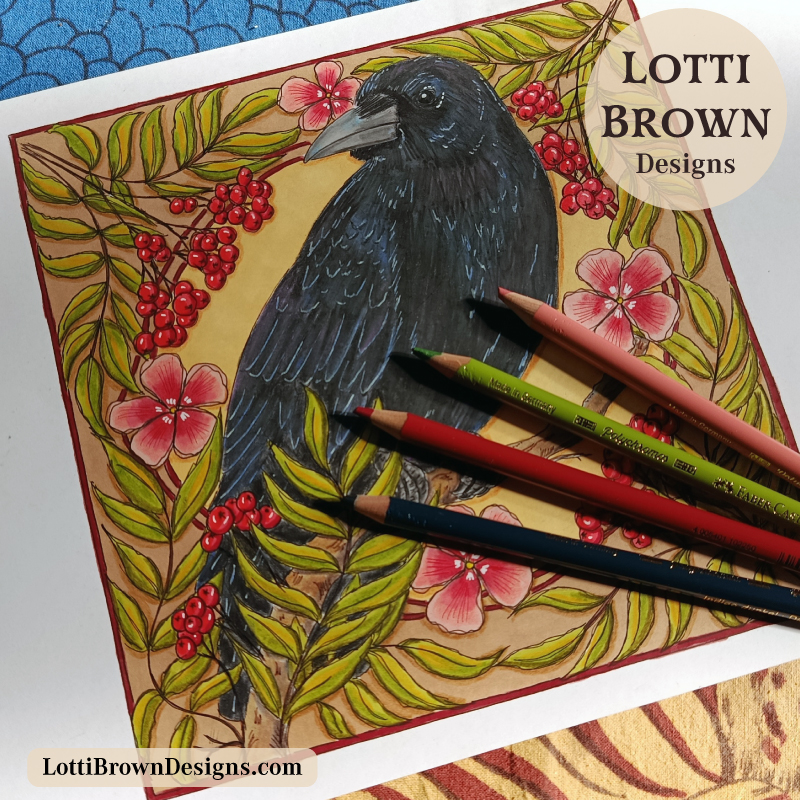 Drawing my raven with pens and coloured pencils
Drawing my raven, I felt like the myths, folklore, and magical presence of this beautiful bird should be imbued into my drawing. As I worked, I found myself thinking about how often ravens appear at turning points - at endings and beginnings alike.
I wanted her to feel watchful, but not threatening. Wise, but not distant.
I tried to show the raven’s shimmering darkness in her feathers using blues and purples to give her an almost magical glow to show her gentle kindness, fierce protection and otherworldly wisdom. There is a quiet dignity in the raven that I wanted to honour.
I realised as I worked that I wasn’t drawing a symbol - I was drawing a guardian.
There is something comforting to me in her darkness - not the darkness of fear, but of depth. I think we all need a reminder that wisdom can be dark and luminous at once.
I paired my raven with rowan berries, a common food for the ravens, especially in the Highlands of Scotland where I have such precious memories of seeing the raven.
The rowan is seen in folklore as a magical and protective tree, just like the raven – a portal between this world and the Otherworld, with links to light, just as the raven has too, so I thought it was a lovely way to add this link into my artwork.
Perhaps that’s why the pairing felt right - together, the raven and rowan feel like two ancient guardians - light and shadow standing side by side.
The raven has walked through our stories for thousands of years - as prophet, protector, companion of gods and guardian of thresholds.
Perhaps we still need a bird who understands both shadow and sun...
When a raven crosses the sky, it is never just a bird.
It is a reminder that mystery still lives among us.
My Raven Art
I love the idea of her watching quietly from a wall - a reminder of protection, wisdom, and the ancient stories that still echo through our landscape.
If she speaks to you, you can find her as part of my beautiful raven artwork collection in my Teemill store…
Raven art by Lotti BrownRaven (Mystery, Intelligence, Watchfulness)
If the raven has resonated with you - that sense of watchfulness, intelligence, and quiet mystery - this piece was created to reflect that presence.
It grew from observing that feeling of being noticed in return - something thoughtful and aware, just beyond reach.
Take a closer look at the raven artwork collection in my Teemill store
A piece like this brings a sense of depth and quiet intensity into a space.
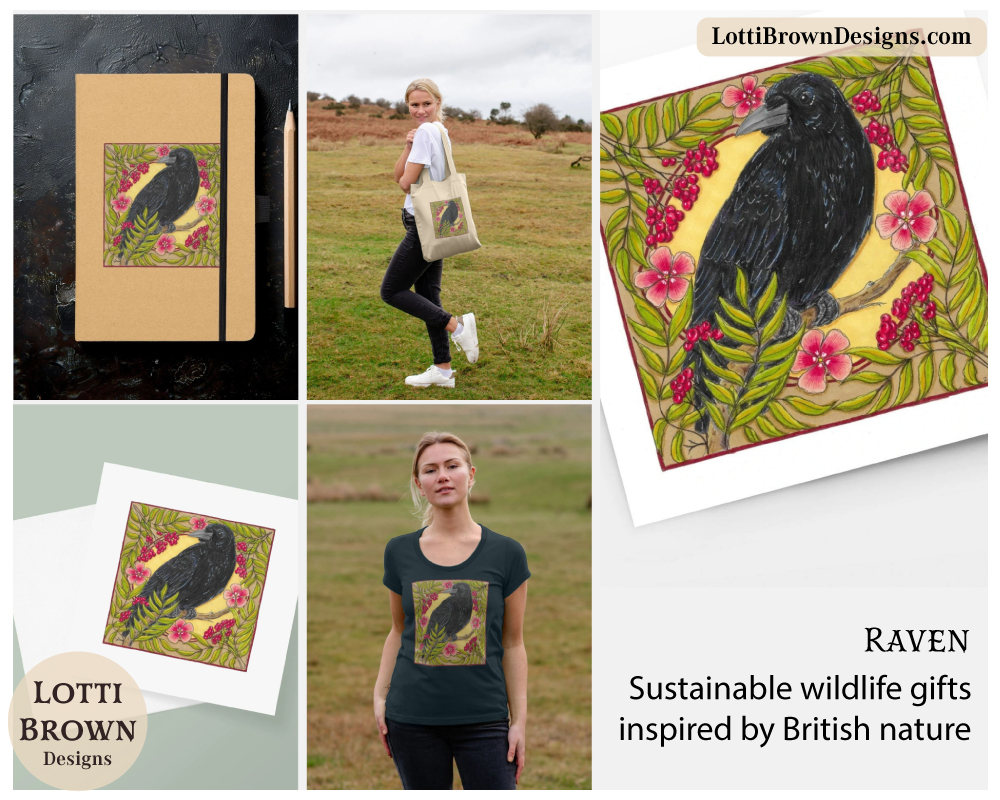
My raven artwork is available as sustainable art prints, notebooks, greetings cards, tote bags and clothing in my Teemill shop.
You might also enjoy:
You might also enjoy:
- Rook art & folklore
- Jackdaw art & folklore
- Crow art & folklore
- Blackbird folklore and symbolism
- Barn owl myth & mystery
- Rowan tree folklore
You can see all the other Corvid birds and read about their folklore in my Corvid Collection here - and see all of my hand-drawn British birds and wildlife artworks here...
If you enjoy folklore, you can explore my Folklore Hub here...
And if you're interested in nature, why not pop by for a peek inside my nature journals, here - and find out all about starting your own nature journaling hobby...
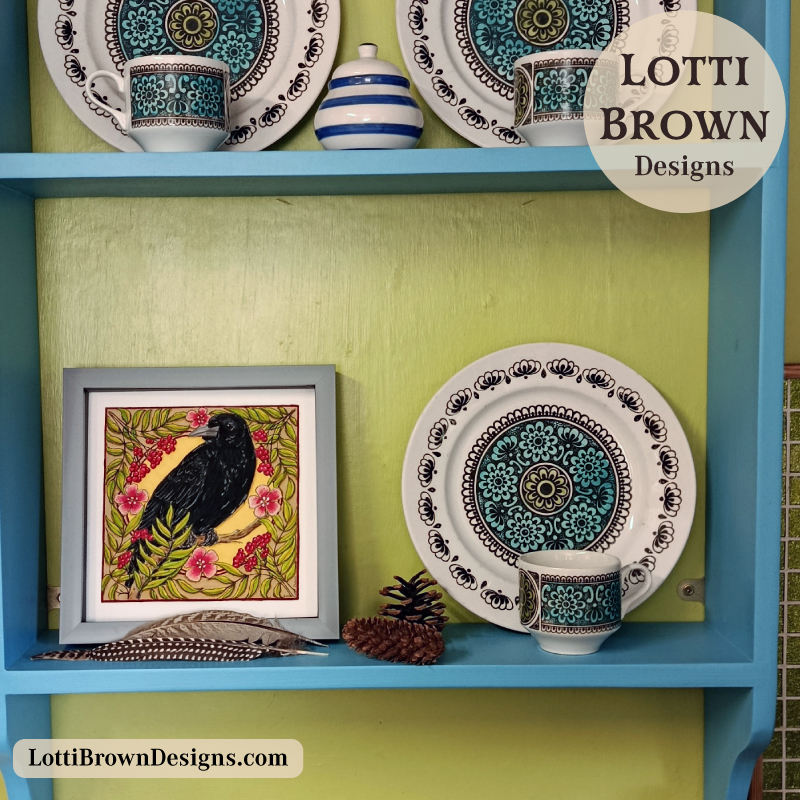 Raven art on display in my home
Further Reading/Resources
- Discovering the Folklore of Birds and Beasts – book by Venetia Newell
- The Folk Lore and Provincial Names of British Birds – book by Charles Swainson
- A Dictionary of English and Folk-Names of British Birds – book by H. Kirke Swann
- Dictionary of Celtic Myth and Legend – book by Miranda J. Green
- Beasts of Albion – book by Miranda Gray
- The Druid Animal Oracle – book by Philip and Stephanie Carr-Gomm

Shall we stay in touch..?
Each month, I share stories from my own nature journal, new art from my studio, and simple seasonal inspiration to help you feel more connected with the turning year - if you'd like to stay updated, please sign up with your email address below...
Recent Articles


-
Barn Owl Folklore & Meaning - Symbolism of the Barn Owl
Sep 15, 26 03:34 AM
 Explore barn owl folklore, symbolism and meaning, from ancient myths to British traditions. Discover the quiet wisdom and mystery of this ghostly bird.
 -
Bramble Meaning, Myth & Symbolism - Celtic Tree Calendar Art
Sep 02, 26 11:32 AM
 A look at bramble meaning, myth and symbolism as I share my bramble Celtic Tree Calendar art for the month of 'Vine'...
 -
Nature Journal Prompts
Aug 26, 26 04:05 AM
 Easy nature journal prompts to inspire and encourage you - one per week...
Shop My Current Artwork Collections

My art is available as sustainable art prints, notebooks, greetings cards, tote bags and clothing in my Teemill shop.
Find my stockists for all my earlier artworks here...
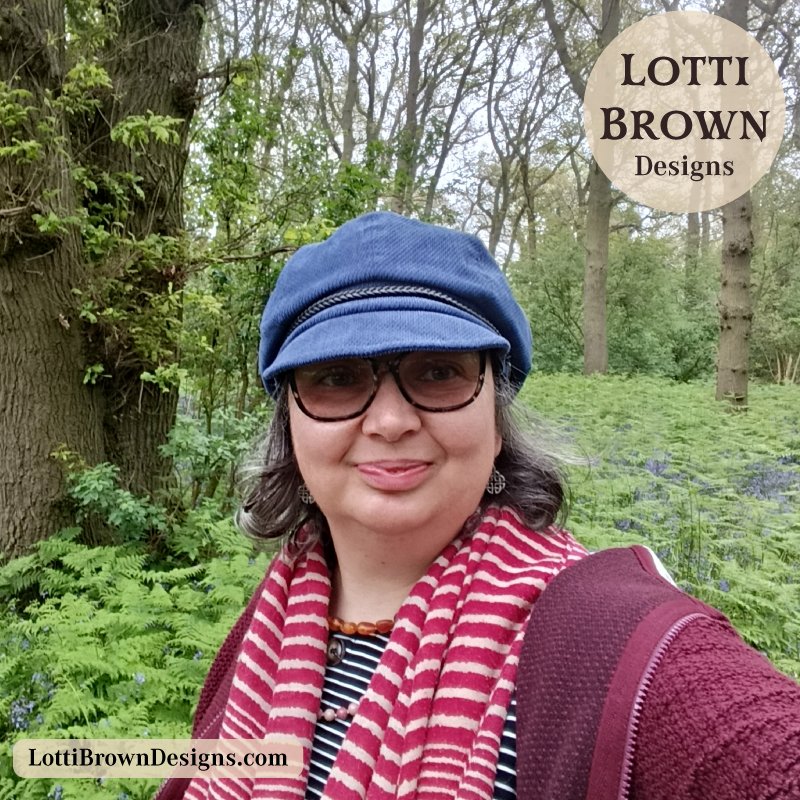
Lotti Brown is a self-taught nature artist and nature journaling educator whose hand-drawn work is inspired by wildlife, folklore, and close observation. With 18 years in creative fields and 10 years creating nature art, she brings deep practical experience to her work. Trained by the Wild Wonder Foundation, she shares nature journaling courses and guides online. Her artwork has been licensed internationally and exhibited at Goole Museum and Bridlington Spa in the East Riding of Yorkshire, UK.
Follow me:
Share this page: