
- Home
- Art
- Corvid Collection
- Crow Art & Folklore

Crow
Folklore, Symbolism and Meaning
Hand-drawn Crow Art
By Lotti Brown
Discover crow meaning and folklore in Britain - a bird of intelligence, family devotion and quiet power with my original hand-drawn crow artwork...
Meet the Crow (Carrion Crow in Britain)
The crow is one of our most common birds here in Britain, but it’s one of the most overlooked, too. It’s almost so familiar that it becomes part of the scenery - easy to pass by without really seeing. But if you take a closer look, if you pause and watch her for a while, I think you might begin to love the crow as I have…
We have a little family of three crows that spend a lot of time in the field behind our house – they aren’t frightened of us when we walk past, so they don’t fly away – and we get to watch them walking and pecking together…
As the weeks and months wore on, watching these three crows, we started to look out for them, wondering what they were doing and they started to feel like companions to our daily walks.
The fact that it’s a group of three crows is a little unusual – and more on that later…
When I started researching crow folklore and symbolism, I really started to appreciate the crow more and love her – she’s one of our most intelligent and most socially-advanced birds – and I want to share what I’ve learned with you…
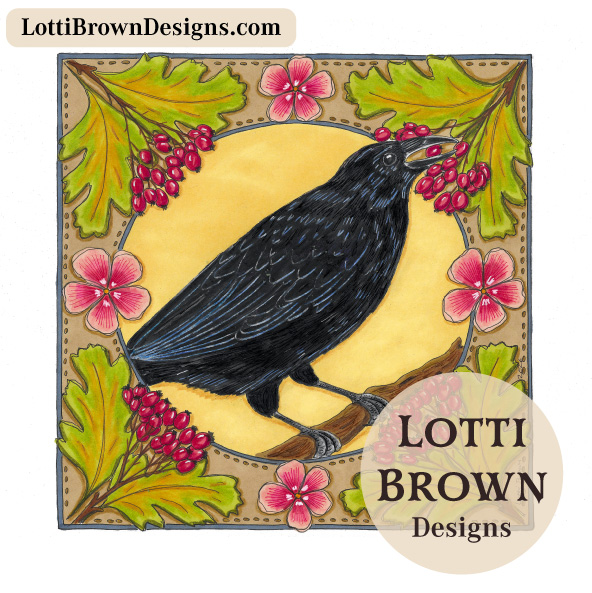 Crow art by Lotti Brown
Crow – What’s in a Name?
The word, ‘crow’ comes from the Anglo-Saxon ‘Crawe’ likely relating to the call of the bird – the crow has been known as such since at least the 7th century.
In Latin, the crow’s name is Corvus corone – ‘Corvus’ is the Latin for ‘crow’ – from the Latin word for crowbar – and ‘corone’ is the Greek for ‘crow’ too.
All ‘true crows’ – those corvids in the ‘Corvus’ family – rooks, ravens, jackdaws and crows - take their name from the crow and often in the past were all just generically known as ‘crows’.
Our crow’s full name is the Carrion Crow – due to its habit of eating carrion - dead flesh.
In Britain, the carrion crow is one of our most familiar corvids, and much of our British crow folklore centres around this intelligent, watchful bird.
This is the main crow we have in England and Wales, while the main crow in Scotland and Ireland is the Hooded Crow.
Other common and folk names for the crow are:
- Craw
- Car crow
- Carner crow or Carener crow
- Flesh crow
- Gor crow or Ger crow
- Ket crow
- Midden crow
- Corbie crow or Corbie
- Black-nebb’d craw or Black neb – for the crow’s black beak
- Land daw - 'daw' was a generic word for crow
- Crake
- Dob, Doupe, Dawp, Dowp, or Dowp-crow
- Bran
The Crow in Celtic Mythology and War Lore
Crows have long been associated with battle and war…
In Celtic mythology, the crow (or raven) is the bird of the Celtic triple goddess the Morrigan. She is a goddess of war and fate, taking the form of three sisters, Badb, Macha, and the Morrigan, (the third sister may sometimes be known as Anu or Nemain).
Badb and Macha were war goddesses called ‘Crow’. The Morrigan was called ‘battle crow’ or ‘battle raven’ - as well as being a fierce protectress of her people and a goddess of land, livestock and fertility. It was said that she appeared in battle as a crow in flight and could inspire victory or spell defeat – and may even enter the battle on the favoured side.
There is something powerful in this image of the crow - not simply as a bird of destruction, but as a watcher at the threshold of great change. In battle, in endings, in turning points, she stands witness.
Celtic people made tiny figurines of crows or ravens to offer as religious offerings at sacred sites – perhaps in supplication for battle victories or in thanks for the same.
It seems this association with crows and victory is an age-old belief. In the 4th-century BC, the army of Alexander the Great was lost in the desert – it’s said that two crows were sent from heaven to guide them to safety.
These ancient stories form part of the rich tapestry of crow mythology and folklore that surrounds this intelligent bird.
The Crow and the Afterlife
Perhaps because of this association with battles, crows were often associated with the afterlife – endings and new beginnings – perhaps a companion or guide at the crossing over.
It was said that if you could obtain a ‘crow stone’ – a magical stone that brings life to the crow’s eggs – you would receive honours, riches and the gift of foresight.
Crows are often associated with times of change - those moments when one chapter closes and another begins. Perhaps this is why they feel so present in winter fields and bare trees, when the year itself seems to be standing between endings and beginnings.
 Crow drawing, close up
Crow Folkore and Witches
Many of the traditions around the crow relate to its dark colour which was often associated with witchcraft…
Crows were often seen as a witch’s familiar – and crows were one of the creatures that a witch was said to be able to turn into.
An 18th-century tale from the Isle of Skye in Scotland tells of a woman, Flora, accused of witchcraft. Rather than deny the accusation, it’s said that Flora spoke with General MacLeod of Dunvegan, the laird, claiming to be the crow who flew before his regiment at the Battle of Fontenoy in 1745, and held back the shots which would’ve killed him.
On learning of this, Flora was instantly freed, brought to live in the castle, and wanted for nothing for the rest of her life.
The Crow in Myth - Apollo and Amaterasu
In Ancient Greek and Roman mythology, the crow is associated with the Greek sun god Apollo and his Roman counterpart, Phoebus. Apollo had a pet white crow which he used as a messenger. One day, when Apollo was away, his wife Coronis took a lover. The crow flies to Apollo and tells him – on learning of Coronis’ betrayal, Apollo kills her in anger…
But he soon regrets his actions and starts to blame his crow for telling him, throwing out the crow and cursing him for his gossip so that his snowy-white feathers turn black, while his voice turned harsh and ugly. Some stories tell that the crow’s feathers turn black in mourning at Coronis’ death.
The crow was often seen as a symbol of blackness with popular folk sayings, “as black as a crow” and “Crows are never the whiter for washing themselves.”
The blackness of the crow would be often seen to symbolize darkness – night or winter.
As well as being linked to the sun god Apollo, the crow also belongs to the Japanese sun goddess Amaterasu. It’s said that a monster tried to swallow the sun, but heaven sent a crow to stop it, choking the monster by flying down its throat.
It’s interesting that such a dark-coloured bird is associated with the sun both with Amaterasu and Apollo – perhaps it’s a recognition of the duality of life, with light there are always shadows – with sun and daylight, there is always the dark and night – and a life truly lived is a balance of both dark and light.
The Crow as a Symbol of Intelligence
 The clever crow
The crow is a bird of very high intelligence, a fact that has been recognised across the ages. Across cultures, the crow’s symbolism has often centred on intelligence, foresight and adaptability.
As early as the 6th century BCE, Aesop shared one of his fables showing the crow’s intelligence…
Crow found a pot with a little water in the bottom, but his beak would not reach the water and he could not drink. Crow found pebbles and dropped them into the pot so that the water level would rise – then he was able to drink.
This is not just a nice story about the crow – modern scientists have discovered that crows can actually solve this puzzle in real life. And in tests, they discovered that crows were able to correctly choose solid objects over hollow objects to drop into the water.
Crows have also been able to successfully solve pairing tests, when shown cards where they had to select correctly-matched pairs in order to receive a food reward. They were also able to generalise this learning to correctly select pairs on newly-shown cards.
Scientists have also discovered that crows can count and distinguish between numbers up to 30.
It’s one thing to read about crow intelligence in books - but quite another to stand in a field and watch one tilt her head and study you in return and wonder what she’s thinking...
Pet crows have been taught to speak and understand human words – they can use language in a way that shows they truly understand and aren’t just repeating, for example by using names correctly in sentences.
Crows can recognise individual humans – and have feelings about them. Crows are able to recognise individual humans who have scared or harmed them and are said to ‘hold grudges’ continuing to recognise those who they dislike over years, even after long absences. As a social bird, they also are able to pass their grudges on to their friends and relatives – sharing information that’s vital to the safety of the community.
As well as holding grudges, crows can make friendships with humans. Humans who have helped or fed a crow may be lucky enough to receive a gift, which might be something small such as a fir cone, berry, feather, twig or flower.
It’s said that St Paul the Hermit (Paul of Thebes) was brought bread to eat each day by a crow.
The 19th-century writer Henry David Thoreau recognises the great wisdom of the crow:
“If men had wings and bore black feathers, few of them would be wise enough to be crows.”
Crows are clever enough to have learned how to use their environment to help them. In Roman times, Pliny notes that crows would drop hard-shelled nuts repeatedly from great heights onto hard stones or tiles until they break and they can get at the nuts inside.
In modern times, crows have been observed using cars to break their nut for them, even learning and understanding traffic lights – using the red light ‘stop’ to place nuts in the road, waiting for the cars to drive over the nuts and break them, and waiting once more for the safety of the red light to retrieve their nuts.
Crow Family Life and Devotion
At one time, the crow was greatly revered for its devoted family life…
The medieval Aberdeen Bestiary praises the ‘devotions of crows’ and suggests that humans could benefit from their example:
“Men should learn to love their children from the practice and devotions of crows. They diligently accompany their children when flying together, anxiously supplying food so that they stay strong and do not abandon responsibility for nourishing them for a long time.”
It’s hard not to feel tenderness reading that - and harder still not to see echoes of ourselves in these dark-feathered families.
One folk saying of crows is that ‘the crow thinks her own bird fairest’ showing her love for her young.
Crows do actually have a very strong family life. Crows mate for life and are often seen in pairs as they keep the same territory all year round.
Crows do feed their young for a long time and the youngsters stick around a long time, often becoming ‘nest-helpers’ who are non-breeding crows who help the pair with the nest-building and feeding the babies.
I think this is why we’ve often seen a little family of three crows – it’s nice to think of that tight-knit family staying together and helping each other.
It seems that the family may also help care for the elderly too. The 13th-century monk Bartholomew the Englishman tells us:
“The mildness of the bird is wonderful. For when father and mother in age are both naked and bare of covering of feathers, then the young crows hide and cover them with their feathers, and gather meat and feed them.”
It seems that crows may even mourn their dead. Crow funerals have been observed – gatherings of crows who group around the body of a dead crow. It’s thought that the crows are learning from the death to avoid a similar fate in the future. As such a social creature, with a strong devotion to family, it seems impossible that they are not also honouring their deceased loved ones.
A medieval belief was that a crow had a long life, which gave her great wisdom – a crow was able to share her knowledge, to guide or warn.
 Crow art print
Three Crows
I mentioned earlier that we often see three crows together in the field behind our house. That little trio has always felt quietly significant to me.
In British folklore, the number of crows seen together has long been thought to hold meaning. The old counting rhyme begins:
“One for sorrow,
Two for joy,
Three for a girl…”
There are many variations, and different regions interpret the numbers differently, but three is often seen as a number of balance, change, or growth.
In Celtic tradition, the number three carries particular power - the triple goddess, the three realms, the threefold nature of life: birth, death, rebirth. The crow itself is closely linked with these ideas of transition and transformation, so three together can feel like a symbol of movement between worlds, or of life unfolding in its natural cycles.
And yet, sometimes three crows are simply a family - a mated pair and a young bird from the previous year, staying close and helping one another.
I rather like that both meanings can sit side by side - ancient symbolism and ordinary family life. It feels very like the crow herself - balanced between myth and meadow.
What Does the Crow Symbolise?
Crow illustration, showing detailThe crow carries many meanings - some shadowed, some luminous…
In folklore and symbolism, the crow has often been seen as a bird of darkness, night and winter - but the crow symbolises far more than shadow alone...
She is a bird who understands balance - light and dark, life and death, endings and beginnings. In folklore she stands on battlefields and at thresholds, yet she also belongs to hearth and home, watching over her family with fierce devotion.
The crow is a bird of intelligence and wisdom - practical, adaptable, and deeply aware. She remembers. She learns. She shares knowledge with her kin. She knows when to distrust and when to offer friendship, holding both caution and generosity in equal measure.
She is a bird of family, loyalty and long memory. Of teaching the young. Of staying close. Of community survival.
And perhaps this is why she has so often been linked with the spiritual world - not because she is dark, but because she walks comfortably between worlds. Between wild and human. Between shadow and sun. Between solitude and belonging.
For me, the crow feels like a companion through change. A reminder that endings are rarely only endings - they are thresholds into something new. That intelligence can be quiet. That strength can be communal. That darkness does not mean absence of light, but depth.
The crow’s symbolism is layered and complex - a bird of intelligence and intuition, family loyalty and ancient wisdom. In British folklore, she stands at the meeting point of darkness and light, endings and beginnings.
She asks us to be observant. To be loyal. To be clever.
And to stand firmly in who we are - glossy black feathers and all.
Drawing my Crow Artwork
My crow artwork was inspired by my nature journal page of a crow eating hawthorn berries in winter – I saw this in the field near our home and wondered if she’d learned this from watching the redwings eating the hawthorn berries as it’s the first time I’ve seen a crow in a hawthorn hedge eating the berries.
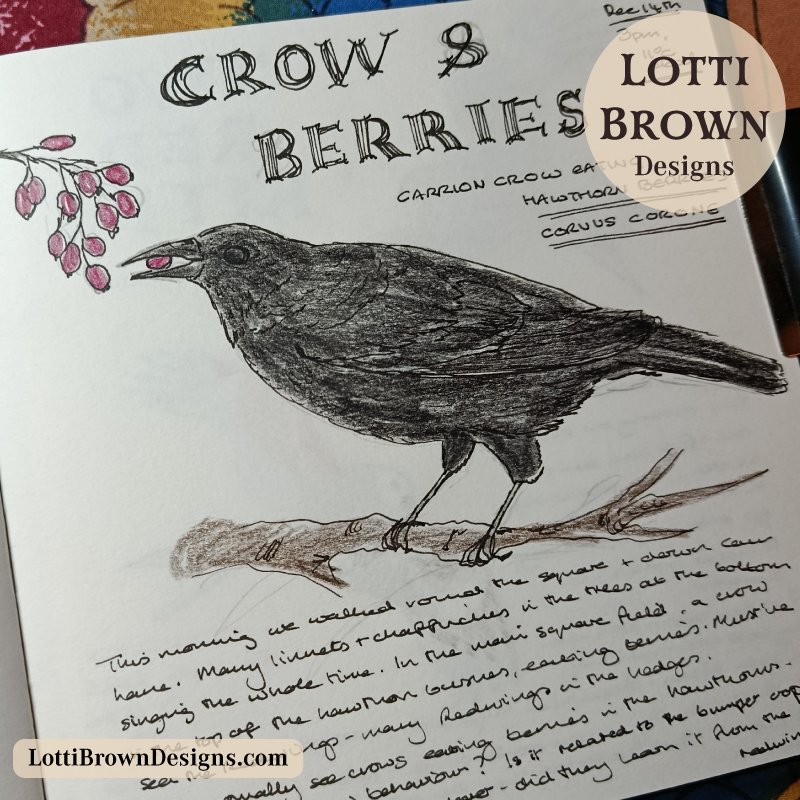 Crow eating hawthorn berries in winter nature journal
I think she’s a bird equally at home in the darkness of mid-winter as the light summer months – with her family always around her.
With my new respect and love for the crow, creating this drawing felt like an act of honouring her - layering blues and purples into her dark feathers to reflect the depth and complexity I had come to see.
I thought about her devotion to her family, her incredible intelligence, and how she’s a bird of such balance and great capacity in folklore – leading armies to battle, saving the very light of the sun, and still sitting at the heart of family life.
 Drawing my crow
My Crow Art Print
If the symbolism and folklore of the crow, with her quiet strength and wisdom, resonates with you too, I hope my crow art print might bring a little of her presence into your home - a reminder of balance, intelligence, and deep-rooted belonging...
Crow illustration by Lotti BrownCrow (Adaptability, Presence, Intelligence)
If the crow has stayed with you - that grounded presence and quiet intelligence - this piece was created to reflect that strength.
It grew from observing how they move through the landscape - adaptable, aware, and always present.
Take a closer look at the crow artwork collection in my Teemill store here...
It’s a piece that brings a sense of strength and quiet awareness into a space.

My crow artwork is available as sustainable art prints, notebooks, greetings cards, tote bags and clothing in my Teemill shop.
You might also like to explore other corvid folklore in my corvid collection – jackdaw, rook, and raven…
Or other British bird folklore in my British birds collection here…
Learn about the barn owl here...
If you enjoy exploring the folklore of nature, start browsing my Folklore Hub here…
If you like nature, you might like to peek inside my nature journals, here – or start your own…
I also have more bird art here – and my archive of earlier artworks here…
 Crow art displayed in my country kitchen
Further Reading/References
- Discovering the Folklore of Birds and Beasts - book by Venetia Newell
- The Folk Lore and Provincial Names of British Birds - book by Charles Swainson
- A Dictionary of English and Folk-Names of British Birds - book by H. Kirke Swann
- A History of Birds - book by Simon Wills
- British Birds: Names, Facts, Myths - book by Geoff Green
- RSPB Bird Tales: Traditional Stories, Folklore & Activities - book by Dawn Casey
- Dictionary of Celtic Myth and Legend - book by Miranda J Green

Shall we stay in touch..?
Each month, I share stories from my own nature journal, new art from my studio, and simple seasonal inspiration to help you feel more connected with the turning year - if you'd like to stay updated, please sign up with your email address below...
Recent Articles


-
Barn Owl Folklore & Meaning - Symbolism of the Barn Owl
Sep 15, 26 03:34 AM
 Explore barn owl folklore, symbolism and meaning, from ancient myths to British traditions. Discover the quiet wisdom and mystery of this ghostly bird.
 -
Bramble Meaning, Myth & Symbolism - Celtic Tree Calendar Art
Sep 02, 26 11:32 AM
 A look at bramble meaning, myth and symbolism as I share my bramble Celtic Tree Calendar art for the month of 'Vine'...
 -
Nature Journal Prompts
Aug 26, 26 04:05 AM
 Easy nature journal prompts to inspire and encourage you - one per week...
Shop My Current Artwork Collections

My art is available as sustainable art prints, notebooks, greetings cards, tote bags and clothing in my Teemill shop.
Find my stockists for all my earlier artworks here...
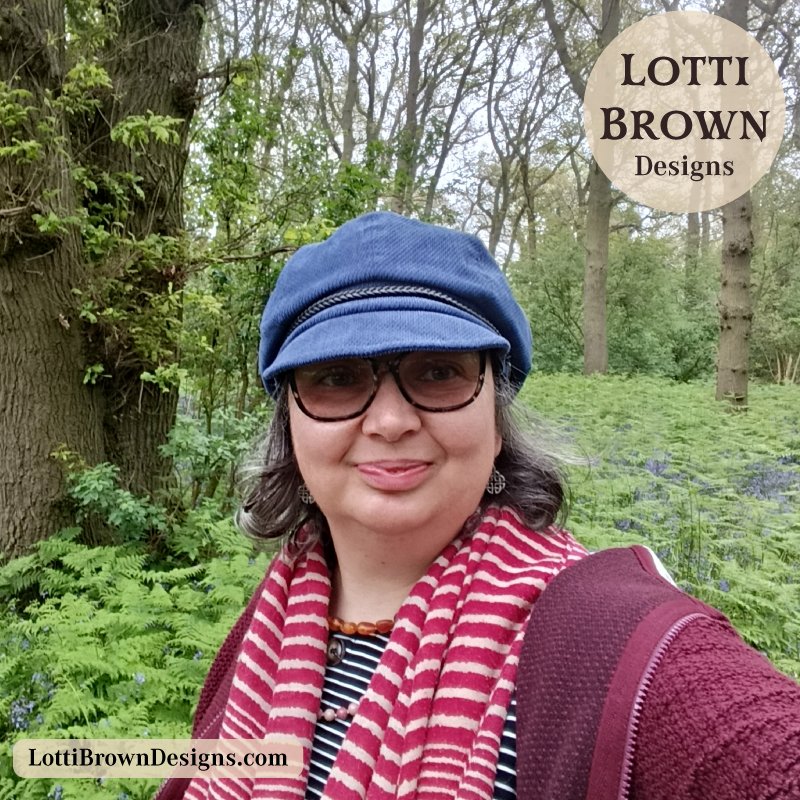
Lotti Brown is a self-taught nature artist and nature journaling educator whose hand-drawn work is inspired by wildlife, folklore, and close observation. With 18 years in creative fields and 10 years creating nature art, she brings deep practical experience to her work. Trained by the Wild Wonder Foundation, she shares nature journaling courses and guides online. Her artwork has been licensed internationally and exhibited at Goole Museum and Bridlington Spa in the East Riding of Yorkshire, UK.
Follow me:
Share this page: