
- Home
- Nature Journaling
- Seasonal Nature Journaling
- July Nature Journaling

July Nature Journaling Ideas
Butterflies, Birds &
Wildflowers
By Lotti Brown
Looking for July nature journaling ideas? Discover butterflies, summer birds, wildflowers, deer and gentle prompts to help you notice the richness of midsummer.
 July walks in golden fields of barley
July nature journaling is all about noticing abundance. This year, sunshine has certainly been in abundance and we’ve taken our walks early in the morning or late into the evening to try and avoid the hottest times of the days.
The track into the fields is dusty and dry – the barley and wheat stretch into the distance and there is little to no shade from the heat of the sun. As the month progresses, the grass dries to light gold and crisps beneath our feet and the straw-like scent of the barley field fills our nostrils, seeming to hold the echoes of the sunshine in its fragrance.
Grass verges and meadows now shimmer with wildflowers, while butterflies drift between thistles and golden ragwort flowers - and the first berries begin to ripen.
 Spotting butterflies in July
In the garden, birds gather around fresh water showing us that even on the hottest days, nature quietly adapts, inviting us to slow down and notice how the season unfolds.
This July has been particularly hot – I’ve also written a separate guide to nature journaling in a heatwave if you too are experiencing particularly hot weather.
July feels full of life. Everywhere I look, there's something new asking to be noticed.
One of my favourite parts of July nature journaling is following the butterflies through the meadows…
Butterflies Everywhere
 Journaling a lovely walk surrounded by butterflies
I think the thing I’ve loved most about this summer is the abundance of butterflies. There seem to have been more than usual enjoying the sunshine and the wildflowers that edge the tracks into the fields.
 Tortoiseshell butterflies on thistles
One butterfly we’ve particularly noticed this year is the Painted Lady – I’ve never seen so many and this year they seem so large and fast as they spin in the air chasing each other.
 Painted Lady butterfly
I’ve really been drawn to take note of which butterflies we can notice on our field walks – which has led to some interesting ‘chases’ as we try to follow an individual until it settles to try to get a good photo or at least a really good look at its wing patterns and colours to try and identify it later.
 Small Copper butterfly
I've realised that I don't always need to know the butterfly's name straight away. Sometimes simply watching how it moves from flower to flower tells me just as much about the season.
Walking in a different location, like the nearby Rail Trail, means noticing different butterflies, like the beautiful Speckled Wood which we found skipping through grassy hedgerows and the tiny Holly Blue which seemed to sparkle with light.
 Rail Trail butterflies
I was particularly excited to spot the Holly Blue butterfly as this is a species I made very detailed natural history illustrations of in my course at Aberystwyth University – see my butterfly illustrations here…
The butterflies seem to lend an additional dimension to summer life – not just the usual wildlife, birds, and insects but these beautiful and exotic creatures of the air who seem to move about on a whim, completely free and carefree.
Perhaps that's why butterflies feel so magical. Their lives are fleeting, reminding us to enjoy the richness of summer while it lasts.
Birds Seeking Water
One of the unexpected joys of summer nature journaling has been watching the birds visiting water...
 This little robin visited my water bowl first during a heatwave but now keeps dropping by for some sips
In the heat of the summer, the birds of the field are quiet, but in the garden it’s the busiest it’s been for months as the birds visit for water.
I have a small garden pond in a half barrel, which is often popular for bathing blackbirds – but in these hot summer days, my large shallow bowl of water set on my patio table, surrounded by plants to shade and protect, draws their attention.
 Blackbird drinking from the water dish
The robin and the blackbird come regularly to drink. Watching them from my kitchen window, only a few feet away, feels like being quietly invited into their world.
I can watch them perch and dip their heads to drink…
The little robin drinks delicately, his tiny throat moving as he swallows the water. The blackbird dips her head to take a sip and then throws her head right back to swallow.
While my most regular visitors are the wood-pigeons, who visit singly or in pairs – they can balance delicately on the edge – but sometimes just sit right in the dish – I think they’re enjoying the cooling sensation of having their toes in the water – and who can blame them!
 My 'bathing beauty' woodpigeon
On one of the hottest heatwave days, while checking on the birds’ water, I notice a tiny bee carrying a leaf…
Leafcutter Bee
I watched the little bee for a while and saw her flying into a hole in the soil in one of my houseplants I’d brought out for the summer, to surround the birds’ water.
Within a minute she came out and I watched her fly to the roses in our garden.
I waited – would I see her come back with a little leaf again?
Within a couple of minutes, yes, she returned carrying a circle of leaf as big as she was…
 Leafcutter Bee
She sat with it for a moment – seeming to agitate it with her legs – then lifted it up and carried it once again into the hole. Emerging after another minute to repeat the process…
This is a leafcutter bee – there are various species and I don’t know which one this is – they are a type of solitary bee, meaning that they don’t live in hives like honeybees, but live on their own.
She lines little chambers with circles of leaves before laying a single egg inside each one, providing food for the young bee until it emerges the following spring.
I’ve seen the rounded circles cut from leaves before, but never been lucky enough to watch the bees carrying the circles into their nests before.
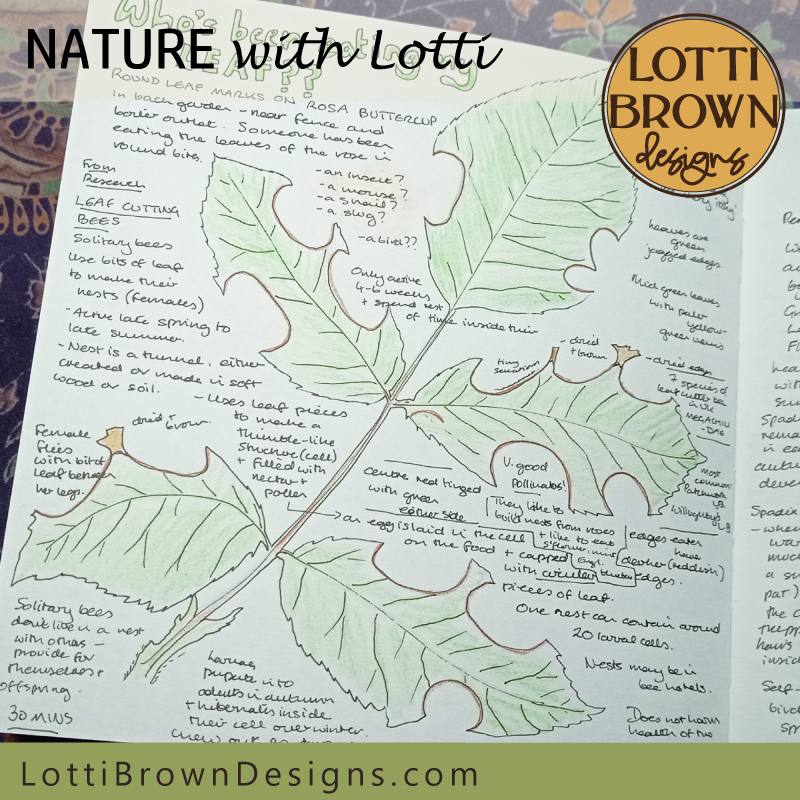 Leaves showing evidence there's a leafcutter bee about - from my nature journal page a couple of years ago
Once, years ago, we thought we had honey bees nesting in the air vents of our loft – and called out a bee expert – who identified them as solitary bees instead who made a community of tiny solitary nests in each little air vent hole. They safely emerged the following spring, literally eating their way out, and went happily on their way.
My bee this year is maybe the great-great-great-great-(more greats)-grandaughter of one of those bees. Amazing to think my house and garden has housed generations of leafcutter bees – almost without me even noticing!
Summer Flowers
If you're wondering what to notice in nature in July, the flowers are a wonderful place to start...
 Pink hydrangea flowers
In the garden, the hydrangea fills the beds with beautiful pink flowers – but requires plenty of extra watering to keep from drying up in the heat.
Closer to the ground, the tiny houseleek (also known as Sempervivum) sends up a miniature but sensational pink flower that looks like a teeny alien. The houseleek flowers just once and this is at the end of its life, so this is the final swansong for my little plant…
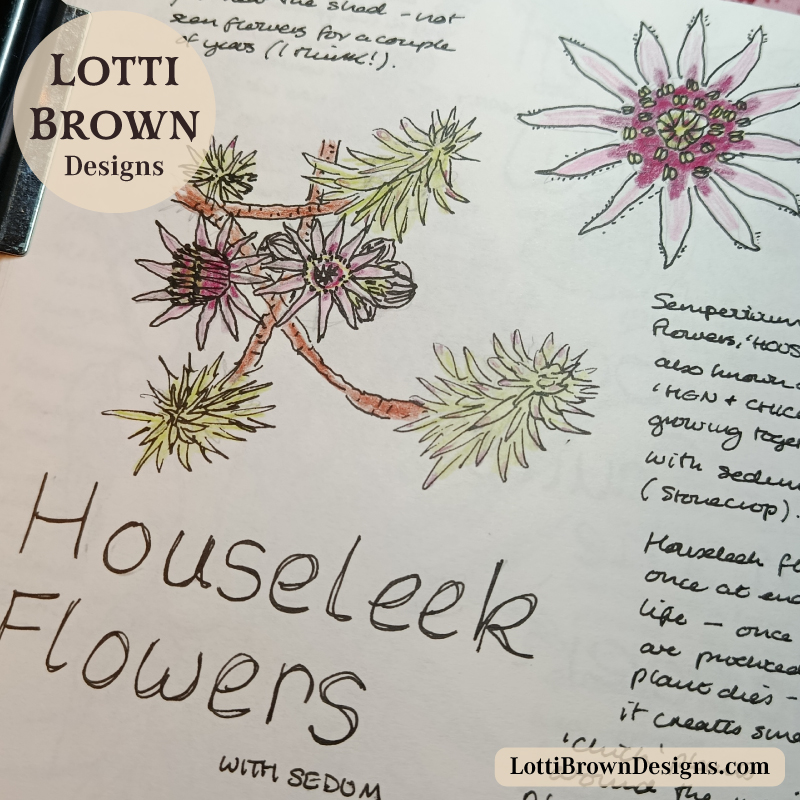 Houseleek flowers
Its common name is ‘Hen and Chicks’ and this tells us how it keeps the generations going – by sending out little ‘chick’ plants from the main ‘hen’, so that once this flowering is over, the plant continues through its ‘children’.
In the village community garden, the hollyhocks grow tall and spectacular – they remind me of old-fashioned, cottage-garden summers...
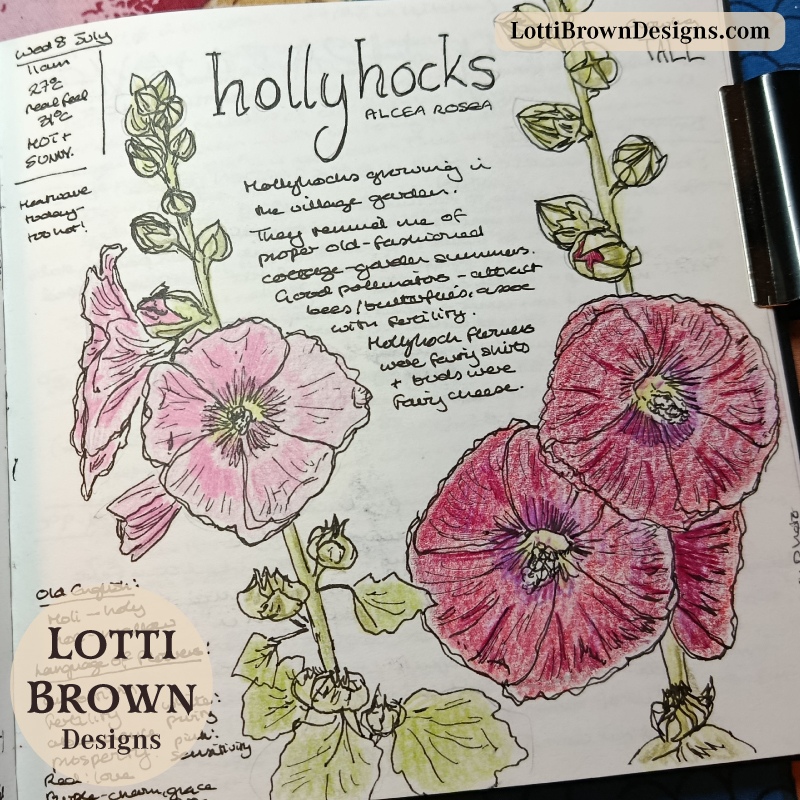 Hollyhocks in my nature journal
The name hollyhock comes from the Old English holi and hoc – meaning holy mallow.
Out in the fields, the stately rosebay willowherb seems to compete with the hollyhock for height. I love these gorgeous magenta-pink wildflowers which seem to bloom wildly and passionately each summer.
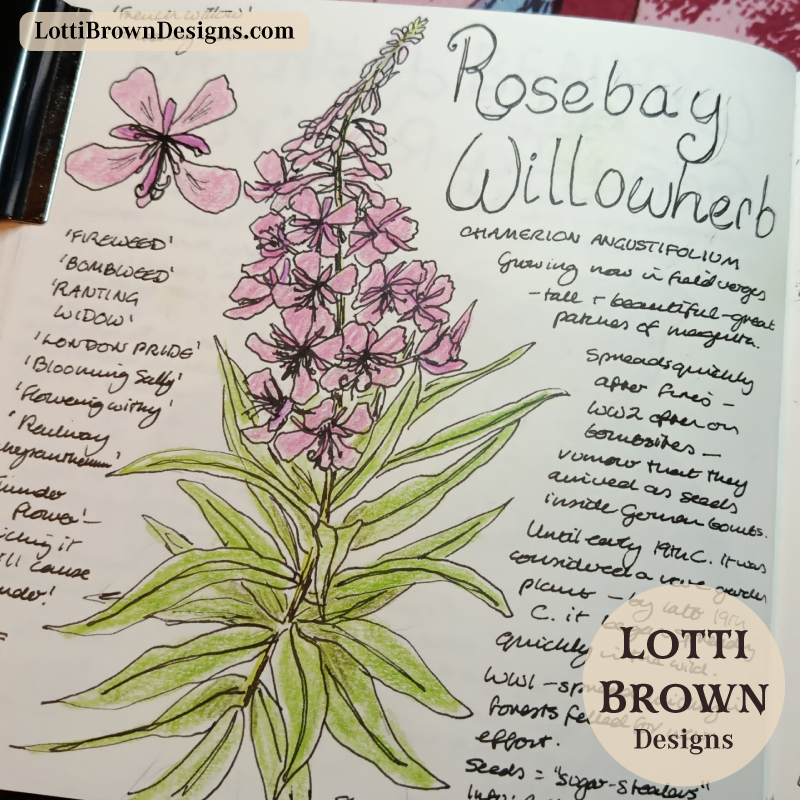 Rosebay willowherb
Their common names include Fireweed and Bombweed – they spread quickly after fires and so colonised World War Two bombsites. There was actually a rumour that the German bombs contained the seeds!
They’re also known as a ‘Thunder Flower’ – to pick it is said to cause thunder – but this year, I wonder if we could do with a nice thunderstorm to cool us down and send us a little rain?
Looking more closely in the verges of the wildflower meadow, I find this beautiful Sainfoin – which I’ve never noticed before...
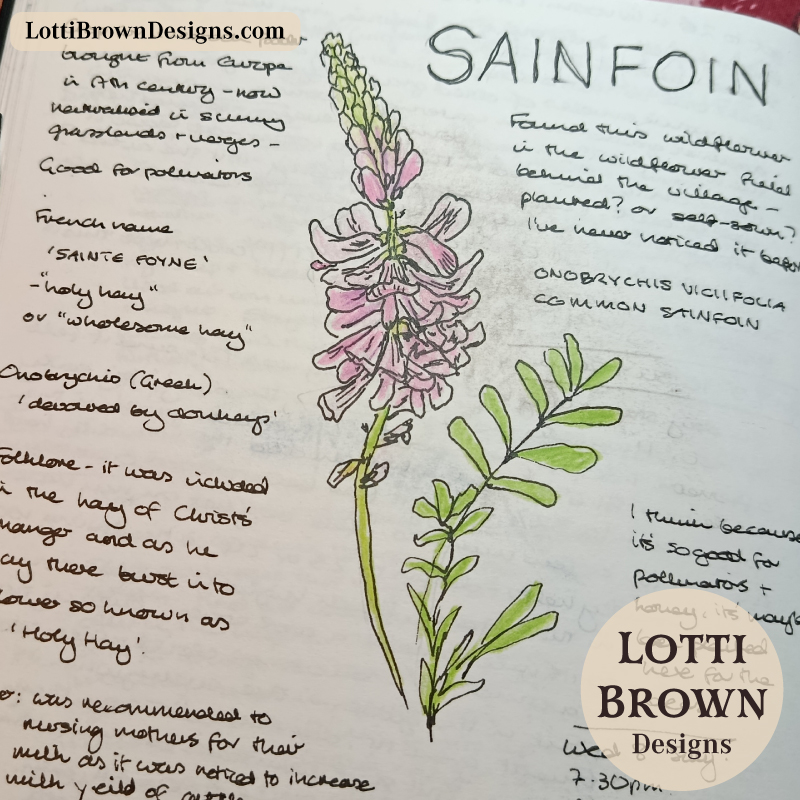 'Sainfoin' wildflower
The name Sainfoin comes from the French name Sainte Foyne, meaning ‘holy hay’ or ‘wholesome hay’.
It’s said it was in the hay that lay in the manger at Christ’s birth and burst into flower as he lay there, so earning it the name of Holy Hay.
Another new flower I found on the edges of the wildflower meadow is Queen Anne’s Lace – I haven’t seen this growing here in the wild before – and only know it from a holiday in Scotland from a few years ago...
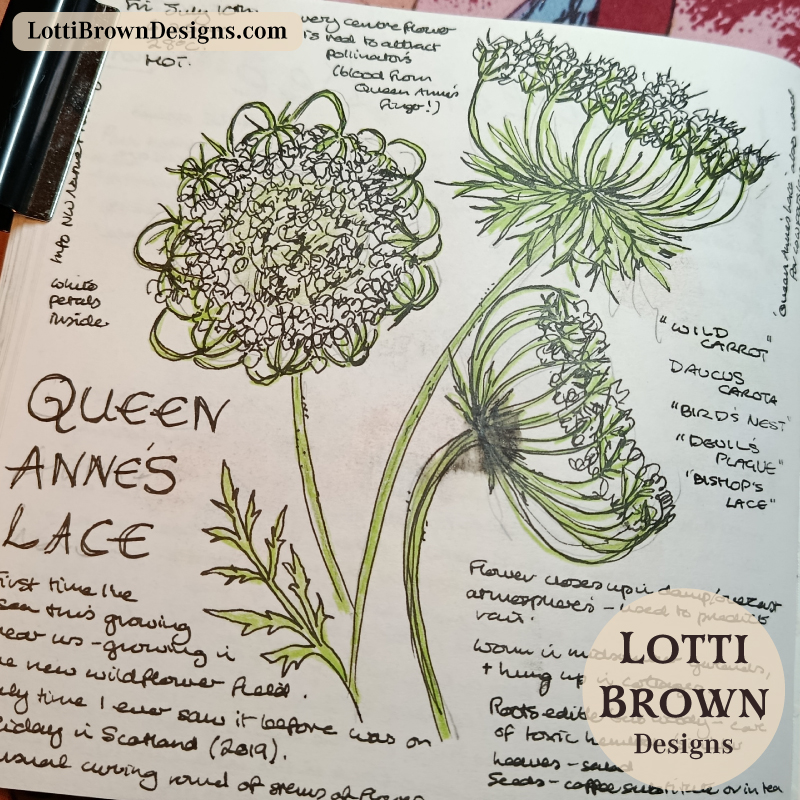 Queen Anne's Lace wildflower
It’s also known as Wild Carrot or Bird’s Nest for its distinctive habit of curling in on itself once the white flowers are spent and the seedheads are forming. It’s also said it curls in on itself in damp or overcast weather and so was once used to predict rain. The flowers were used in the past for midsummer garlands and home decorations.
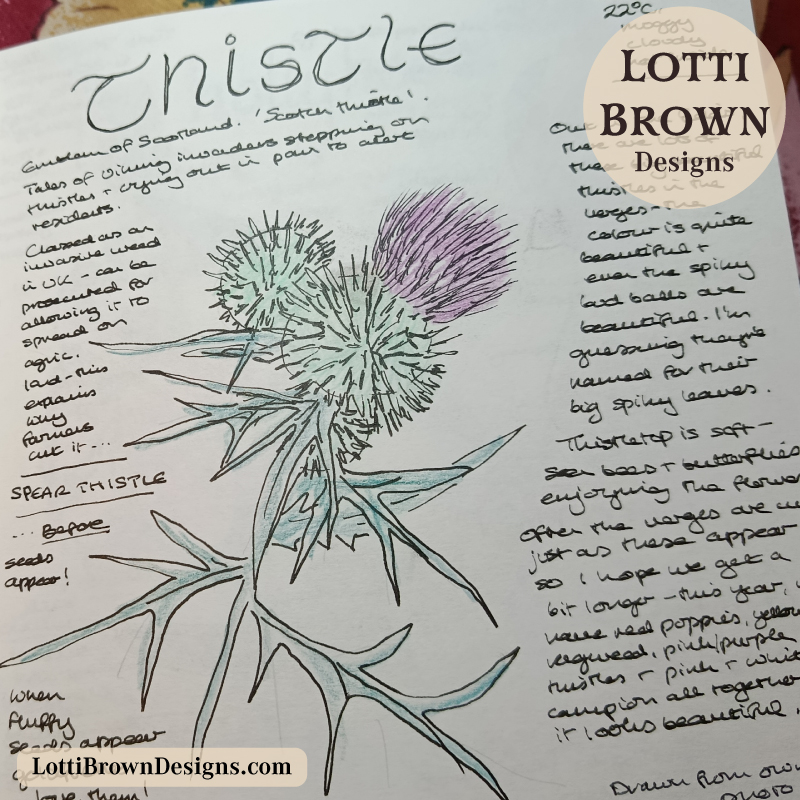 Thistle journal sketch
As the month progresses, the colourful flowers turn to seedheads – the thistles turn from silken strands of purple to wisps of white thistledown and take to the air at the slightest breeze.
Each red poppy flower makes a tiny pepperpot of seeds (below)…
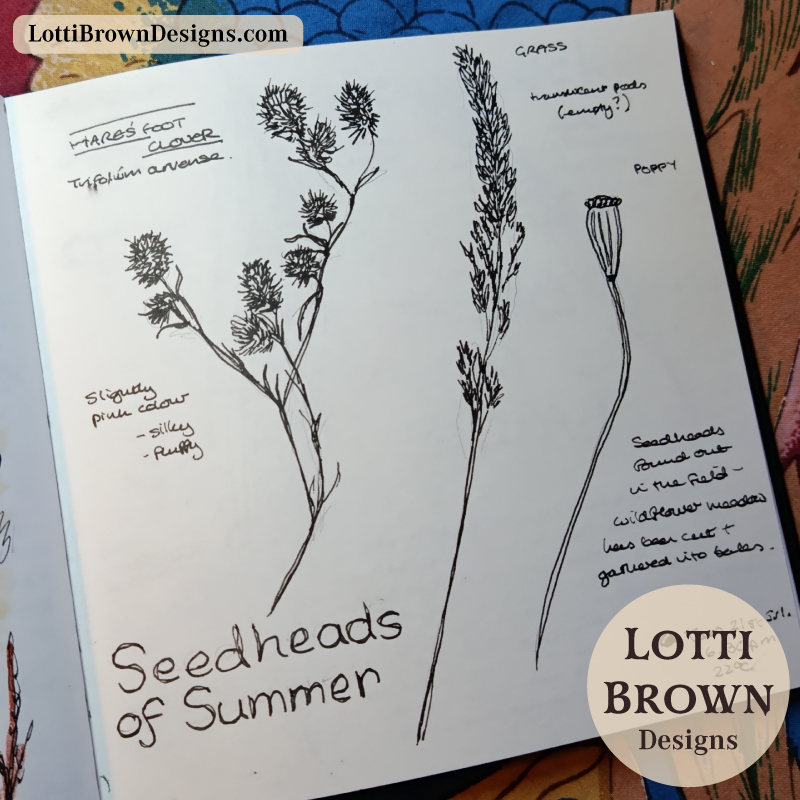 Summer seedheads journal page
And the grasses turn pale and translucent in the low sun of the morning and evening. I find this really pretty Hare’s Foot Clover (above) after the wildflower meadow has been mowed, which has turned pale pink in the summer light and sheds its tiny fluffy seeds to ensure a new generation.
The flowers of the wildflower meadow have been bundled into huge bales of hay – and out in the fields, now, more big round bales start to appear where the crops are harvested.
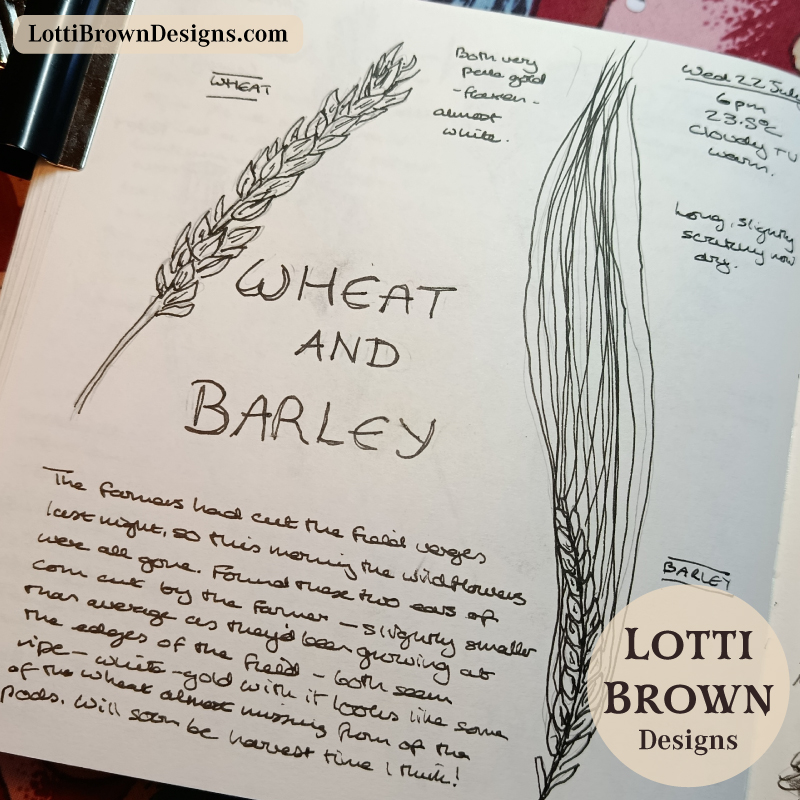 Wheat and barley - the ears of corn are now ripe and golden, ready to harvest
Near us, the closest fields of wheat and barley are yet to be harvested and shine with a silvery-gold as they gently rustle in the breeze. They look ripe, so I think it won’t be too long before we hear the big machinery out the back of our house, feel the ground thundering as they move, and smell the dust of the harvest in the air.
First Fruits
It will soon be harvest time in the garden, too – although my harvest may well be a meagre one this year. I have just a few tiny strawberries and this one (ripening) yellow cherry – which actually I deem a success as it’s the first the little cherry tree has ever produced.
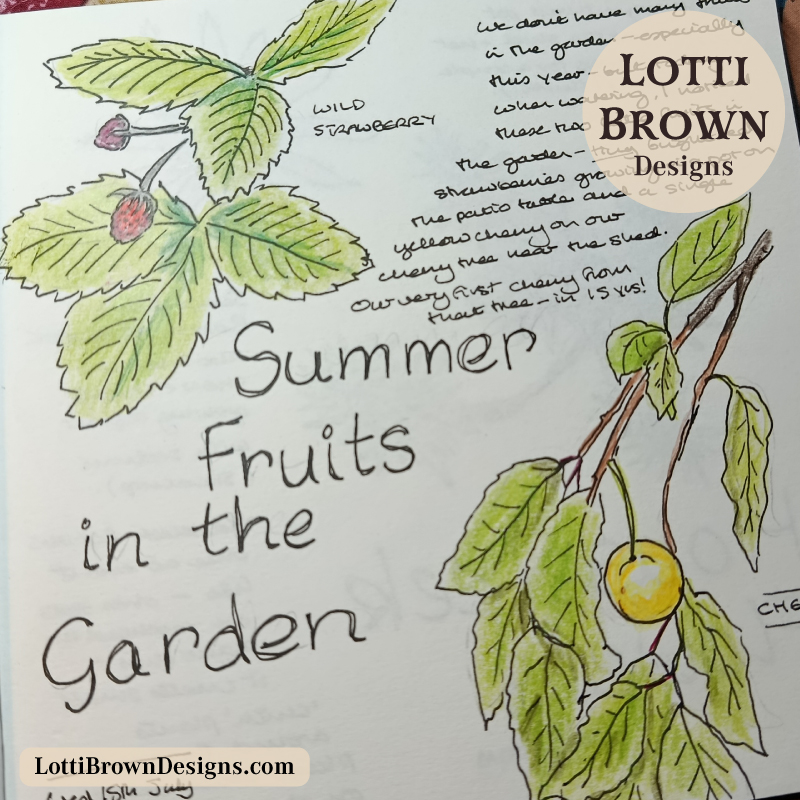 Tiny wild strawberries and a single cherry - fruits from the garden this summer
I must keep watering it as it’s in a pot and could easily dry out in this weather.
In the fields, too, I see the first signs of autumn – the rowan tree on the track into the fields is now showing off her beautiful bright berries…
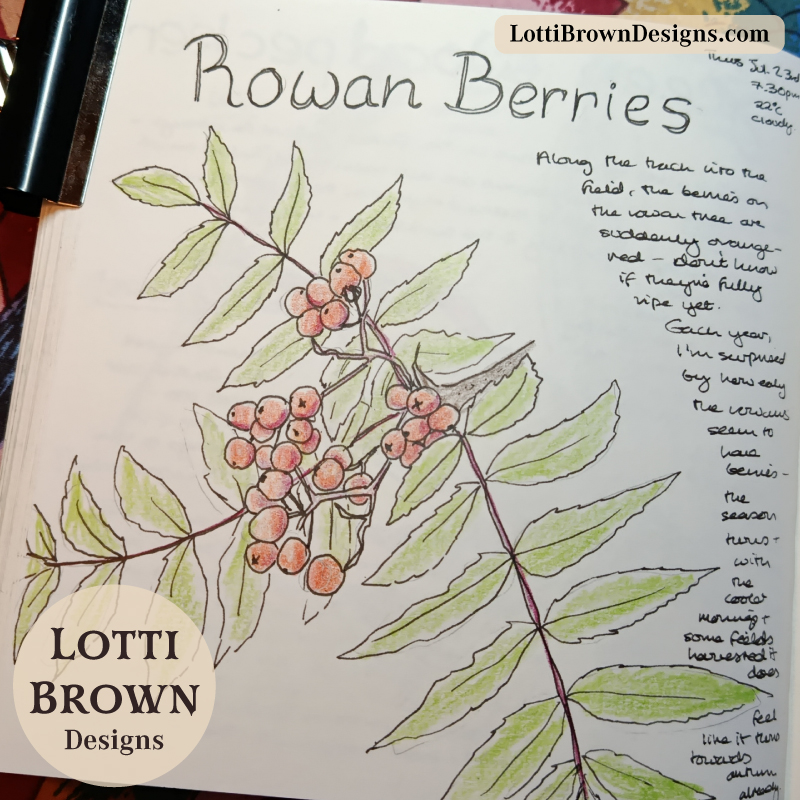 Rowan berries
I suspect they’re not quite ripe yet and I always feel shocked to see these first signs of autumn in July, as it seems too early – but here now, as the end of July is in sight, the height of summer is now passed and we’re heading towards autumn – and this, for me, is always the first sign…
Summer Birds
One of the highlights of summer is always the summer birds – while many of our more familiar garden and countryside birds go quiet in the summer – these visitors to our summer skies are busy on the wing catching flies for hungry mouths or developing their own flying skills…
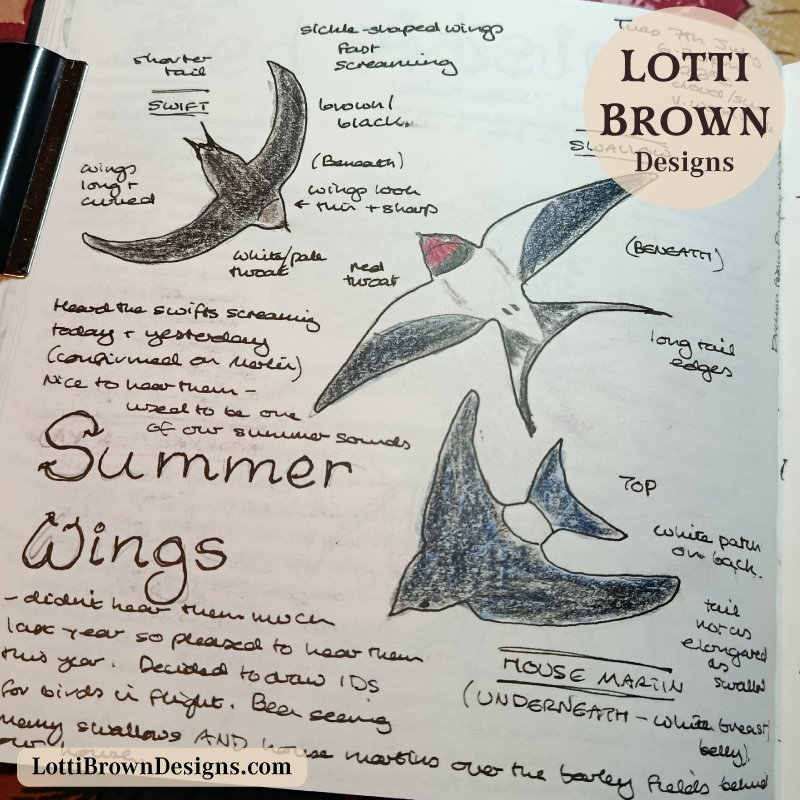 Birds of summer skies
I just love seeing the swallows and house martins swooping down low over the fields on our walks – or seeming to dance high in the sky – chattering cheerfully to each other the whole time.
I know it can be difficult to identify them sometimes, so I made my nature journal page with this in mind, looking at silhouettes and identifying features.
I notice that the swallows and house martins often seem to fly together – likely chasing the same group of insects. The swallow has longer tail points and a red breast, although the youngsters’ tails are not as long.
While the house martin’s forked tail is much shorter and it has a distinctive white patch on its lower back.
Once you recognise the shape and hear their wonderful screaming calls overhead, they're surprisingly easy to tell apart.
We did not seem to have many swifts last year, but I’m pleased that I’ve heard several ‘screaming swifts’ this month.
A little closer to earth, we’ve watched young goldfinches perched enjoying the seeds from the thistles – they love to eat these. I sometimes wonder if these are part of the family of goldfinches we had nesting just outside our bedroom window last year.
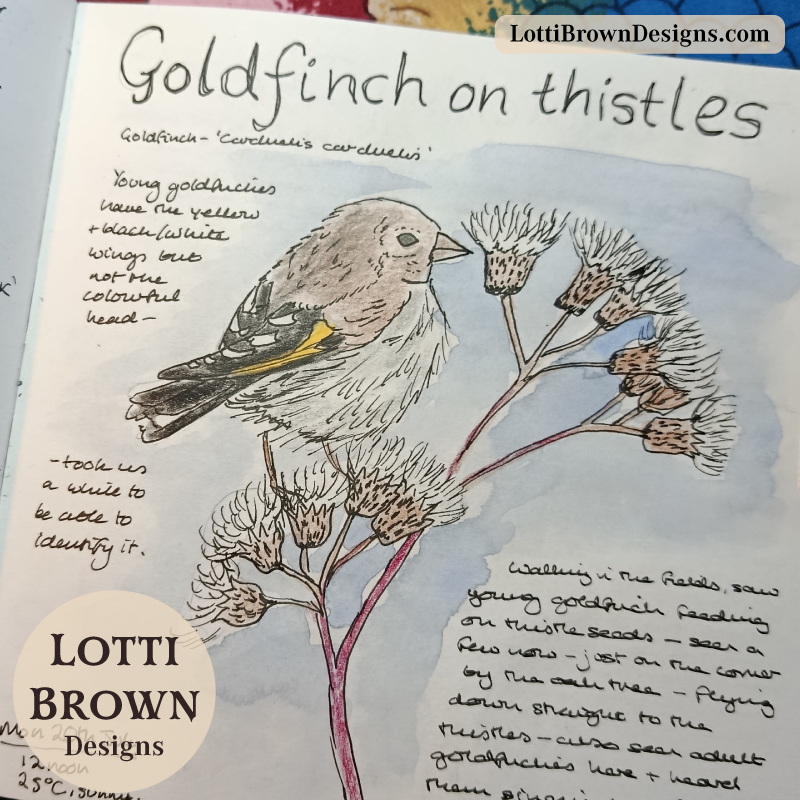 Young goldfinch perched on thistles
And although the month has been quite quiet with birdsong, we were very excited to pick up the calls of a Green Woodpecker in the field – close to where we saw one earlier in the year.
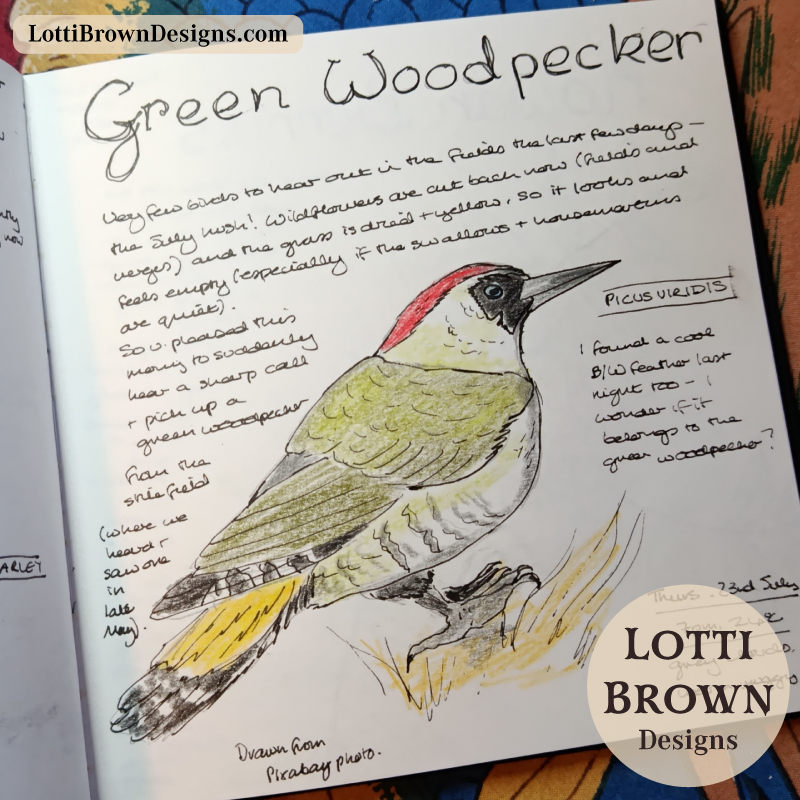 Green woodpecker
Even when most of the birds go quiet in July, there’s always something to notice, enjoy and record in my nature journal!
Roe Deer in the Fields
One of my most memorable July nature journaling moments came during an unexpected encounter with two roe deer...
Early one morning, in the cool, we were walking quietly by the maize field. We heard a rustling, and then the sound of galloping hooves – and turned to see just 2 or 3 feet away a beautiful doe (female deer) emerge from the maize…
Followed a minute later by the buck (male deer)…
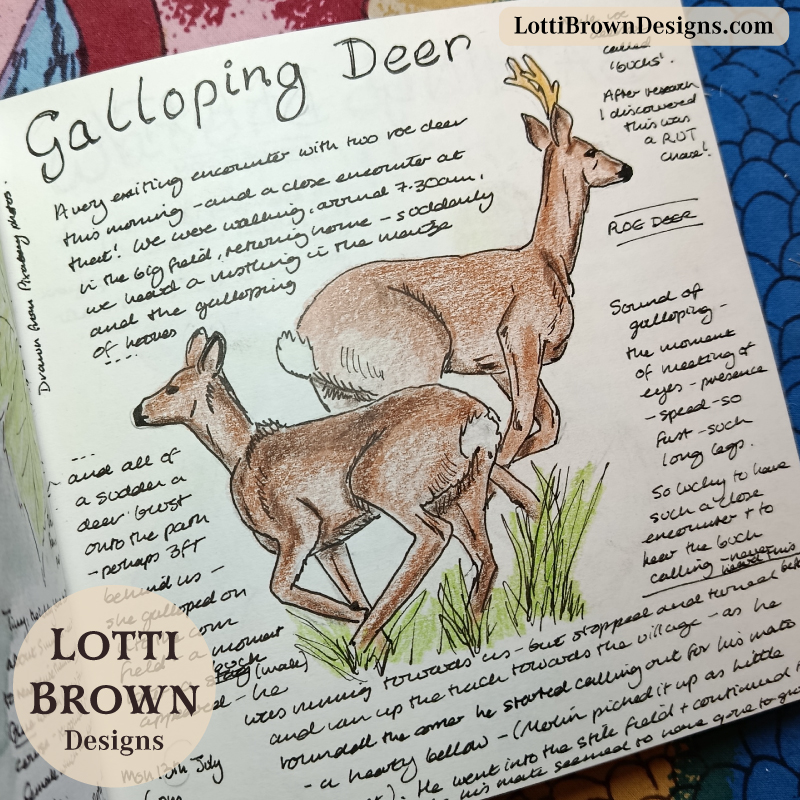 An unexpected (and close) encounter with two roe deer
Each met our eyes momentarily, pausing to look and assess, before resuming their gallop – the male continuing with sharp barks which were amazing to hear and I’ve never heard before.
It turns out that we’d disturbed the headlong chase of the roe deers’ rut season. I don’t know who was most surprised, us or the deer – it’s certainly a memorable encounter and one I won’t forget in a hurry – the closeness, the beautiful russet fur like velvet, the noise of the galloping hooves coming out of the maize field so unexpectedly, and the moment we met their big dark eyes.
I think this is a once in a lifetime memory…
It's moments like these that often find their way into my journal almost before I get home. Not because the sketch will be perfect, but because I never want to forget how it felt.
A week or so later, near the same location, we see a deer watching us from the wheat field – he’s close, but does not run away – following us with his eyes as we walk by. Perhaps he recognises us now, as we think we recognise him?
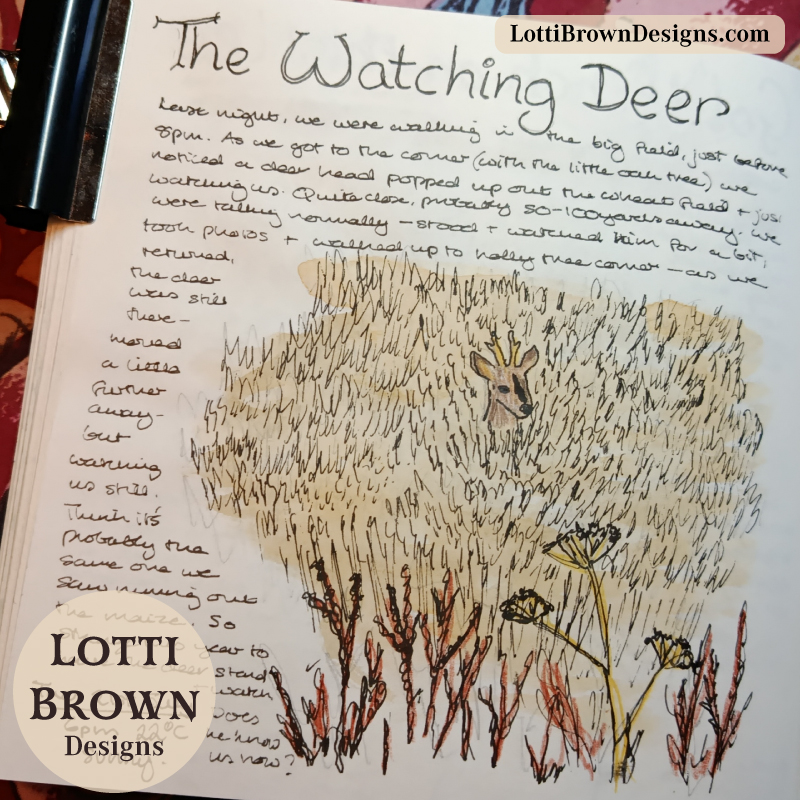 'The Watching Deer'
July has felt full of contrasts this year - long hot days, thirsty birds, colourful wildflowers and wonderful encounters with butterflies and deer.
Some moments have lasted only seconds, while others have stayed with me for weeks afterwards.
That's one of the things I love most about keeping a nature journal...
It isn't really about filling pages - it's about collecting moments of attention that might otherwise slip quietly away.
Whether you've been watching butterflies in a wildflower meadow, listening to swifts overhead or simply noticing the flowers blooming in your own garden, I hope July has offered you plenty of opportunities to slow down and enjoy the richness of midsummer.
July Nature Journal Prompts & Ideas
If you'd like to get journaling in July, here are some ideas and prompts inspired by my own July nature journaling...
You don't need to do them all (or any at all). Choose whichever catches your attention this month.
- Watch a butterfly for five minutes. Notice how it moves and which flowers it chooses.
- Spend a few minutes watching birds drinking or bathing. Does each species behave differently?
- Sketch a summer flower, paying attention to its shape or colour rather than trying to make it perfect.
- Collect a fallen seedhead or grass stem and draw its patterns.
- Watch for swallows, house martins or swifts overhead. Try to describe the way they fly.
- Notice the first berries beginning to colour on trees or shrubs.
- Look closely at a leaf. Can you spot any neat circles cut by a leafcutter bee? Perhaps something else has been having a nibble?
- If you're walking in the countryside in the early morning or evening, keep watch for deer or other mammals moving through the fields.
- Record one thing that surprised you or made you wonder this month.
- Finish the sentence: "The thing I'll remember most about July is..."
Whether you're just beginning or have been keeping a journal for years, I hope these July nature journaling ideas encourage you to slow down, notice the richness of midsummer and enjoy recording the small moments that make this season so special.
More to explore...
On very hot July days, you might also find my tips for nature journaling in a heatwave useful - as well as my nature journaling from home page...
You might also enjoy my July nature journal (from 2024) and my summer journal pages (from 2025)...
See my nature journal pages from June here - along with more seasonal journal pages here...
Or jump ahead to August, here...
You might also like to explore tips for nature journaling in everyday life - or get ideas for beginners (that's here).
Want weekly nature journal prompts? Find those here...
Or explore my year of birdsong, here...
Deepen Your Nature Journaling Practice
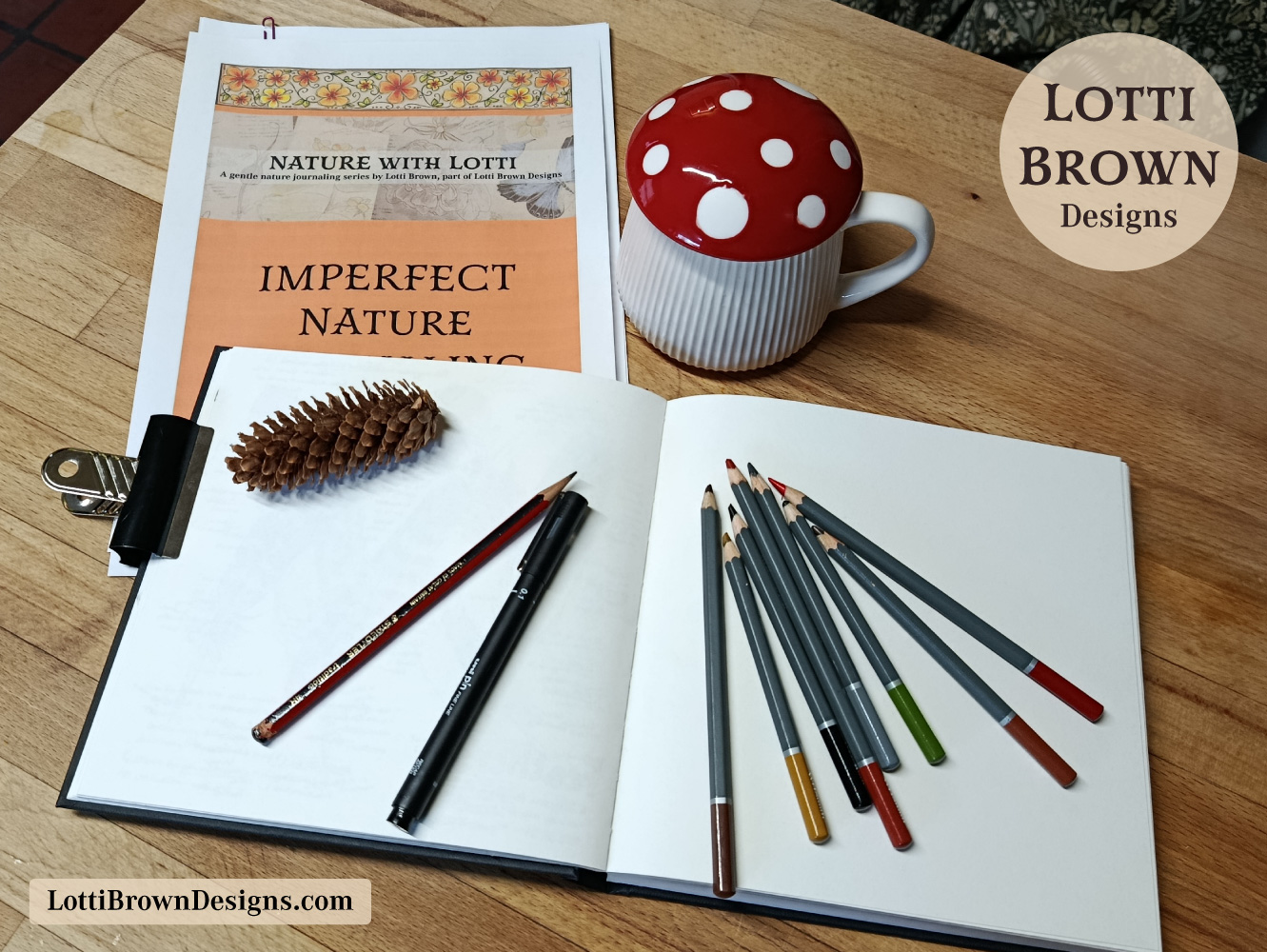 Deepen your nature journaling practice with me...
If you’ve enjoyed my nature journaling reflections, you might also like my 20-lesson course, Imperfect Nature Journaling.
It’s a gently structured, self-paced journey designed to help you:
• Slow down and notice more deeply
• Build confidence in drawing and observing
• Create a calming journaling ritual you can return to
• Feel more connected to the seasons and the natural world
No perfection required. Just curiosity and a notebook.
You can explore the course here whenever you’re ready...
P.S. If you’re just beginning - or would like something quieter and more simple to start with - you might first like to get started with my free 'Getting Started' guide or gain momentum with my 'Gentle Introduction' guide to help you through your first few pages - here...

Shall we stay in touch..?
Each month, I share stories from my own nature journal, new art from my studio, and simple seasonal inspiration to help you feel more connected with the turning year - if you'd like to stay updated, please sign up with your email address below...
Recent Articles


-
Magpie Folklore and Meaning - Symbolism & Superstitions - Magpie Art
Oct 06, 26 05:02 AM
 Discover magpie folklore, symbolism, and superstitions from around the world. Explore the meaning of this intelligent and mysterious bird.
 -
Nature Journal Prompts
Oct 05, 26 04:42 AM
 Easy nature journal prompts to inspire and encourage you - one per week...
 -
Meaning and Symbolism of Ivy in the Celtic Tree Calendar
Sep 29, 26 05:05 AM
 Explore the meaning and symbolism of ivy as part of the Celtic Tree Calendar...
Shop My Current Artwork Collections

My art is available as sustainable art prints, notebooks, greetings cards, tote bags and clothing in my Teemill shop.
Find my stockists for all my earlier artworks here...

Lotti Brown is a self-taught nature artist and nature journaling educator whose hand-drawn work is inspired by wildlife, folklore, and close observation. With 18 years in creative fields and 10 years creating nature art, she brings deep practical experience to her work. Trained by the Wild Wonder Foundation, she shares nature journaling courses and guides online. Her artwork has been licensed internationally and exhibited at Goole Museum and Bridlington Spa in the East Riding of Yorkshire, UK.
Follow me:
Share this page: