
- Home
- Nature Journaling
- Seasonal Nature Journaling
- Nature Journaling in June

Nature Journaling in June
Wildflowers, Birds &
Summer Inspiration
By Lotti Brown
June is filled with poppies, ox-eye daisies, young birds and long golden evenings. Explore nature journaling in June, inspired by the beauty of early summer...
If you're looking for June nature journaling ideas, early summer offers endless inspiration, from wildflowers and young birds to long golden evenings and quiet encounters with wildlife.
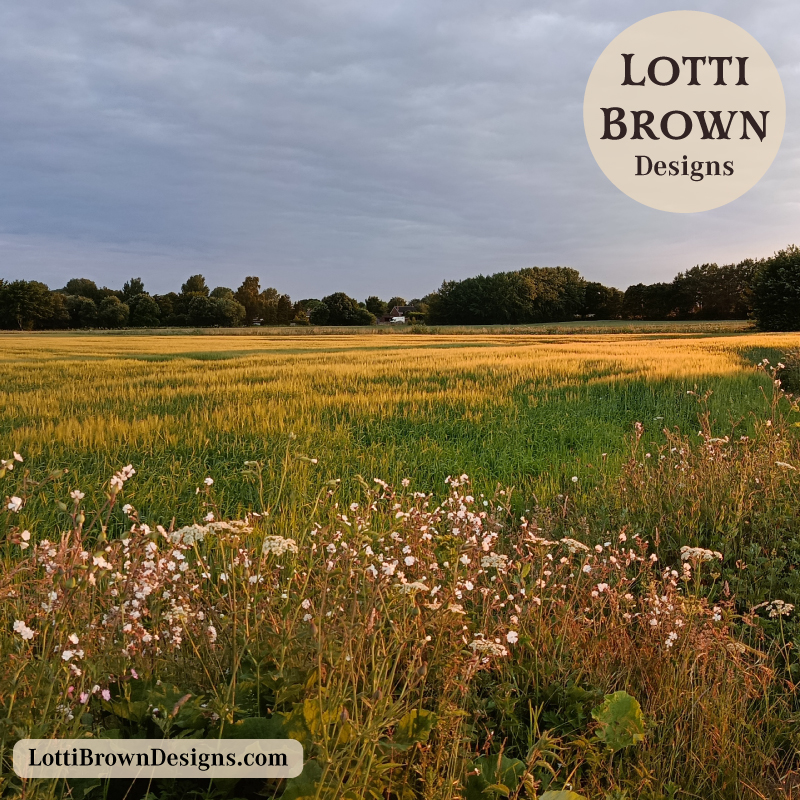 June walks - fields of barley and verges filled with wildflowers
The perfect June day is soft and golden…
Balmy summer days stretch long into the evening and birdsong begins to soften after the urgency of spring. Hedgerows and verges seem filled with flowers…
There is a sense that nature has settled into itself now – abundant, warm, unhurried – as if the season itself is taking a long, contented breath.
Our walks are early in the morning, starting our days in a sea of green – the barley in the fields undulating gently in the breeze like waves.
And we return again later, in the evening, once the heat of the day has softened and the light has turned warm and golden – a soothing balm after a busy day – ambling gently through the fields to explore the wildflowers, plants and wildlife of the season.
Birds of June
June is the month when we start to see the young fledgling birds out in the world – young fluffy fledglings learning to feed like this little yellow blue tit chick which I saw from my kitchen window, after being alerted to its presence by its high-pitched chirping…
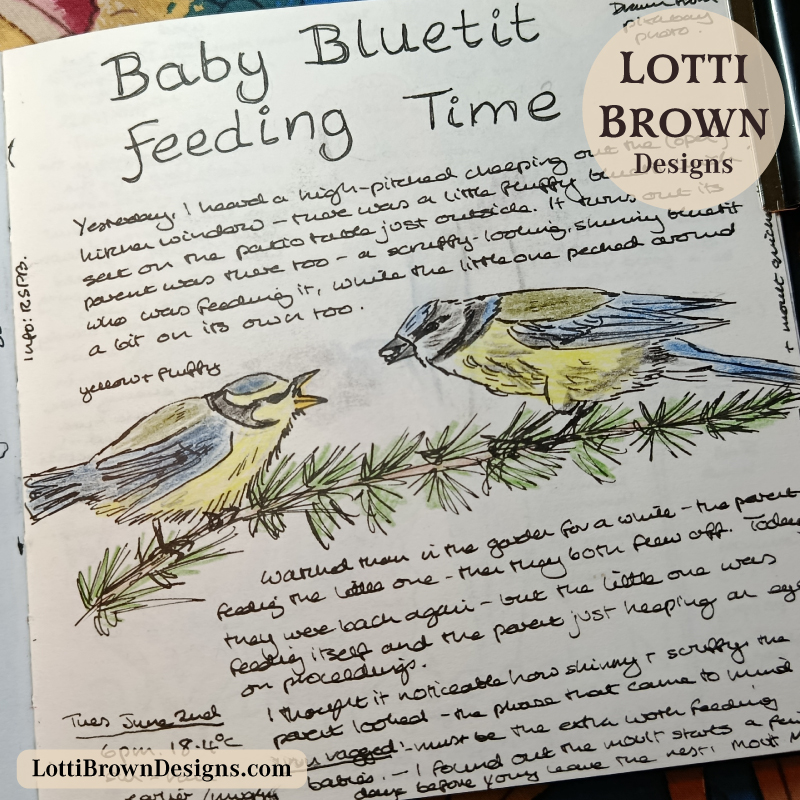 Feeding time for baby blue tit
The poor parent looked scruffy and utterly run ragged - the result of many weeks spent feeding a hungry new family.
And time well spent, as the following day I saw the pair again, but this time the youngster was feeding itself while the proud parent just kept an eye on proceedings.
And later in the month, the fluffy fledglings have grown slim and sleek - juveniles or teens, but not quite fully grown, still smaller than adults and not quite grown into their features and markings.
We saw this young crow on our walk – just waiting in the hedgerow – smaller and with a shorter tail than an adult crow. He did not seem scared, but started to walk away up the path…
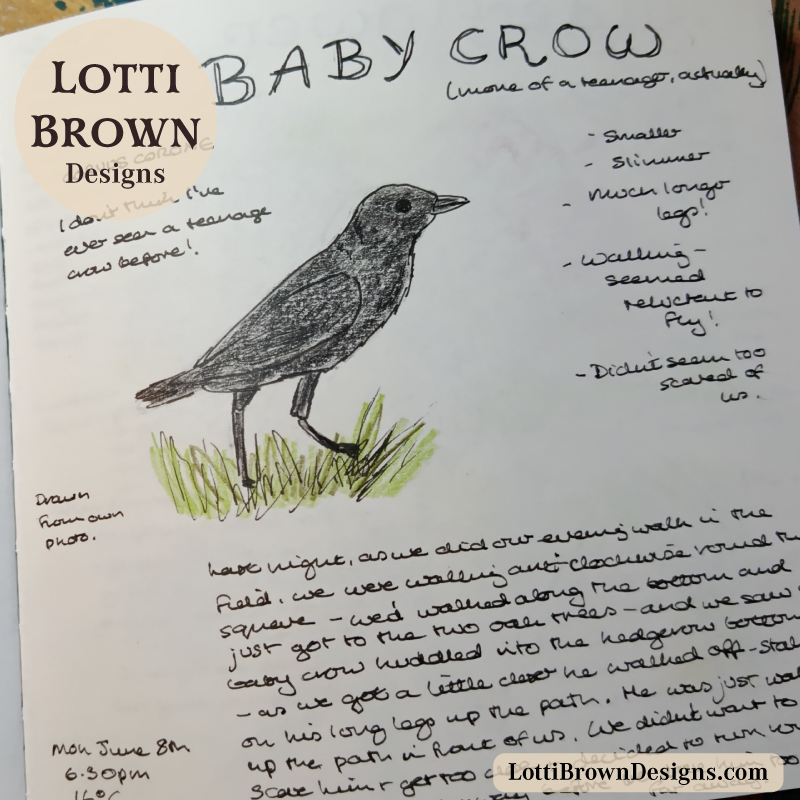 Juvenile crow - sweet!
After just a few short yards we decided to turn around and retrace our steps rather than scare him or drive him away from familiar surroundings.
A tiny teen goldcrest was also seemingly unafraid – we saw him hopping gently from twig to twig in the hedgerows of the rail trail – we were just a few feet away and could see him clearly – and were able to watch him for several minutes before deciding to leave him in peace…
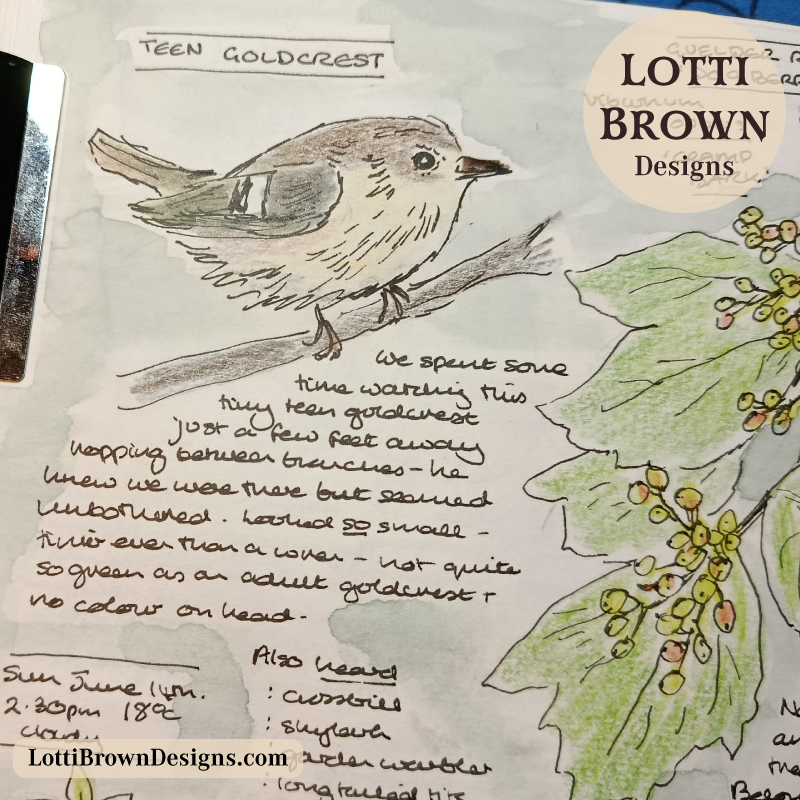 Juvenile goldcrest
Special moments of connection that feel like tiny treasures to hold so gently in the heart…
Yellowhammers have serenaded us on so many walks this summer – their light trilling of ‘a little bit of bread and no cheese’ is instantly recognisable and has become one of the sounds of our summer walks.
And sometimes we’re rewarded by a glimpse of this brilliant-yellow bird, like we were on one of the many rail trail walks we’ve enjoyed this month…
Also wheeling in the sky were swifts – we’ve not seen any at home so far, although the skies there are filled with little house martins and swallows, swooping so low to catch tiny flies that they almost seem to brush the barley tips…
 Birds of the Rail Trail
And a chattering jay in a wooded area where the trees meet overhead. We thought we’d heard one on Merlin a few weeks ago, but it turned out to be just an annoyed squirrel – so it was nice to encounter a jay for real.
Dusk Walk
Many of our evening walks have been towards dusk, which falls late in the evening now, as the days approach the peak of the solstice and the longest day.
The long light evenings seem to draw out a lot of wildlife – often nocturnal creatures which we don’t normally see in daylight the rest of the year. But in June, the combination of fewer hours of darkness and hungry youngsters to feed brings the wildlife of the night out before it’s fully dark…
On one of our later walks, towards 9 o’clock, the fields quiet and the light low, we walked into the field near our home and almost immediately spotted the white silhouette of a hunting barn owl. We watched as we walked and were rewarded by the sight of a second barn owl appearing.
They crossed paths, ghostly and silent, above a deer standing motionless in the barley – one of those rare moments in nature that feels almost unreal in its perfect synchronicity.
 Barn owls and deer on a dusk walk in June
We have seen the deer several evenings or early in the morning – a male stood still watching us. As our eyes meet, we wonder if he’s standing guard, protecting his family.
Wildflowers of June
Everywhere we go, the verges and hedgerows are heavy with grasses and colourful wildflowers…
We’ve really enjoyed our rail trail walks, exploring different parts of the rail trail each time, and seeing wildflowers that we don’t normally see in the fields and tracks closer to home.
 Wildflowers of the Rail Trail
Fragrant honeysuckle climbs across hedgerows while foxgloves stand tall like sentinels - and close to the ground, a tiny scarlet pimpernel creeps and the purple meadow cranesbill blooms.
In the hedgerows, the berries of the blackthorn and hawthorn are already starting to round and ripen – and everywhere are roses, beautiful pink dog roses, the wild cousin of our garden rose – small, fragrant celebrations of summer…
I discover an elegant yellow spire of flowers which I don’t recognise – and researching later, discover it’s Agrimony, once a well-known herb used for thousands of years to to heal and also with magical associations, sometimes known as ‘fairy’s wand’ or ‘fairy’s rod’. I can certainly imagine how fairies would love the tiny yellow flowerheads, glowing like little lanterns in the sunshine.
 Agrimony
In the field closer to home, the crimson clover of May has given way to big, beautiful ox-eye daisies growing alongside scarlet field poppies.
 Red poppies
In the mornings, the light shines through the red petals of the poppies and seems to glow with warmth and quiet optimism – and in the evenings, the white petals of the ox-eye daisies luminesce…
 Daisies - ox-eye daisies and scentless mayweed
These gorgeous daises are also known as moon daises or moon pennies – the perfect name for their pearly glow. They grow thick and beautiful in the field along with their smaller sisters, mayweed, named from the Old English word for maiden.
Close to the ground, I notice the rosette of miner’s lettuce, also known as winter purslane or spring beauty – another wildflower that’s new to me. This is a plant that arrived in the UK in the 19th century from North America. It’s named for the gold-rush miners who were shown the plant by the Native Americans and ate it to ward off scurvy.
 Miner's lettuce
As the long days of midsummer and the solstice approach, two wildflowers that are commonly associated with this time of year are flowering – their bright yellow flowers like tiny drops of sunshine.
The common St John’s wort and shrubby St John’s wort (Tutsan) are both named for St John’s day, June 24th, Midsummer Day. Both have a long history of healing and protective uses – and with their golden flowers feel especially fitting for this celebration of the sun.
 Common St' John's Wort (Hypericum perforatum) left - right: Tutsan (Shrubby St John's Wort, Hypericum androsaemum)
Trees & Hedgerows
June is a month of ripening and plenty in the trees and hedgerows – I notice fat, rounded, green beech nuts ripening on the trees…
 Ripening beech nuts
And large frothy heads of elderflowers which hang heavy on the elder branches. Some summer evenings, the scent of the white flowers is almost intoxicating and I can almost believe the folklore that if you sleep under an elder tree, you will be stolen away by fairies into the otherworld. Midsummer is supposed to be a particularly dangerous time for this – so I better keep walking…
 Elderflowers
The elderflowers are commonly gathered to make elderflower cordial or elderflower champagne, which I made once, and it tasted divine.
In my June Garden
In my tiny backgarden, the June flowers crowd together – pink foxgloves growing tall, and self-seeded this year in gravel – I hope they’ll continue to spread and that in a few years' time I might have a little foxglove colony of my own.
 Garden foxglove
It’s thought that the name foxglove may have come from an amalgamation of ‘folks’, meaning belonging to the little folk (fairies) and ‘gliew’, an Anglo-Saxon musical instrument with lots of little bells – one of the foxglove’s common names is ‘fairy bells’.
In another interpretation, it’s named from the Old English ‘glofa’ meaning fox – the flowers of the foxes.
Roses abound too – although our garden is little, we try to fit in as many roses as we can and they climb over doors and sheds, and are squeezed into pots and flowerbeds – sometimes on hot evenings, our garden smells heavy of roses.
My favourites are…
 Rosa Nostalgie - Nostalgia Rose
The beautiful two-colour Nostalgia rose which begins as a fresh white bud rimmed with deep magenta-red and deepens as it opens to a soft red.
 Rosa Scarborough Fair (pink) & Rosa Buttercup (yellow)
The delicate flowers of Rosa Scarborough Fair and Rosa Buttercup – both are beautifully open and informal rose flowers, really delicately coloured and flower reliably.
 Rosa mundi
The unusual Rosa Mundi – a ‘gallica’ (French) rose that has been known since the 16th century – it’s candy-striped in pink and white and so pretty and unusual.
It’s a type of ‘Apothecary Rose’ (Rosa officinalis) meaning a species of rose traditionally used for herbal preparations.
Folklore tells the story that the Rosa Mundi, ‘Rose of the World’, is named for Rosamund Clifford, the lover and mistress of King Henry II – often known as ‘Fair Rosamund’s Rose’.
It’s said that when Rosamund died, she was buried at Godstow Abbey – and her tomb was to be covered in Rosa Mundi flowers. Her resting place became a shrine to her with an inscription reading “Let them adore… and we pray that rest be given to you, Rosamund. Here in the tomb lies a rose of the world, not a pure rose …”
The beautiful flecks of magenta in the purity of the white rose petals perhaps signify her beauty and passion.
 Peach-leaved Bellflower
These beautiful periwinkle-blue bell-flowers have wildly self-seeded in our front garden this year – I love them, I think they look so pretty.
Last year, I thought this flower was a harebell, but this June, I realised it was a peach-leaved bellflower instead! A lovely reminder that noticing is always an ongoing process, and that our understanding of nature can continue to deepen over time.
The peach-leaved bell flower is named for its long thin leaves at the base, which look just like the leaves of the peach tree. It is actually a cousin to the harebell – and was introduced to Britain in the 16th century, often traditionally used in folk medicine for coughs, headaches and digestive upsets.
I love that my modern garden can include flowers and plants that would’ve been familiar to people centuries ago, and I love discovering what they meant to people in the past and gently translating that meaning into our lives today – because these flowers and plants are important to us - they’re part of our world and our culture and our history, too and I love that our gardens can reflect that.
June feels like a month suspended in golden light – flowers spilling into every corner, young birds testing their wings out in the world, and long evenings that seem reluctant to end.
It is a season of fullness, but also one of quiet transition. Elderflowers are beginning to hint at berries, flowers are already turning towards seed, and midsummer waits just around the corner. The year is still growing, but it is also slowly changing.
Nature seems to invite us simply to linger a little longer – to walk more slowly, stay outside until dusk, and notice the small moments that fill these long days with wonder.
Nature Journaling in June – Prompts
If you'd like to try some June nature journaling prompts of your own, here are a few ideas inspired by my own observations this month…
Wildflowers in long grass
- Choose a patch of long grass and notice the wildflowers growing among it. Sketch a few favourites, record their colours and shapes, or simply write about the feeling of standing among flowers gently moving in the breeze.
A favourite verge or hedgerow flower
- Pick one flower that catches your eye this month. What draws you to it – its colour, scent, shape, or perhaps a memory it brings back? Spend a little time getting to know it more closely.
Young birds and family behaviour
- Look out for fledglings and watch how they interact with their parents and siblings. Notice their calls, behaviour, and how different they look from the adults – these busy family moments can be a delight to record.
The scent of elderflower or roses
- Nature journaling isn't only about what we see. Take a few moments to notice the scents of early summer – the sweetness of roses or the heady fragrance of elderflower – and try describing them in words.
A flower you once misidentified
- Has there ever been a plant or flower you thought you knew, only to discover it was something different? Record the story of your misidentification and what, if anything, it taught you about looking more closely.
A long evening walk
- Take a gentle walk in the golden light of evening and record what feels different at this time of day. Notice the colours, sounds and wildlife that appear as the day begins to soften into dusk.
Dusk colours and shadows
- Observe how the landscape changes as the sun sinks lower. The softening colours, long shadows and glowing skies can make a beautiful page of sketches, colour swatches or simple written observations.
A quiet encounter with deer or owls
- Record a special wildlife encounter, whether it's a deer standing silently in a field or the sudden appearance of an owl. What made the moment memorable, and how did it make you feel?
The first signs of fruits and seeds forming
- Look closely at hedgerows and trees and notice where flowers are beginning to turn into berries, fruits and seedheads. June is a month of abundance, but also a gentle reminder that the seasons are already moving on.
A page simply recording the abundance of June
- Create a page that captures the feeling of June itself. Fill it with snippets of colour, lists of wildlife sightings, pressed petals, sketches or words – a joyful celebration of the fullness and beauty of early summer.
June always feels fleeting to me. The year is at its greenest and fullest, and yet there is already a hint of change in the air. The first berries are swelling, flowers are beginning to turn to seed, and midsummer quietly marks the turning of the wheel once again.
For now, though, there is still time to linger in the long evenings, to follow butterflies and birdsong, and to fill our journals with the small, beautiful moments that seem to glow in the golden light of early summer.
Perhaps that's why I love June so much. It invites us to slow down and simply be present in the world – to stand among the ox-eye daisies, breathe in the scent of elderflowers and roses, listen to the chatter of young birds, and watch the light linger long after the day should have ended.
These small moments may seem ordinary, but together they become the quiet treasures of a summer remembered.
If you'd like to explore more June nature journal pages, you can see my pages from June 2025 here...
You might like to see what happened in the previous month, May, here...
Or the following month - July - here...
If you're experiencing a June heatwave, I have some ideas and tips for your nature journaling practice here...
You can also discover more weekly nature journal prompts and ideas here...
Or read about my year of birdsong here…
You might also enjoy more of my seasonal nature journaling, here - or take a look at my first year of nature journaling, here...
If you're just getting started with your first nature journal, this is a gentle place to begin...
If you love folklore, you might like to explore my folklore hub here… or discover the folklores and myths of the trees of the Celtic Tree Calendar, here...
Deepen Your Nature Journaling Practice
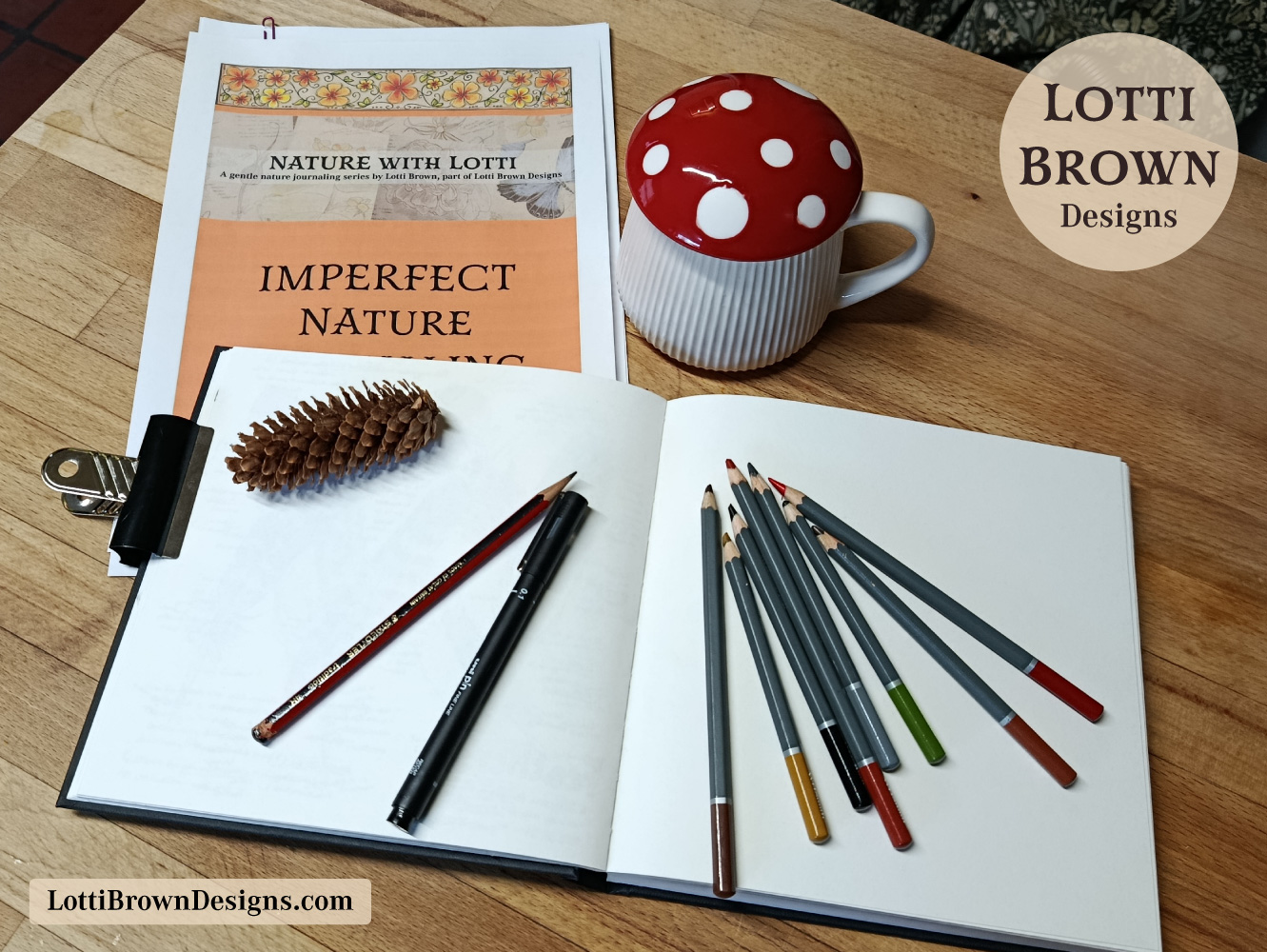 Deepen your nature journaling practice with me...
If you’ve enjoyed my nature journaling reflections, you might also like my 20-lesson course, Imperfect Nature Journaling.
It’s a gently structured, self-paced journey designed to help you:
• Slow down and notice more deeply
• Build confidence in drawing and observing
• Create a calming journaling ritual you can return to
• Feel more connected to the seasons and the natural world
No perfection required. Just curiosity and a notebook.
You can explore the course here whenever you’re ready...
P.S. If you’re just beginning - or would like something quieter and more simple to start with - you might first like to get started with my free 'Getting Started' guide or gain momentum with my 'Gentle Introduction' guide to help you through your first few pages - here...

Shall we stay in touch..?
Each month, I share stories from my own nature journal, new art from my studio, and simple seasonal inspiration to help you feel more connected with the turning year - if you'd like to stay updated, please sign up with your email address below...
Recent Articles


-
Barn Owl Folklore & Meaning - Symbolism of the Barn Owl
Sep 15, 26 03:34 AM
 Explore barn owl folklore, symbolism and meaning, from ancient myths to British traditions. Discover the quiet wisdom and mystery of this ghostly bird.
 -
Bramble Meaning, Myth & Symbolism - Celtic Tree Calendar Art
Sep 02, 26 11:32 AM
 A look at bramble meaning, myth and symbolism as I share my bramble Celtic Tree Calendar art for the month of 'Vine'...
 -
Nature Journal Prompts
Aug 26, 26 04:05 AM
 Easy nature journal prompts to inspire and encourage you - one per week...
Shop My Current Artwork Collections

My art is available as sustainable art prints, notebooks, greetings cards, tote bags and clothing in my Teemill shop.
Find my stockists for all my earlier artworks here...

Lotti Brown is a self-taught nature artist and nature journaling educator whose hand-drawn work is inspired by wildlife, folklore, and close observation. With 18 years in creative fields and 10 years creating nature art, she brings deep practical experience to her work. Trained by the Wild Wonder Foundation, she shares nature journaling courses and guides online. Her artwork has been licensed internationally and exhibited at Goole Museum and Bridlington Spa in the East Riding of Yorkshire, UK.
Follow me:
Share this page: