
- Home
- Nature Journaling
- Nature Journaling in Everyday Life
- Heatwave Journaling

Nature Journaling in a Heatwave
Staying Safe While
Noticing Nature
By Lotti Brown
Discover gentle ideas for nature journaling in a heatwave - including safety tips plus inspiration for noticing wildlife, weather and seasonal change during very hot weather.
Nature journaling in a heatwave can feel very different from journaling at other times of year.
When the summer heat arrives, you might wonder whether nature journaling should be put away until cooler days return. Is it simply too hot? Is it safe? And what is there to notice when even the birds seem to have disappeared into the shade?
I've wondered exactly the same.
And yet, the weather is so extremely hot, and it seems important – and perhaps you even want to keep a record of record-breaking temperatures.
Let's explore how heatwave nature journaling can remain safe, gentle and enjoyable.
 Walking during the heatwave - dried grass - trying to find shade
We’ve had three major heatwaves so far here in the UK this summer (by July 2026), with temperatures for the time of year being broken each time. So this really is unprecedented weather, so normal rules for nature journaling do not apply.
The summer sun can be welcome and enjoyable – but it can also become uncomfortable and even unsafe. And nature journaling should never become something that puts us at risk.
Personally, I hate the hot weather. I’ve had bad experiences with sunstroke (heat exhaustion) as a child – and honestly, it’s left me slightly wary of very hot weather, so at any whisper of hot weather I’m the first to retreat somewhere cooler.
In 2022, we experienced the extreme heat of a 40-degree centigrade day here in East Yorkshire, which was overwhelming – stepping outside was like opening an oven and having hot air blown at you. So heatwaves are certainly to be treated with respect and recognised as extreme weather.
That said, it doesn’t necessarily mean that nature journaling has to stop, full-stop – but it would be wise to consider the conditions…
Hopefully, I can give you some ideas, inspirations, and considerations to keep nature journaling in a heatwave safe as well as inspiring.
But before we start, if you’re in a heatwave, and you feel like you’re struggling with the heat already, you are allowed to let your nature journaling practice lapse. You don’t need to nature journal unless you really want to – it’s always okay to miss a day, a week, a month, or as long as you need. Your journal will still be there, quietly waiting whenever you're ready to return to it.
If you do want to journal, here are some ideas for heatwave journaling – some of them without going into the sun…
Safety First
No nature journal page is ever worth risking your health for.
If you're planning to try nature journaling in a heatwave outdoors, take sensible precautions regarding the weather.
- Check weather forecasts and any local weather or health and safety warnings for advice
- Avoid the hottest parts of the day – usually between 11 and 3, but also be aware that the heat can linger long into the evening.
- Go prepared with loose, light-coloured clothing that covers your skin, a sunhat, suncream, and plenty of water.
- Seek shade (but take care sitting under trees as they can drop branches suddenly in periods of prolonged or extreme heat)
- Avoid strenuous activity – this might include long or tiring hikes
- Be aware that public transport may be uncomfortably hot and services may be cancelled – it might be better to stay closer to home
- Know about the risk of wildfires and avoid naked flames in risk areas - avoid littering glass bottles or other glass items, cigarette ends, and other smoking materials.
- Don’t stay out too long
- Let someone know where you’re going and when you plan to return
If a trip out seems too much in the hot weather, consider a journaling session from the shade of your garden where you can easily go indoors or rehydrate instead, while still noticing nature and the effects of the heatwave.
Choose Better Times
The middle of the day and afternoon are usually the hottest parts of the day, so avoid these. Much wildlife will also avoid the intense heat, so there may not be as much to see at the hottest parts of the day.
Instead, choose the cooler times of the day to go out and about for your nature walks or nature journal activities.
Early morning is great, usually much cooler and you may even get a cooling dew, while the birds are likely to be up early and feeding.
In the evening, the hour or so before sunset is also a wonderful time and as the sun drops in the sky, the world is lit with a beautiful golden light that photographers know as the ‘golden hour’.
This is a beautiful time for a walk in the cool and you might see more activity from birds or animals who’ve spent most of the day avoiding the heat of the sun.
Some of my favourite summer wildlife encounters have happened in that cooler hour before darkness, when both people and wildlife seem able to breathe again.
 Lovely wildlife encounters on a dusk walk
Dusk can also be beautiful as the light softens to blue, temperatures drop, and the world quietens. We’ve really enjoyed our dusk walks out in nature and have often seen beautiful barn owls and deer at this time. In cities, you might see foxes start to appear around dusk.
Notice How Nature Changes in a Heatwave
The world changes when the heat is so intense – and this can be well worth noticing and recording in your nature journal.
We’ve noticed the earth on grassy paths, first harden like rock, then crack with patterns of crevices crossing the earth, and finally turn to fine dust as the soil becomes drier and drier.
Grasses dry and bleach to white in the sun – lawns are yellow-brown and crispy while long grasses wave their delicate seedheads, almost translucent in the sunlight.
Normal processes of nature happen much faster, like berries ripening or flowers blooming. It often means, also, that flowers and plants can also wilt very quickly.
 Beech nuts big and ripening in early June after a May heatwave
Leaves may scorch in the intense heat or trees and plants may drop their leaves to try and protect their core functions. Some plants may drop branches or even die.
Notice how the light changes – the world seems to take on a golden glow and may turn hazy from the heat.
How does the landscape feel different?
Birds During a Heatwave
 A wood pigeon seeking shade ended up looking into our kitchen window
Sometimes noticing what's missing is just as interesting as noticing what's there.
You may notice birds are quieter during a heatwave. This is because the middle of summer tends to be a quieter time for birds anyway as many have their summer moult of feathers during July and August, when they hide away as they’re vulnerable to predators.
And they may also hide because it’s hot – and they may suffer from heat stress in extreme temperatures too.
Sometimes, birds will take a dust bath in the dusty earth – or sit with wings outstretched in the sun, which is a way of using the heat from the sun to kill off any parasites. You might be able to notice these and record them in your nature journal.
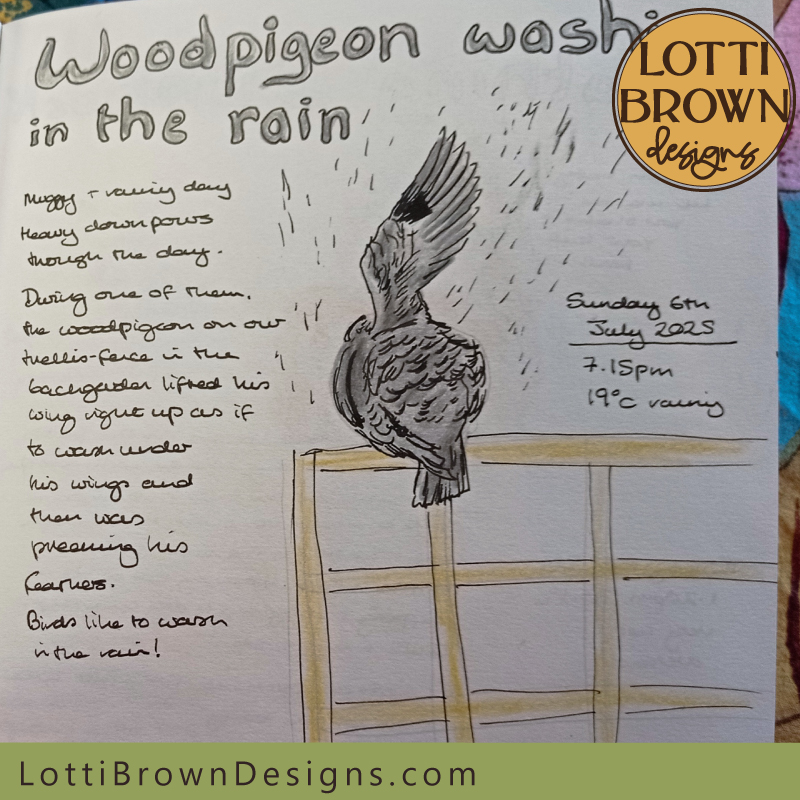 Woodpigeon washing in heavy rainstorm after hot muggy days
Even if you can’t hear birds, you will likely hear insects instead – the buzzing of bees and flies, and the chirruping of crickets in long grass. If you’re lucky, you might hear the beat of a tiny butterfly’s wings as it passes by, as butterflies love the sun and are often found wings open, basking on flowers.
 Lots of butterflies on flowers on a hot sunny day
The increased flies in summer are a real boon for our summer birds of the skies though – the swifts will chase tiny insects high up in the air, while swallows and house martins will swoop down low to catch them.
Watch out to see if you can see them dancing through the skies near you.
Wildlife Seeking Shade & Water
Even though hot days and heatwaves are a quiet time for the birds, I’ve seen an increased number of birds in my garden seeking the shade of the trees and bushes.
I have a shallow bowl of water for the birds in a shady part of my garden and also a very shady, small pond (in a half-barrel). The birds love it and during these hot heatwave days there is no shortage of birds visiting to drink or cool off.
 Blackbird drinking from our water dish
I’m lucky that it’s on a patio table, surrounded by plants so the birds feel safe – and just outside my kitchen window – so I get a great view of visitors to my water dish, which I keep clean and topped up.
On very hot days, I've found myself checking my bird bath almost as often as the birds do.
 Wood pigeon sat in the water dish - cooling off for a bit!
In sunnier parts and in extreme heat, you might notice birds with their beaks wide open, trying to cool off, or with all their feathers fluffed out. Last year, when we had a goldfinch nesting just outside our bedroom window, on very hot afternoons she sheltered her young with her wings outstretched and her beak gaping open, trying to stay cool.
Small mammals too, might seek the shade of woodlands, dense tree cover or the shade under hedgerows to try to keep cool.
So shady spots are good for us and for wildlife spotting too.
Night Nature
On extremely hot heatwave days, you might feel like the only time it’s cool enough to venture into nature is after dark.
This can be a very good idea as it’s cooler, there’s likely to be more wildlife than in the heat of the day, and it can give you a whole different perspective on nature journaling if you don’t normally nature journal at night.
Look out for bats, moths, foxes and owls (listen too) – these may all be about at night.
It might be quieter too, so you might notice different noises that you don’t normally hear.
You can also observe the night sky, moon and stars, if you prefer.
Do think about safety, too, with torches and lights, reflective clothing and be aware of your surroundings – remember to also let someone know where you’re going and when you expect to return – or you might prefer to go out with a companion.
Journaling from Home
Sometimes the best way to enjoy nature journaling in a heatwave is simply to stay indoors.
If the weather feels too hot to go out, you don’t need to. You can easily nature journal from home using photos, collections of found objects or reference photos and videos.
See more about this in my nature journaling from home page here…
If you have a cool room to nature journal from, this would be my personal option to stay out of the heat and stay cool as much as possible in heatwave conditions.
Although it’s not fun to stay in with curtains closed and the world trapped outside, nature journaling can bring a little of the beauties of nature in to you while the heat rages outside and help pass the time until it cools.
Journaling the Heatwave
 Journaling the June heatwave
A heatwave is part of nature too. So you might like to journal about the heatwave itself – this is something I’ve done a couple of times.
Seeking a small aspect of nature to journal about seems somehow unimportant when the real nature news is the weather and the heatwave itself.
So record temperatures, news stories, and your own experiences of the heatwave, whether that’s inside or outside – it’s all relevant and it all relates to the weather and climate phenomenon of the heatwave.
Perhaps you want to research the influence of the climate on the weather and heatwaves. This is important work and it can all go in your nature journal if you choose.
It doesn’t have to be drawings – charts, numbers, notes or written prose are all valuable ways of nature journaling and can belong in your journal.
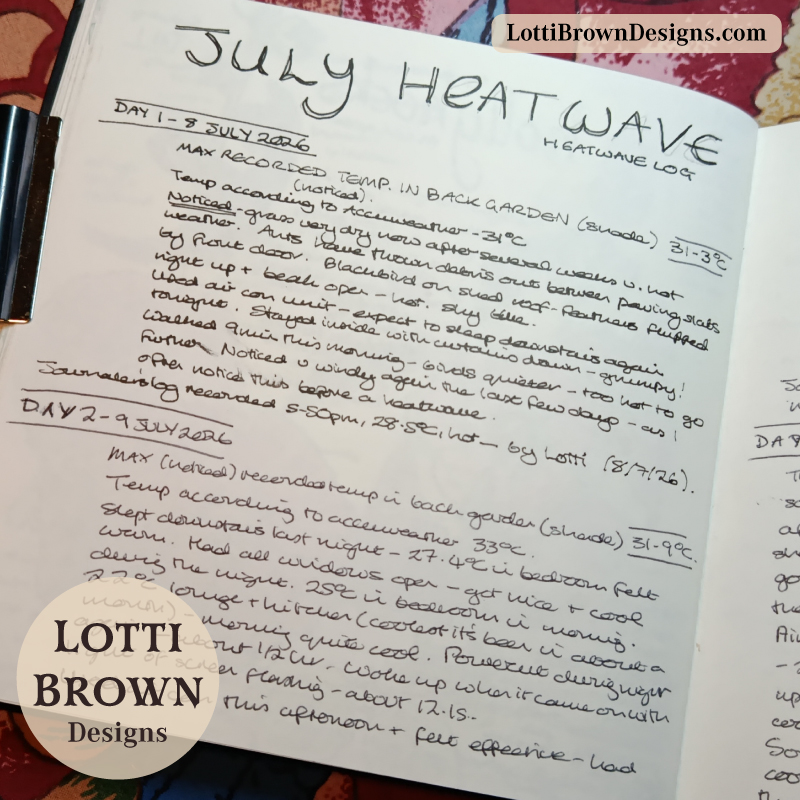 I journaled the July heatwave with daily 'journaler's logs' (taking inspiration from a ship's 'Captain's log')
Years from now, your journal may become a fascinating record of the changing seasons and changing climate you've lived through.
Gentle Pages
Heatwave days are not normal days. The heat can make us tireder than usual. It can make us busier as there’s sometimes more to do to try and mitigate the hot weather and routines change.
That’s all okay and to be expected.
The most important thing is to rest if needed – you don’t need to nature journal at all if it will trouble more than it soothes.
If you want to nature journal, give yourself permission for your journal pages to be simple or brief.
Your heatwave journal page might just be:
- A single feather, quickly sketched
- A square to show the colour of the sky
- A single sentence
Nature journaling doesn't have to become another thing to achieve – and especially so when it’s hot!
Perhaps different seasons ask different things of us in our nature journaling. Sometimes, the season invites long walks or days out in nature…
And sometimes, the season asks us simply to sit quietly in the cool and calm of the shade to rest.
Both are ways of noticing the natural world, and that's what nature journaling has always been about for me. Not producing perfect pages or keeping to a schedule, but learning to pay closer attention. Sometimes that happens on a long walk, and sometimes it happens while sitting quietly in the shade with a cool drink, simply watching the world carry on around you.
Nature journaling in a heatwave reminds us that every season - and every kind of weather - invites us to notice nature in different ways.
If this article has reassured you that nature journaling doesn't have to happen on perfect days or in perfect places, you might enjoy my Gentle Introduction to Nature Journaling or Imperfect Nature Journaling courses. They're designed to help you build a gentle, sustainable journaling practice that fits around real life – whether you're exploring the countryside, sitting in your garden, or simply noticing the changing sky from your window.
Because nature isn't waiting for the perfect day – it's waiting to be noticed.
Deepen Your Nature Journaling Practice
 Deepen your nature journaling practice with me...
If you’ve enjoyed my nature journaling reflections, you might also like my 20-lesson course, Imperfect Nature Journaling.
It’s a gently structured, self-paced journey designed to help you:
• Slow down and notice more deeply
• Build confidence in drawing and observing
• Create a calming journaling ritual you can return to
• Feel more connected to the seasons and the natural world
No perfection required. Just curiosity and a notebook.
You can explore the course here whenever you’re ready...
P.S. If you’re just beginning - or would like something quieter and more simple to start with - you might first like to get started with my free 'Getting Started' guide or gain momentum with my 'Gentle Introduction' guide to help you through your first few pages - here...
See more ideas for nature journaling in everyday life here...
Get more nature journaling inspiration in my main Nature Journal hub here...
You might also enjoy a look at my summer nature journal pages for:
- July 2024
- August 2024
- June 2025
- Summer 2025 (July/August)
- June 2026
- July 2026
- August 2026 (coming soon)
More seasonal nature journaling here - plus weekly prompts for your nature journal here...

Shall we stay in touch..?
Each month, I share stories from my own nature journal, new art from my studio, and simple seasonal inspiration to help you feel more connected with the turning year - if you'd like to stay updated, please sign up with your email address below...
Recent Articles


-
Magpie Folklore and Meaning - Symbolism & Superstitions - Magpie Art
Oct 06, 26 05:02 AM
 Discover magpie folklore, symbolism, and superstitions from around the world. Explore the meaning of this intelligent and mysterious bird.
 -
Nature Journal Prompts
Oct 05, 26 04:42 AM
 Easy nature journal prompts to inspire and encourage you - one per week...
 -
Meaning and Symbolism of Ivy in the Celtic Tree Calendar
Sep 29, 26 05:05 AM
 Explore the meaning and symbolism of ivy as part of the Celtic Tree Calendar...
Shop My Current Artwork Collections

My art is available as sustainable art prints, notebooks, greetings cards, tote bags and clothing in my Teemill shop.
Find my stockists for all my earlier artworks here...

Lotti Brown is a self-taught nature artist and nature journaling educator whose hand-drawn work is inspired by wildlife, folklore, and close observation. With 18 years in creative fields and 10 years creating nature art, she brings deep practical experience to her work. Trained by the Wild Wonder Foundation, she shares nature journaling courses and guides online. Her artwork has been licensed internationally and exhibited at Goole Museum and Bridlington Spa in the East Riding of Yorkshire, UK.
Follow me:
Share this page: