
- Home
- Nature Books
- Robin Books

British Robin Book Recommendations
By Lotti Brown
Two British robin book recommendations for lovers of our nation's favourite little birds...
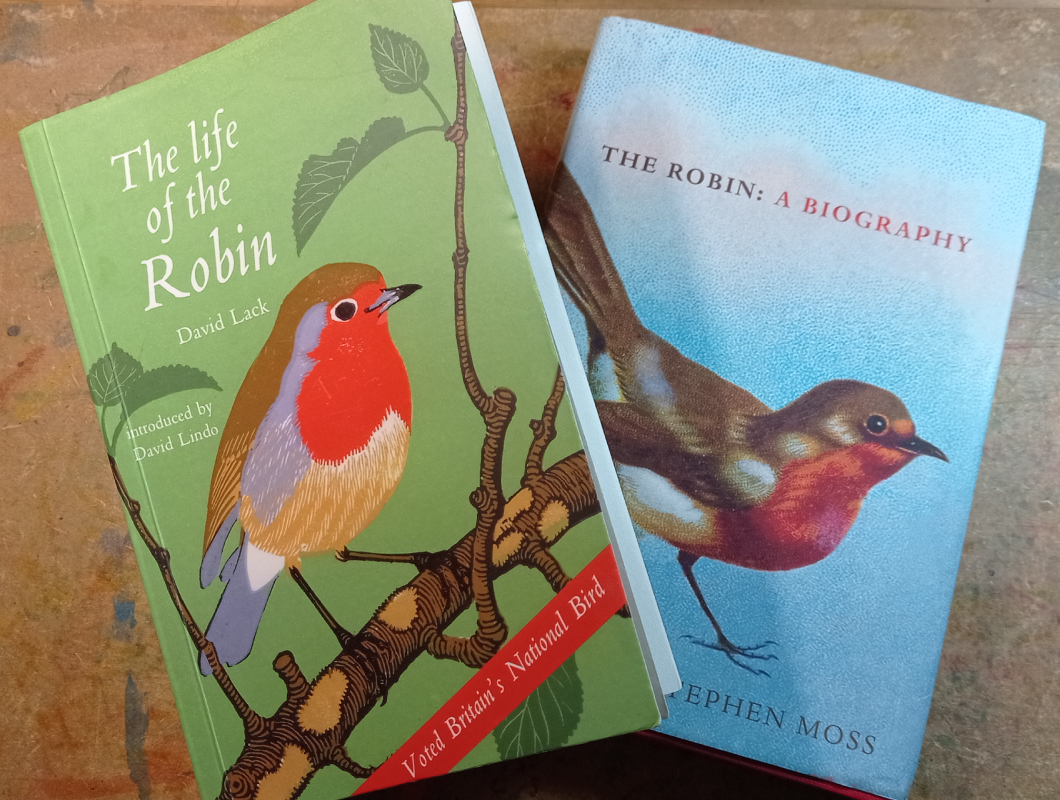 Two lovely books for robin lovers!
Books for Robin Lovers!
I’m sharing two books about the British robin (Erithacus rubecula), which I really enjoyed and recommend for nature lovers, bird lovers, and nature journalers.
- David Lack – The Life of the Robin (2016 reprint of 1965 edition)
- Stephen Moss – The Robin: A Biography
Both are interesting and informative books about our best-loved British bird, the Robin, and both filled with facts about its behaviour, life, and life-cycle.
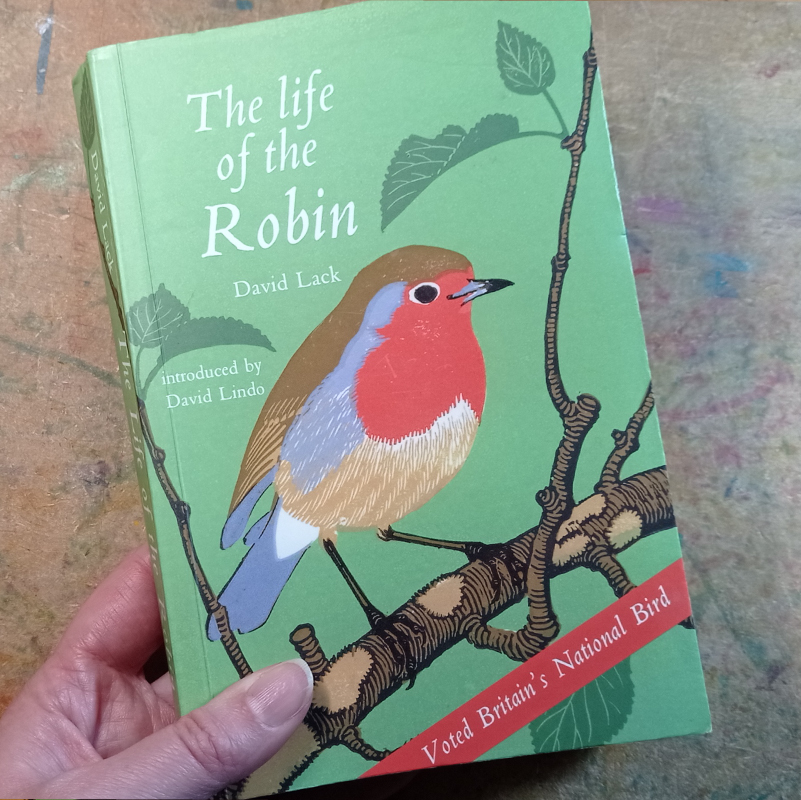 David Lack's The Life of the Robin
David Lack’s ‘The Life of the Robin’ is actually a modern reprint of Lack’s book originally published in 1943, based on Lack’s personal observations of robins between 1934 and 1938. It’s the updated 1965 edition which has been reprinted in this modern version, and it’s been brought up to date with a contemporary introduction by naturalist David Lindo as well as final chapters on how Lack’s studies have been built on by further research (chapter by David Harper) and on the importance and impact of his father’s work by Lack’s son, Peter Lack.
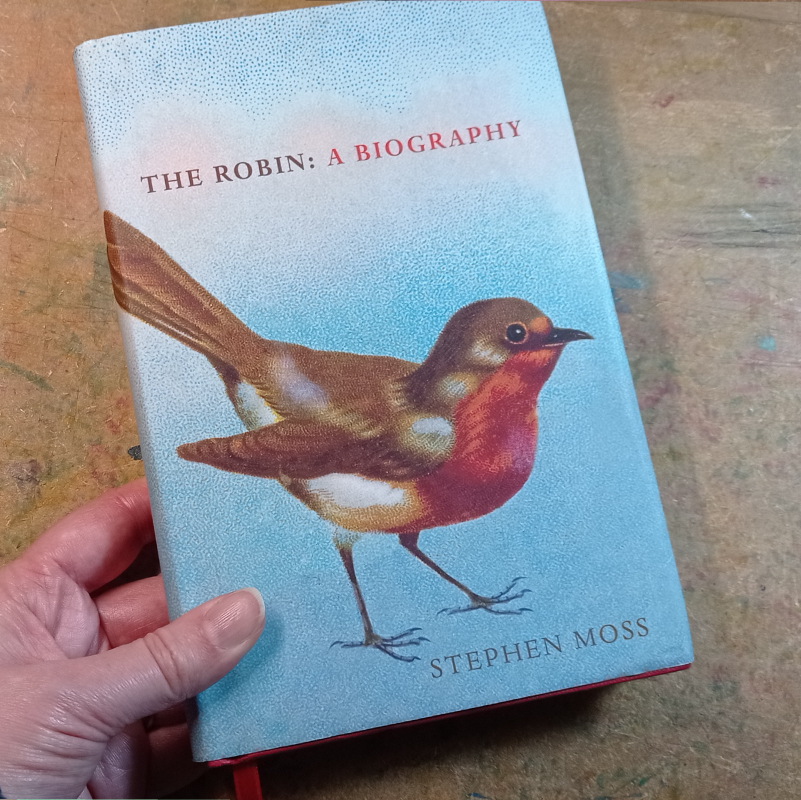 Stephen Moss's The Robin: A Biography
Stephen Moss’s ‘The Robin: A Biography’ also follows the life, lifecycle, habits and behaviour of the robin, but whereas Lack’s book follows chapters based on themes (such as Song, Feeding, Fighting, Nesting and Young etc.), Moss’s book is on a month by month basis which I found really useful to follow through the year to reflect what’s actually happening outside in my garden, whilst still giving the same information on these themes, at the appropriate time of the year.
Both books are very readable, although they’re filled with facts and scientific information, they are not dry academic tomes and both are very enjoyable to read by the lay person, and if you’ve got the slightest interest in birds in general and/or robins in particular, I’m sure you’ll find them very interesting.
Both books also include personal anecdotes from each author’s robin watchings in their own gardens, which makes the information more relatable and easy to absorb. Lack’s observations are more in depth and in the way of scientific findings (as very few had ever previously taken the time and trouble to observe robins in such depth) whilst not losing the personal touch, whilst Moss’s book follows the monthly activities of the robin by relating what he sees in his own garden, too.
David Lack was actually an amateur naturalist and made his in-depth observations and studies of robins in his spare time over several years. This makes his work all the more remarkable, especially since he made several discoveries that were unknown or unproven at the time.
Indeed, Lack’s study on the robin has become a major work on the subject, and remains so, even today. Stephen Moss’s biography of the robin quotes liberally from Lack’s work.
Both books do also discuss studies by earlier writers and naturalists, and interestingly, both also include our cultural relationship with the robin, from its name, Robin Redbreast, to literary references to the robin and the Victorian association with Christmas and the robin’s appearance on greetings cards, (especially Christmas cards), as well as our continuing affection for the robin in Britain – often considered our national bird!
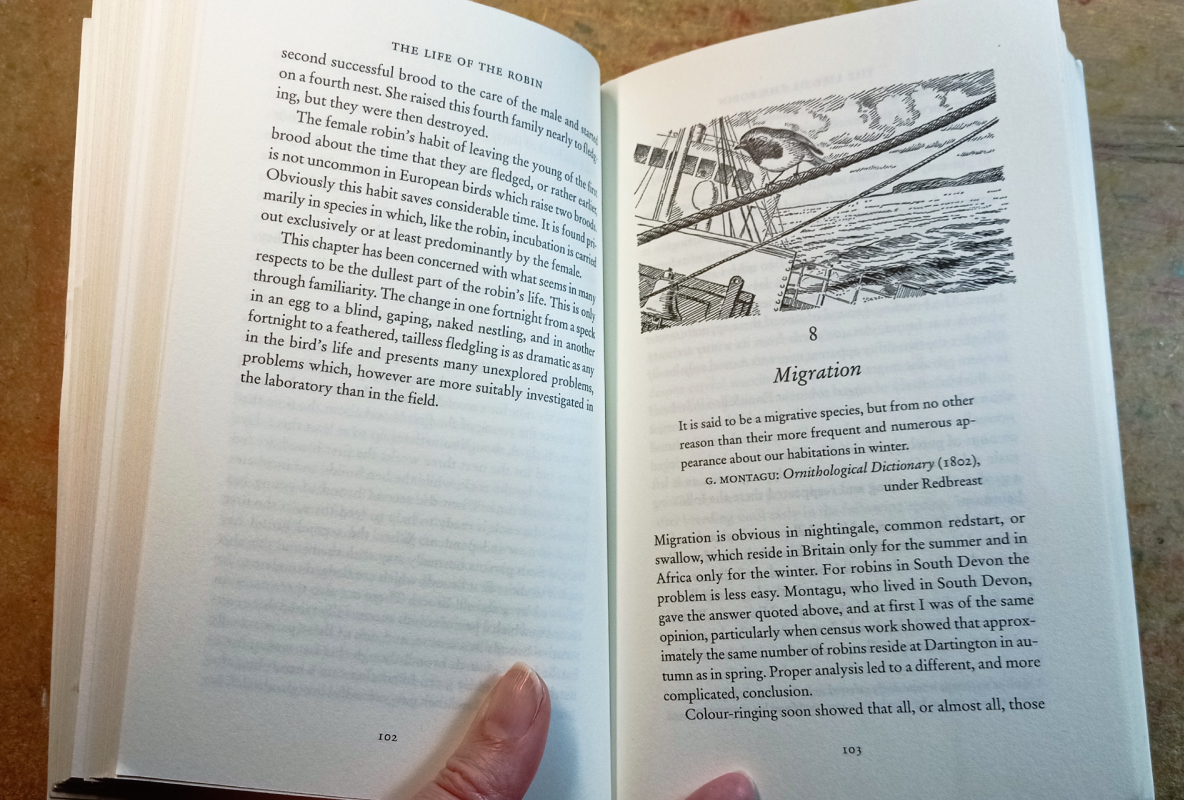 Black and white illustrations by Robert Gillmor in Lack's The Life of the Robin
While Lack’s book contains the beautiful black and white illustrations of Robert Gillmor at the start of each chapter, Moss’s book includes many large and small colour paintings and illustrations of the robin, most, I think, Victorian. This does add another layer of interest and attractiveness to the book as it’s always nice to have colour images in a non-fiction book.
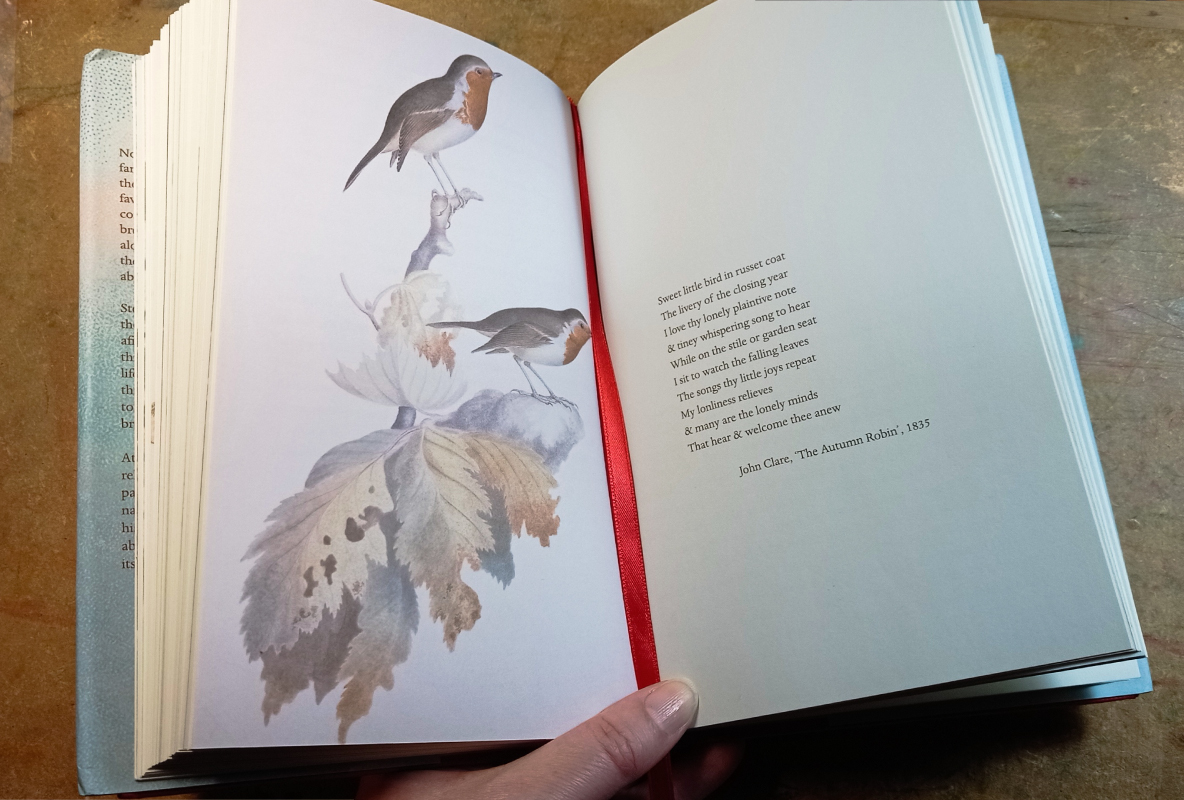 Stephen Moss's Robin Biography with colour images
Lack’s book contains:
- When and why robins sing
- About territorial fighting (occasionally to the death!) and trespassing
- What birds do in their spare time
- Robin ‘courtships’, engagements, marriages, families, and divorces
- Nesting habits
- About the life of a fledgling
- About robin migration habits
- Tameness of robins and their relationship with us
- Robin recognition of its mate, its own species, and other species
- What is instinct and what is inherited behaviour
- Forest robins vs garden robins (this was not a battle!)
Moss’s book seemed to me to include the same and similar themes and is brought more up to date with more recent studies, anecdotes, observations and stories which makes the book more relevant and relatable to the modern reader.
It’s also very interesting, having read David Lack’s book, that Moss’s book does revisit many of Lack’s findings, and Moss also writes about his pilgrimage to Dartington, where Lack made his own robin studies so many years ago.
I bought both of these robin books as I couldn’t decide which of the two to purchase from their descriptions on Amazon, so in a bit of a splurge, I got both.
Now, having read both, I still can’t really decide between them. They both do cover much of the same information – about how the robin lives, loves, fights, and even dies. The robin’s territorial behaviour, migration, and it’s unique relationship with humans, both in the garden and in our literature, art and culture, are fully explored in both books.
Both are, certainly, wonderful books for learning about the robin, and if you read either, you’ll learn lots about Britain’s favourite little bird.
Moss’s book is conveniently set out month by month, which is very helpful to dip into regularly and relate to what’s going on outside, and also to refer back to in subsequent years, perhaps. It also has colour pictures, which I really enjoyed.
And of course, the big one, it’s from 2017, so most of the information, stories, and anecdotes are very relevant to the modern reader, as well as being able to touch on contemporary concerns of habitat loss and climate change.
Moss’s book is also able to cover Lack’s work, along with later studies to give a wider overview.
There’s something very personal and direct in the voice and writing of Lack’s book, though, which seems to speak more directly about his very in-depth observations, and that makes this beautiful book still extremely appealing in a way that makes me feel a more emotional connection to it – perhaps more personal.
You really can’t go wrong with either book. If I had to recommend just one of the two, it would have to be Moss’s book, as the monthly format is perfect for casual reading, just dipping in and out of to learn what that robin you just spotted in your garden is really doing… and maybe why, too!
It’s also very up to date, whilst also containing all the important points in Lack’s book and references to earlier writings and studies – and also has those lovely colour images, which give it real appeal.
If you love robins, I can recommend either or both of these charming books – you can’t go wrong and you’ll learn so much about this lovely little bird!
Where to go next...
If you like birds, I think you'll also enjoy this book about bird behaviour and language - it's based on American birds but most of the information is pretty much universal to all birds...
You can also find all my other book recommendations for nature journalers and nature lovers here...
If you'd like to learn about nature journaling, also, start here...
You might also enjoy looking at my bird artworks here - I also have birds in my Celtic art section here, too...
Or exploring stories about British nature in my Folklore Hub - you can find that here...
Visit my Little Art Shop for my newest art prints & products...
Deepen Your Nature Journaling Practice
 Deepen your nature journaling practice with me...
If you’ve enjoyed my nature journaling reflections, you might also like my 20-lesson course, Imperfect Nature Journaling.
It’s a gently structured, self-paced journey designed to help you:
• Slow down and notice more deeply
• Build confidence in drawing and observing
• Create a calming journaling ritual you can return to
• Feel more connected to the seasons and the natural world
No perfection required. Just curiosity and a notebook.
You can explore the course here whenever you’re ready...
P.S. If you’re just beginning - or would like something quieter and more simple to start with - you might first like to get started with my free 'Getting Started' guide or gain momentum with my 'Gentle Introduction' guide to help you through your first few pages - here...

Shall we stay in touch..?
Each month, I share stories from my own nature journal, new art from my studio, and simple seasonal inspiration to help you feel more connected with the turning year - if you'd like to stay updated, please sign up with your email address below...
Recent Articles


-
Barn Owl Folklore & Meaning - Symbolism of the Barn Owl
Sep 15, 26 03:34 AM
 Explore barn owl folklore, symbolism and meaning, from ancient myths to British traditions. Discover the quiet wisdom and mystery of this ghostly bird.
 -
Bramble Meaning, Myth & Symbolism - Celtic Tree Calendar Art
Sep 02, 26 11:32 AM
 A look at bramble meaning, myth and symbolism as I share my bramble Celtic Tree Calendar art for the month of 'Vine'...
 -
Nature Journal Prompts
Aug 26, 26 04:05 AM
 Easy nature journal prompts to inspire and encourage you - one per week...
Shop My Current Artwork Collections

My art is available as sustainable art prints, notebooks, greetings cards, tote bags and clothing in my Teemill shop.
Find my stockists for all my earlier artworks here...
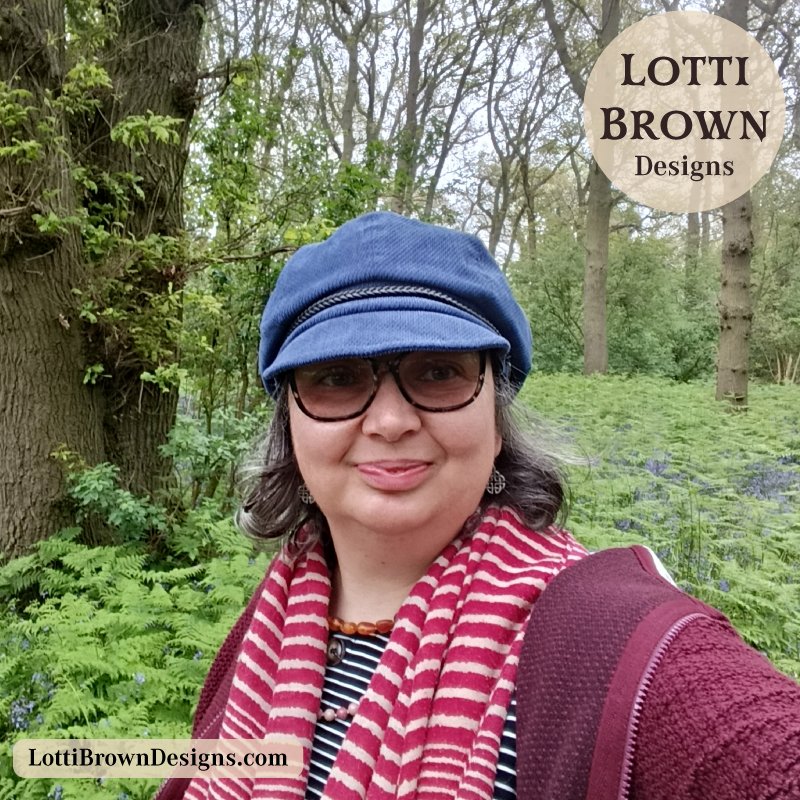
Lotti Brown is a self-taught nature artist and nature journaling educator whose hand-drawn work is inspired by wildlife, folklore, and close observation. With 18 years in creative fields and 10 years creating nature art, she brings deep practical experience to her work. Trained by the Wild Wonder Foundation, she shares nature journaling courses and guides online. Her artwork has been licensed internationally and exhibited at Goole Museum and Bridlington Spa in the East Riding of Yorkshire, UK.
Follow me:
Share this page: